Common Conveyor Belt Problems and How to Fix Them Fast | Neo Conveyors
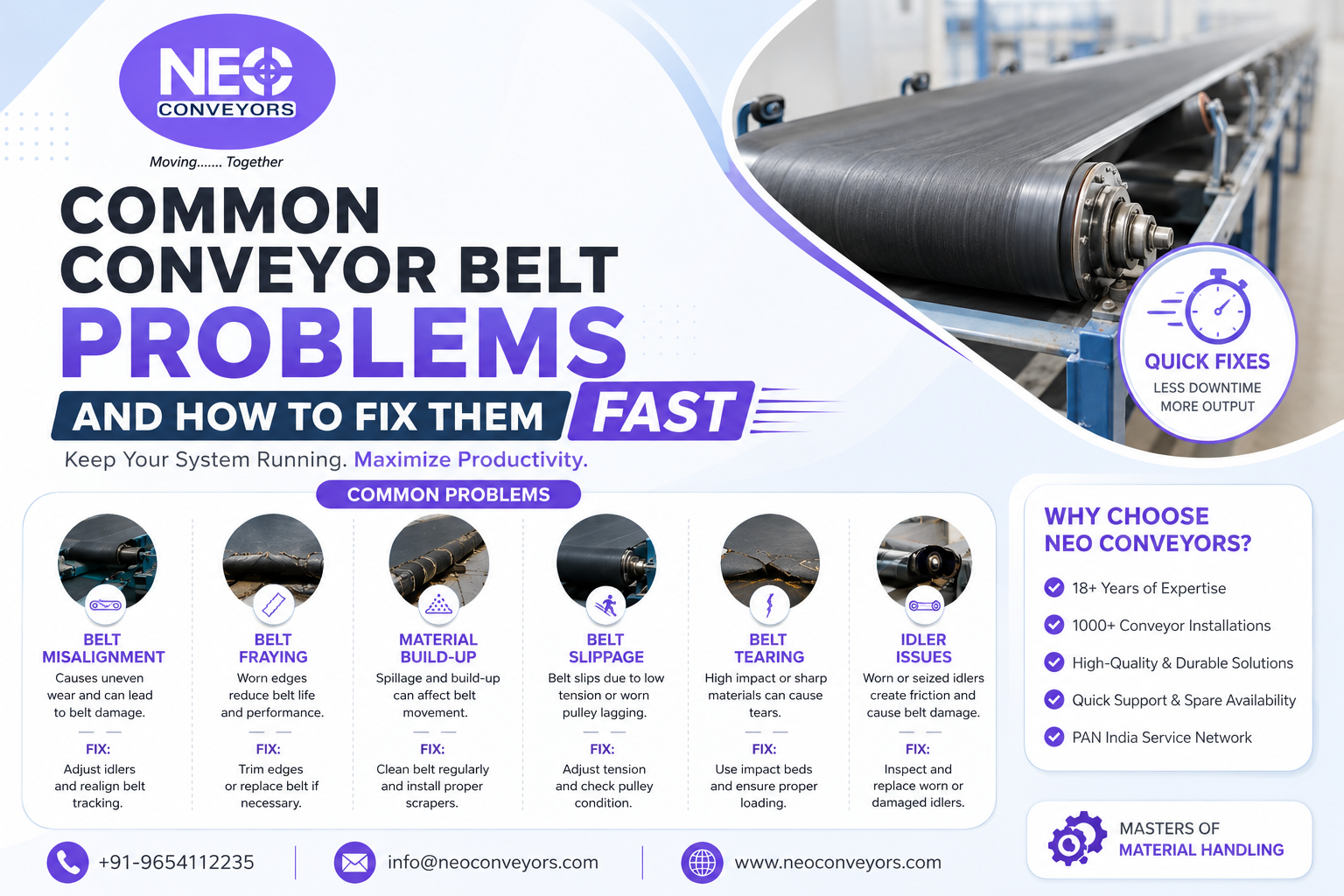
Picture this: it is peak production hours, orders are piling up, and suddenly your conveyor belt grinds to a halt. The line stops. Workers stand idle. Every minute of downtime is money walking out the door.
If you run a manufacturing plant, warehouse, or packaging unit in India, you have probably been there. Conveyor belt problems are among the most common — and most costly — operational headaches in industrial settings. The good news? Most of them are predictable, preventable, and fixable, if you know what to look for.
At Neo Conveyors, we have spent 18+ years designing, installing, and supporting conveyor systems across India. In that time, we have seen virtually every belt problem there is. Here is our no-nonsense guide to the 7 most common conveyor belt issues — and how to fix them fast.
Problem 1: Belt Slippage
What it looks like
The belt moves slower than the drive pulley, slips intermittently, or fails to carry loads uphill. You might hear a squealing sound near the drive end.
Why it happens
• Insufficient belt tension
• Worn or glazed drive pulley lagging
• Overloaded conveyor beyond design capacity
• Wet or oily belt surface reducing friction
How to fix it
Adjust belt tension using the take-up mechanism. Replace worn pulley lagging with ceramic or rubber-lagged pulleys for better grip. For inclined conveyors, consider upgrading to a cleated belt. For full technical guidance, visit our
Problem 2: Belt Mistracking (Misalignment)
What it looks like
The belt drifts to one side, rubs against the frame, and causes uneven wear along the belt edge. Left unchecked, it will tear the belt completely.
Why it happens
• Off-centre loading — material not deposited at the belt's centre
• Misaligned idlers or pulleys
• Uneven belt tension across the width
• Conveyor frame not level or twisted
How to fix it
Check that all idlers and pulleys are square to the frame. Adjust self-aligning idlers in the problem zone. Fix the loading point — a well-designed loading chute that centres material on the belt prevents 80% of mistracking issues.
Problem 3: Premature Belt Wear
What it looks like
The belt surface wears out far faster than expected — thinning, cracking, or showing exposed carcass within months of installation.
Why it happens
• Wrong belt grade for the material being conveyed
• Sharp, abrasive, or hot materials degrading the cover
• Frozen or seized idlers creating friction hot spots
How to fix it
Always match belt grade to your application. Inspect idlers monthly and replace any seized ones. Explore our range of purpose-built conveyor products suited to specific materials and industries.
Problem 4: Material Spillage
What it looks like
Material falls off the sides or ends of the belt, creating mess, waste, and safety hazards on the factory floor.
Why it happens
• Overfilled belt carrying more than its rated width
• High-speed loading causing impact and bounce
• Missing or worn skirting boards at the loading zone
How to fix it
Install properly designed skirting boards along the loading zone. Reduce loading height to minimise impact. For high-volume operations, impact cradles at the loading point absorb shock and protect the belt.
Problem 5: Belt Stretch and Tension Loss
What it looks like
The belt sags excessively between idlers, slips on the drive pulley, or the take-up device reaches its limit.
Why it happens
• Natural elongation of belt over time — especially fabric-ply belts
• Inadequate take-up travel in the original design
• Sudden shock loads causing permanent stretch
How to fix it
Adjust the take-up counterweight or screw mechanism. If the take-up has reached its limit, cut and re-splice the belt. For persistent stretch issues, specify a steel cord carcass belt — near-zero elongation for long or heavily loaded conveyors.
Problem 6: Belt Joint or Splice Failure
What it looks like
The belt separates at the joint, either partially or completely, causing an immediate shutdown.
Why it happens
• Poor quality vulcanised or mechanical splice
• Splice done incorrectly without proper tools
• Belt tension exceeding the splice's rated strength
How to fix it
Always use certified belt splicing technicians. For permanent high-tension conveyors, vulcanised splices are far stronger than mechanical fasteners. If splices fail repeatedly, the root cause is likely excessive tension or undersized pulley diameter — both of which need to be corrected in the system design.
Problem 7: Excessive Noise and Vibration
What it looks like
Unusual rattling, squeaking, or rhythmic thumping during operation.
Why it happens
• Seized, worn, or unbalanced idler rollers
• Belt joint passing over idlers — especially if thicker than the belt
• Material build-up on pulleys causing imbalance
How to fix it
Walk the conveyor while it is running and listen for the source. A rhythmic squeak repeating at regular intervals usually points to a specific idler — replace it. Clean pulleys regularly and tighten all structural bolts on a quarterly schedule.
Prevention Is Always Cheaper Than Repair
Every problem above shares a common thread: far cheaper to prevent than fix. Here is Neo Conveyors' recommended monthly maintenance checklist:
• Belt tension check: Verify tension at take-up and adjust if sagging is visible
• Idler inspection: Replace any seized, noisy, or visibly damaged rollers
• Alignment check: Confirm belt runs centrally across all pulleys and idlers
• Loading zone: Check skirting boards for wear and replace if gaps appear
• Splice condition: Visually inspect splice integrity — look for lifting edges or cracking
• Pulley lagging: Check for wear, hardening, or glazing on drive pulleys
• Structure & bolts: Tighten any loose frame connections and check for corrosion
A trained eye walking the conveyor once a month will catch 90% of problems before they become breakdowns.
Why the Right Manufacturer Makes All the Difference
Many conveyor belt problems are actually design problems in disguise. A belt that consistently slips may have been specified with insufficient tension capacity. Chronic mistracking often points to a loading chute that was never properly designed.
This is why choosing the right manufacturer matters so much. Neo Conveyors conducts detailed needs assessments, recommends the correct belt grade and conveyor type, and provides ongoing support after commissioning. Explore our full product range, view real installations in our gallery, or read answers to common questions in our FAQ section.
Explore More from Neo Conveyors
Everything you need to make the right conveyor decision:
🔗 Products — Full Range of Conveyor Systems
🔗 Technical Support & AMC Services
🔗 About Neo Conveyors — Our Engineers & History
🔗 Gallery — See Our Work in Action
🔗 FAQs — Common Questions Answered
🔗 Contact Us — Get a Free Site Assessment
Related Blogs
📖 How to Choose the Best Conveyor System Manufacturer in India
📖 10 Types of Industrial Conveyor Systems and Their Applications
Facing a conveyor problem right now?
Do not let downtime eat into your production targets. The Neo Conveyors technical team is ready to diagnose your issue, recommend the right fix, and get your plant back on track — fast.
📞 +91-9654112235 | ✉ neoconveyors@yahoo.com
Products: www.neoconveyors.com/products | Technical Support: www.neoconveyors.com/technical-support
Contact Us: www.neoconveyors.com/contact