Benefits of Bucket Elevators for Bulk Materials Handling
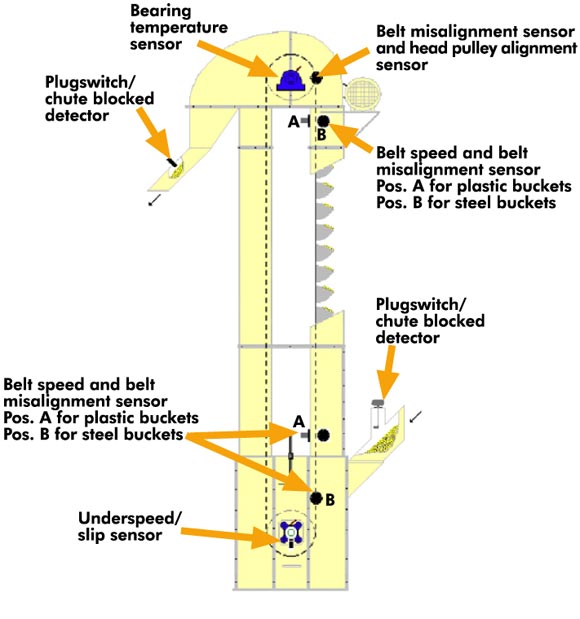
Every plant handling bulk material eventually hits the same problem: material needs to go up — into a silo, a hopper, an overhead bin — and floor space to do that is limited. A bucket elevator solves this more efficiently than almost any other vertical conveying method, which is why it remains the standard across cement, grain, fertilizer, food, chemical, and mining plants decades after the technology was first introduced.
Here's what that advantage actually looks like in practice, and where it matters most.
1. Highest capacity per unit of floor space
A bucket elevator delivers the highest volumetric capacity per unit of floor space of any vertical conveyor type — up to 200 TPH in a footprint measured in a couple of square metres, regardless of how high the material needs to travel. Compared to a vertical screw conveyor, which tops out at roughly 50 TPH and a practical lift limit of 10–15 metres, a bucket elevator scales to up to 40 metres of lifting height at several times the throughput. For any plant where lifting large volumes matters more than lifting small volumes cheaply, that gap is decisive.
2. Lower power consumption per tonne lifted
Because a bucket elevator moves material in discrete, well-supported buckets rather than pushing it against friction along a screw or trough, it consumes less power per tonne lifted at height than a comparable vertical screw conveyor, where friction losses climb with lift height. Over continuous 24×7 operation — common in cement and fertilizer plants — that efficiency difference compounds into a meaningful running-cost advantage.
3. A configuration for almost every material
Not every bulk material behaves the same way going up a vertical lift, which is why bucket elevators aren't a single design — they come in variants matched to material behaviour:
- Centrifugal discharge — high-speed operation, centrifugal force throws material into the discharge chute. Best for free-flowing, non-fragile material like grain, cement, fertilizer, and sand.
- Continuous discharge — low-speed operation, closely spaced buckets tip material gently without impact. Essential for fragile, abrasive, or lumpy material like clinker, coal, and minerals that centrifugal throwing would degrade.
- Belt type — rubber-reinforced belt, lower cost, suitable up to roughly 80°C.
- Chain type — forged steel chain, required for abrasive or high-temperature material up to 250°C, such as hot clinker, limestone, and pet coke.
- Food-grade SS — SS304/SS316 casing, polished interior, hygienic seals, and GMP-compliant construction for flour, sugar, spices, milk powder, and pharmaceutical excipients.
That range means the elevator can be engineered around the material's fragility, abrasiveness, and temperature rather than forcing every material through a single generic design.
4. Gentle handling where it actually matters
Product degradation during vertical lift is a real cost, not a theoretical one. In one documented installation, a rice mill switching from an inclined screw conveyor to a belt-type centrifugal bucket elevator with plastic buckets cut grain breakage from around 4% to under 0.5% — at 12 metres of lift and 50 TPH, with the added benefit of a fully enclosed, pest-proof casing. For any material where breakage, degradation, or fines generation has a real cost, choosing continuous discharge or the right bucket type is what protects the product, not just the equipment.
5. Enclosed, dust-controlled operation as standard
An enclosed casing with sealed joints keeps material and dust contained through the entire lift — important both for housekeeping and for meeting pollution control board requirements, particularly around fly ash handling at thermal power and cement plants. This isn't an upgrade tier; it's the standard construction on a properly engineered bucket elevator, unlike open conveying methods where containment has to be added separately.
6. Built for continuous, high-temperature, and hygroscopic material
Real installation data illustrates how far this can be pushed:
- A cement plant in Rajasthan needed to lift hot clinker at 120–150°C, 28 metres, at 80 TPH — after belt-type elevators had been failing from heat degradation within 6–8 months. A heavy-duty chain-type continuous elevator with heat-resistant buckets and expansion joints has run 18+ months with zero belt replacement and zero clinker spillage.
- A fertilizer plant in Gujarat needed to lift hygroscopic urea granules 18 metres at 120 TPH across three shifts daily. A belt-type centrifugal elevator with deep steel buckets, sealed MS casing, and PVC moisture strips has maintained zero moisture ingress over 12 months, with VFD speed control adjusting throughput between grades.
These aren't edge cases — they're representative of how the right elevator configuration solves problems that a generic, catalogue-spec unit typically can't.
7. Serves nearly every bulk-handling industry from one core technology
Because the underlying mechanism scales across discharge type, drive type, bucket material, and casing grade, bucket elevators cover an unusually wide span of industries from a single core technology:
- Cement — raw meal, clinker, and fly ash between mills, preheaters, and silos
- Grain and rice mills — wheat, rice, maize, and pulses, food-safe and easy to clean between changeovers
- Fertilizer — urea, DAP, MOP, and NPK, with sealed casing against moisture ingress
- Food processing — sugar, flour, spices, and milk powder in GMP-compliant SS elevators
- Chemical and pharmaceutical — powders and excipients in dust-tight SS casing, with explosion-proof motor options for hazardous areas
- Mining and minerals — limestone, coal, pet coke, and ore in heavy-duty abrasion-resistant chain-type units
- Biomass and power plants — rice husk, wood pellets, and bottom ash, including high-temperature chain options
Bucket elevator vs. vertical screw conveyor, side by side
| Factor | Bucket Elevator | Vertical Screw Conveyor |
|---|---|---|
| Vertical lift capacity | Up to 200 TPH | Up to 50 TPH |
| Lifting height | Up to 40 m | 10–15 m practical limit |
| Material fragility | Gentle with continuous type | Screw can degrade fragile granules |
| Power consumption | Lower per TPH at height | Higher — screw friction losses |
| Dust control | Fully enclosed | Fully enclosed |
| Best application | High TPH, any height, grain/cement | Low-medium TPH, short lifts, powder |
For lower-volume powder lifting over a shorter height, a vertical screw conveyor or screw conveyor can still be the more practical and economical choice — the two technologies aren't competing for the same job so much as covering different ends of the capacity and height range.
Final thoughts
The core benefit of a bucket elevator comes down to one thing: it moves more material, higher, in less floor space, and with less product damage, than almost any alternative — provided the discharge type, drive type, and casing are specified correctly for the material going through it. Getting that specification wrong is what turns a bucket elevator into a maintenance problem instead of a floor-space and throughput advantage.
Neo Conveyors has manufactured bucket elevators since 2007, with over 1,000 installations up to 200 TPH and 40 metres of lift, engineered from your material's bulk density, abrasiveness, and temperature rather than a catalogue size chart. Get in touch with your material and capacity requirements for a free calculation.