Mezzanine Floor Conveyor Systems: Types, Design & Cost in India
By Neo Conveyors Engineering Team · Ghaziabad · Published 19th Oct 2026
Most warehouses build a mezzanine first and think about moving stock to it later. Cartons then travel up a staircase or queue for a goods lift until the bottleneck is obvious. A mezzanine floor conveyor removes that step. This guide explains the types available, how to size one, what safety it needs, and what drives cost.
What is a mezzanine floor conveyor?
A mezzanine floor conveyor moves cartons, bags or totes between the ground floor and an elevated mezzanine level. It normally has three parts:
- Ground-floor infeed, where operators load product, often from a roller or flat belt line.
- Inclined or vertical section, which carries product up through a guarded opening in the mezzanine deck.
- Mezzanine discharge, a short horizontal run for pick-face replenishment or staging.
Types of mezzanine conveyors
| Type | Best for | Typical angle |
|---|---|---|
| Inclined belt conveyor | Rigid cartons, short rises | Up to ~20° |
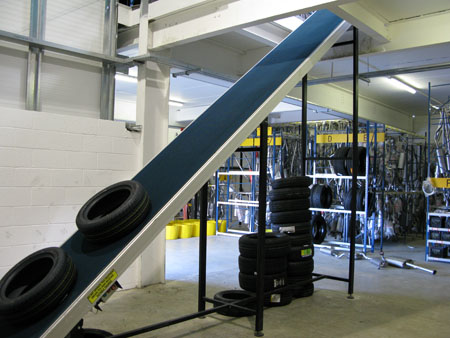
| Inclined cleated belt conveyor | Cartons, bags, mixed loads | 20–35° |
| Roller / powered roller conveyor | Flat sections at both levels, totes | Flat |
| Vertical reciprocating conveyor | Pallets, tight floor space | Vertical |
For most carton replenishment lines, a cleated inclined belt with roller conveyors at each end is the usual choice. See our Inclined Belt Conveyor and Roller Conveyor pages.
How to choose: five variables
- Mezzanine height sets the vertical lift.
- Load and capacity. Carton weight and cartons per hour decide motor size and belt strength.
- Belt width. Largest carton plus clearance, commonly 500–800 mm.
- Speed. Fast enough for throughput, slow enough to avoid tipping or jams at the transition.
- Material type. Rigid cartons, soft bags and totes each need a different belt surface or roller pitch.
Layout: how much floor length do you need?
Floor length is usually the limiting factor. Incline run ≈ height ÷ tan(angle), before adding horizontal runs at each end.
| Mezzanine height | At 25° | At 30° | At 35° |
|---|---|---|---|
| 3 m | ≈6.4 m | ≈5.2 m | ≈4.3 m |
| 4 m | ≈8.6 m | ≈6.9 m | ≈5.7 m |
| 5 m | ≈10.7 m | ≈8.7 m | ≈7.1 m |
If floor space is short, use a steeper cleated or sidewall belt, or a vertical conveyor. Cutting the deck opening changes the load path, so get approval from whoever certified the mezzanine.
Worked example: 4 m mezzanine, carton replenishment
This is an illustrative specification, not a named project.
- Mezzanine height: 4.0 m
- Incline: 28° cleated belt, ≈8.5 m long
- Belt width: 650 mm
- Carton weight: up to 20 kg
- Throughput: 300 cartons/hour (one every 12 seconds)
- Motor: 2 HP geared motor
- Infeed: roller conveyor at ground floor
- Discharge: 1.5 m horizontal run on the mezzanine
At this rate, belt speed matters less than the discharge run length and the safety gate position. Together they decide whether cartons jam at the transition.
Safety requirements
- Emergency stop pull cords along the full length, reachable from both sides
- Interlocked safety gate at the mezzanine opening
- Guarding at pinch points (head and tail pulleys)
- Toe boards or side guards where the incline passes an open edge
- Floor marking and signage at both loading points
- Lockout/tagout before any maintenance
This is separate from the structural certification of the mezzanine deck itself.
Applications
- E-commerce: replenishing elevated pick faces from ground-floor bulk storage
- FMCG distribution: moving cases between receiving and an upper storage mezzanine
- Manufacturing: feeding components to an upper-level assembly area
- Retail back-of-house: moving stock between stockroom and overflow mezzanine
Mezzanine conveyor vs manual handling
| Factor | Manual / staircase | Mezzanine conveyor |
|---|---|---|
| Throughput | Low, limited by trips | High, continuous |
| Labour | 1–2 workers per route | 1 operator at loading |
| Injury risk | Higher | Lower |
| Peak-hour reliability | Degrades sharply | Consistent |
| Upfront cost | None | Capital investment |
What affects the cost in India
There is no fixed price list. These factors move the price:
- Length and angle: longer, steeper runs need a stronger frame and bigger motor
- Belt type: cleated belt costs more than flat belt
- Safety package: gates, guarding and pull cords are not optional
- Deck opening: cutting and reinforcing the opening is usually a separate civil cost
Send your mezzanine height, available floor length and carton details to get an itemised quote.
Common design mistakes
- Skipping the safety gate, which leaves an open fall hazard
- Choosing a belt barely wider than the carton, which causes jams
- Making the top discharge run too short
- Sizing for average volume instead of peak-hour volume
Maintenance checklist
- Weekly: belt tracking and tension
- Monthly: emergency stop cords, gate interlock, cleat/roller wear
- Daily: clear build-up at the discharge point
- Per schedule: bearing greasing and guarding checks
FAQs
What is a mezzanine floor conveyor?
A conveyor that moves cartons, bags or totes between a ground floor and a mezzanine level, replacing manual stair carrying or a goods lift.
Which type is best for a mezzanine?
For cartons and bags, an inclined cleated belt. For pallets or tight floor space, a vertical reciprocating conveyor.
What incline angle is used?
Typically 25–35° with a cleated belt, balancing floor length and product stability.
How much floor length is needed?
Roughly height ÷ tan(angle), plus horizontal runs. A 4 m mezzanine at 30° needs about 7 m of incline alone.
What safety features are required?
Pull-cord e-stops, guarding at pinch points, an interlocked gate at the opening, and signage.
What does a mezzanine conveyor cost in India?
It depends on length, belt width, angle, motor size and safety package. Send your layout for a firm quote.
Can it move product both up and down?
Yes, but many warehouses use separate up and down conveyors to avoid bottlenecks.
How is belt width chosen?
Slightly wider than your largest regular carton, commonly 500–800 mm.
Can I retrofit one into an existing warehouse?
Yes. The main constraints are floor length for the incline and structural approval of the deck opening.
What motor size is typical?
For a 5–8 m carton conveyor, usually 1–3 HP, sized to the actual load, speed and angle.
Get a layout for your warehouse
Send your mezzanine height, floor length and carton size/weight, and our engineers will confirm the incline angle, belt width, motor and safety package. Request a quote or WhatsApp us.
Recent Posts