Vertical Screw Conveyor Manufacturer in India

Vertical Screw Conveyor Manufacturer in India | Dust-Free Vertical Powder Lifting | Neo Conveyors

Vertical Screw Conveyor Manufacturer in India | Neo Conveyors

Home Products Screw Conveyors Vertical Screw Conveyor
Vertical screw conveyor manufacturer since 2007


Vertical Screw Conveyor Manufacturer in India

Established 2007 1,000+ installations PAN India installation Heavy-duty industrial design

Custom vertical screw conveyors for dust-free, space-saving vertical elevation of powders and granules — fly ash, cement, limestone powder, fertilizer, chemical powder, food ingredients, and mineral dust. Short-pitch helical screw in enclosed casing. MS, SS304, SS316. Up to 15 m lift. Minimum footprint. PAN India installation.

Fully Enclosed — Dust-Free 150–300 mm Diameter Up to 15 m Vertical Lift Minimum Floor Footprint MS / SS304 / SS316
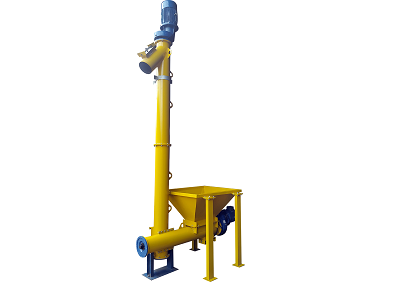
MOTOR Discharge Inlet Up to 15 m lift Vertical Screw Conveyor Minimum footprint · Dust-free
1,000+Conveyor installations
18+Years manufacturing
Up to 15 mVertical lift standard
Dust-freeFully enclosed design
PAN IndiaOwn engineers install
What is it

What is a Vertical Screw Conveyor?

A vertical screw conveyor uses a short-pitch helical screw rotating at high speed inside a fully enclosed vertical casing — lifting bulk powders and granules straight upward in the minimum possible floor footprint, with complete dust containment from inlet to discharge.

Short-pitch screw — how vertical conveying works

Unlike horizontal screw conveyors that use full-pitch flights to push material axially, vertical screw conveyors use short-pitch (reduced-pitch) flights rotating at higher speed. The centrifugal force generated by the faster rotation pushes material outward against the casing wall — creating friction between material and casing that prevents material from sliding back down under gravity. This friction-supported conveying is what enables vertical elevation on the same basic screw principle.

The result is a conveyor that can elevate dry powders and granules vertically through a casing only slightly larger than the screw flight diameter — the most space-efficient vertical conveying solution available for suitable materials.

Minimum footprint — why engineers specify vertical screw

The primary reason engineers specify a vertical screw conveyor over a bucket elevator is floor space. A bucket elevator requires a full casing width (head and boot section), a separate loading section, and a separate discharge section — all taking up floor area and headroom that may not be available in an existing plant. A vertical screw conveyor requires only the casing cross-section at the floor — the footprint of the tube itself.

In plant retrofit projects, between processing floors, between silo levels, and in any plant where horizontal space is severely constrained, the vertical screw conveyor's minimal footprint makes it the only practical vertical conveying solution.

Free capacity calculation & equipment selection included: Share your material name, bulk density, required TPH, lift height, and available floor space. Our engineers calculate whether a vertical screw conveyor or bucket elevator is the correct choice — and size the equipment accordingly at no charge. Send material & space details

Working principle

How a Vertical Screw Conveyor Works

Four stages of vertical material transfer — all within a sealed casing that prevents any dust emission from inlet to discharge, in a footprint as small as the casing diameter.

1
Material fed at bottom inlet

Material enters the vertical screw conveyor at the bottom inlet — connected via a flanged spout to a horizontal screw conveyor, bin outlet, or process machine discharge. The bottom inlet is typically designed to deliver material directly into the rotating screw without overfilling or bridging.

2
Short-pitch screw elevates material

The short-pitch helical screw rotates at high RPM inside the enclosed casing. Centrifugal force pushes material outward against the casing wall — creating friction that holds material against the wall and allows the rotating screw flight to push it upward against gravity. Material travels in a helical path up the casing.

3
Continuous vertical elevation

Material is continuously elevated at the rated TPH — determined by screw diameter, pitch, and rotational speed. The enclosed casing prevents any dust emission throughout the vertical lift path. No buckets, no chains, no belts — only the rotating screw shaft inside the sealed casing.

4
Discharge at top outlet

Material discharges at the top outlet — flanged to downstream equipment (silo, bin, horizontal conveyor, or process unit). The drive motor typically mounts at the top of the casing, directly above the head bearing, minimising the drive arrangement footprint and simplifying alignment.


Advantages

Advantages of Vertical Screw Conveyors

Five engineering advantages that make the vertical screw conveyor the preferred vertical elevation solution for space-constrained plant layouts handling dry powders and granules.


Space Saving Design

The smallest floor footprint of any vertical conveying system — only the casing cross-section at floor level. A 200 mm vertical screw conveyor occupies just 200 mm × 200 mm at the floor — vs 600 mm+ width for a bucket elevator casing of equivalent capacity. Critical for plant retrofit and multi-floor installations.


Fully Enclosed Conveying

Complete sealed casing from inlet to discharge — no openings, no gaps, no cover plate joints. Material is enclosed for the entire vertical lift path. Meets PCB dust emission standards for cement, fly ash, and chemical powder handling without additional dust extraction.


Dust Free Operation

The sealed casing eliminates dust emission at the conveying stage — significant for fly ash (PCB compliance), cement (workplace dust standards), chemical powders (OEL compliance), and food ingredients (FSSAI hygiene requirements). SS304/SS316 options for food and pharma applications.


Low Maintenance

No buckets to inspect and replace, no chains or belts to lubricate and tension, no head and boot pulleys or sprockets. Only the screw flight wear and two shaft bearings (head and boot) require periodic attention — significantly lower maintenance than equivalent bucket elevator systems.


Continuous Vertical Material Transfer

Unlike skip hoists or batch vertical lifts, the vertical screw conveyor provides continuous material flow at rated TPH — no batch cycles, no idle time between lifts, no need for upstream surge hoppers to match a batch lift schedule. Material flow is as continuous as the upstream feed.


Simple Integration

Flanged inlet and outlet for direct bolted connection to upstream and downstream equipment. Drive motor mounted at head — no intermediate drives, no complex take-up arrangements. VFD option for throughput control. Standard flanges simplify integration with existing equipment.

150–300 mmDiameter range
Up to 15 mVertical lift
MS / SS304 / SS316Construction options
MinimumFloor footprint

Applications

Applications of Vertical Screw Conveyors

Vertical screw conveyors are deployed wherever tight floor space, complete dust enclosure, and moderate vertical lift heights are needed — across cement, power, chemical, food, fertilizer, and mineral processing industries.


Cement Plants

Cement powder, raw meal, and limestone dust elevation between floors within the cement plant — where the compact vertical screw footprint fits in structural bays that are too narrow for bucket elevator installation. MS with air-purge shaft seals.


Fly Ash Handling Systems

Fly ash elevation from ESP hopper level to silo infeed — for moderate lift heights (under 8 m) and lower capacities where a vertical screw conveyor is more economical than a chain-type bucket elevator. Sealed MS casing for PCB compliance.


Chemical Industry

Chemical powder elevation between production floors — calcium carbonate, talc, gypsum, pigments. Fully enclosed casing prevents worker exposure to chemical dust. SS316 option for corrosive chemical powders. Explosion-proof motor for hazardous areas.


Food Processing Industry

Flour, sugar, salt, starch, and food ingredient elevation between floor levels in food processing plants. SS304 casing with polished bore and food-grade seals. Pest-proof complete enclosure for FSSAI compliance. Easy-clean flanged inlet and outlet.


Fertilizer Plants

Fertilizer powder and granule elevation between blending and storage floors — where the plant layout constrains horizontal screw conveyor inclination. Sealed MS casing for hygroscopic materials. SS options for corrosive fertilizer environments.


Mineral Processing Plants

Mineral powder, gypsum, barite, calcium carbonate, and silica elevation between process stages in mineral processing facilities. Heavy-duty MS casing with abrasion-resistant flight for abrasive mineral powders. Complete enclosure for silica dust compliance.


Materials handled

Materials Handled

Vertical screw conveyors handle free-flowing dry powders and granules — materials that have adequate angle of repose and flowability to be pushed vertically by centrifugal-friction conveying.


Cement Powder

OPC, PPC, slag cement between floors within plant. Bulk density 1.0–1.5 t/m³. MS casing with air-purge seal. PCB dust standard.

Fly Ash

ESP and bag filter fly ash — moderate lift heights. Bulk density 0.6–0.9 t/m³. Sealed MS casing for dust control and PCB compliance.

Limestone Powder

Ground limestone between mill, classifier, and silos. Bulk density 1.2–1.4 t/m³. AR-steel flight option for abrasive grades.

Chemical Powders

Calcium carbonate, talc, gypsum, pigments, barite — between dryer, mill, and storage. SS316 for corrosive chemicals. Explosion-proof motor option.

Fertilizers

Urea powder, DAP fines, fertilizer powder — between floors. Sealed casing prevents moisture ingress for hygroscopic materials.

Food Ingredients

Flour, sugar, salt, starch — between mill and processing floors. SS304 polished bore, food-grade seals. FSSAI-compliant design.

Mineral Dust

Silica powder, gypsum, barite, kaolin — between processing stages. Complete enclosure for silica dust OEL compliance at processing facilities.

Grain & Seeds

Wheat, maize, milled rice, oil seeds — short vertical lifts between intake pit and first-floor cleaning or processing equipment. Low RPM to minimise breakage.
Not suitable for: Sticky, wet, or highly cohesive materials (wet cake, clay, sludge) that would pack between the screw flights and casing wall. Large-lump materials that cannot pass through the screw-to-casing clearance. Very light, fluffy materials (cotton fibre, whole biomass chips) that do not generate enough wall friction for vertical conveying. Our engineers confirm material suitability at no charge — and recommend the correct alternative if the vertical screw is not the right choice.

Engineering data

Technical Specifications

All vertical screw conveyors are made-to-order. Casing diameter, screw pitch, and screw speed are calculated from your material's bulk density, required TPH, and lift height.

ParameterSpecification
Conveyor typeVertical screw — short-pitch screw in enclosed vertical casing
Casing diameter150 mm / 200 mm / 250 mm / 300 mm standard
Lift heightUp to 15 m standard; multi-stage for greater heights
Screw pitchShort pitch (30–60% of diameter) — for vertical conveying
Screw speedHigher than horizontal — calculated per material and diameter
Filling degree15–25% of casing cross-section (limited by centrifugal action)
Casing thickness3–6 mm (per material abrasiveness)
Shaft bearingsHead bearing (above motor) + boot bearing (at inlet)
Intermediate bearingsAdded at 4–6 m intervals for lifts over 8 m
Shaft sealsMechanical seal / stuffing box / air purge — per material
Drive positionMotor at top (standard) — direct drive or gearbox
Power supply415 V, 3 Phase, 50 Hz

Conveyor Diameter Options

150 mmLow capacity — tight spaces
200 mmStandard medium capacity
250 mmHigher capacity
300 mmMaximum capacity

* Capacity depends on material bulk density and screw speed. Free calculation with every quotation.

Construction Materials

Mild Steel (MS) Construction
Standard for cement, fly ash, limestone, fertilizer, and industrial powders. Epoxy-painted exterior. Optional abrasion-resistant casing bore for highly abrasive materials.
Stainless Steel 304 (SS304)
For food processing, pharma, and hygiene-sensitive applications. Polished bore, food-grade seals. FSSAI-compliant. Easy-clean design for regular product changeover requirements.
Stainless Steel 316 (SS316)
For corrosive chemicals, coastal fertilizer environments, and pharma GMP applications requiring higher chloride resistance. SS316L available for welded GMP designs.

Drive Systems

Direct Drive
Motor directly coupled to screw shaft via flexible coupling — for smaller diameter, lower-torque vertical screw conveyors. Simplest and most compact drive.
Geared Motor Drive
Helical gearbox provides torque multiplication — standard for medium to large diameter vertical screw conveyors. Gearbox mounted at head above the casing for easy access.
Variable Speed Drive (VFD)
VFD on geared motor enables screw speed adjustment — for throughput control or where feed rate to downstream equipment must be varied. Energy saving at partial load.
Cement powder
Fly ash
Raw meal
Limestone dust
Gypsum powder
Chemical powder
Calcium carbonate
Talc & kaolin
Silica powder
Fertilizer powder
Wheat flour
Sugar & salt
Starch
Pigments & dyes
Barite powder
Pharma excipients

Download Screw Conveyor Catalogue

Vertical, tubular & U-trough specs — PDF, free.

Download PDF
Get free capacity calculation

Selection guide

How to Select the Right Vertical Screw Conveyor

Five parameters our engineers use to specify casing diameter, screw pitch, construction material, and drive — plus confirming whether a vertical screw or bucket elevator is the correct choice for your application.

1. Material Characteristics
Free-flowing dry powderVertical screw suitable
Sticky or cohesiveNot suitable — consider U-trough or chain
Abrasive materialAR-steel casing + thick flight
Food / pharma gradeSS304 / SS316 polished bore
Hygroscopic powderSealed shaft seals + dry nitrogen purge
2. Bulk Density & Capacity
Light (0.3–0.6 t/m³)Larger dia. / higher speed
Medium (0.6–1.2 t/m³)Standard specification
Heavy (1.2–1.8 t/m³)Stronger flight, motor sizing
High capacity needConsider bucket elevator instead
3. Lift Height
Under 5 mSingle-shaft, boot + head bearing
5–10 mSingle shaft + intermediate bearing
10–15 mTwo intermediate bearings
Over 15 mBucket elevator likely more suitable
4. Available Floor Space
Very tight (under 300 mm)Vertical screw — only option
Narrow (300–600 mm)Vertical screw preferred
Moderate (600 mm+)Both options viable
Adequate (1 m+)Bucket elevator may be better value
Share 4 parameters — material name, bulk density, required TPH, lift height, and available floor space — and our engineers confirm whether vertical screw or bucket elevator is the correct choice, then size the equipment and provide a GA drawing. No charge, no obligation. Submit requirements

Watch it work

Vertical Screw Conveyors — Live at Customer Plants

Real Neo Conveyors screw conveyor systems in operation — cement, fly ash, and powder handling installations across India.


Neo Conveyors — Screw conveyor systems in operation at customer plants
Click to play · YouTube

Neo Conveyors — Manufacturing & installation overview India
Click to play · YouTube

More installation videos: youtube.com/@neoconveyors


Comparison guide

Vertical Screw Conveyor vs Bucket Elevator

The two most common choices for vertical bulk material elevation — selecting the correct one depends on lift height, capacity, floor space, material, and budget.

Feature ✅ Vertical Screw Conveyor (This page) Bucket Elevator
Floor footprintVery small — just casing diameterLarger — full casing width + boot + head
Dust controlExcellent — fully sealed casingGood — sealed casing, but more joints
Fine powder handlingExcellent — screw carries fines reliablyGood — centrifugal loss at discharge for very fine
Lift heightModerate — up to 15 m standardHigh — up to 40 m+ standard
Capacity per unit sizeLower — limited by centrifugal fillingHigher — bucket volume × speed
Fragile material handlingModerate — screw contact may break fragile materialExcellent — gentle bucket scooping
MaintenanceLow — no buckets, no chain/beltModerate — bucket and chain/belt inspection
Capital cost (same capacity)Lower for smaller capacitiesLower for larger capacities and heights
Best applicationsSpace-constrained, fine powder, moderate liftHigh capacity, tall lift, fragile materials

Need higher capacity or taller lifts? Bucket Elevator →


Recent installation projects

Recent Vertical Screw Conveyor Installations

Four recent projects — fly ash, cement, chemical, and mineral processing — demonstrating real-world capacity, lift height, and results achieved at customer plants.

Fly Ash Handling System — Uttar Pradesh
MS Vertical Screw — Fly Ash Elevation to Silo

Thermal power plant needed fly ash elevated 6 m from ESP collection level to silo infeed — moderate lift height where a chain bucket elevator was considered oversized and costly. MS vertical screw conveyor with air-purge shaft seals, sealed casing, and flanged connections to horizontal screw at base and silo nozzle at top. PCB dust compliance required fully sealed design.

Diameter:200 mm MS
Lift height:6 m
Capacity:4 TPH fly ash
Motor:2.2 kW geared VFD
PCB ambient dust: 0.02 mg/m³ — well below 10 mg/m³ limit
30% lower cost than chain bucket elevator for this lift height
Fits in 220 × 220 mm structural bay — bucket elevator impossible
Cement Plant Installation — Rajasthan
MS Vertical Screw — Cement Powder Inter-Floor Transfer

Cement packing plant needed OPC cement transferred vertically 8 m between dispatch floor and mezzanine hopper — in a narrow structural bay where no bucket elevator could fit. MS vertical screw conveyor with two intermediate bearings, air-purge shaft seals at boot and head, and dedicated VFD for throughput matching to packing machine speed.

Diameter:250 mm MS
Lift height:8 m
Capacity:10 TPH OPC cement
Motor:5.5 kW geared VFD
Fits in 270 × 270 mm opening — the only option for this bay
VFD — throughput matched to packing machine; zero overfill
10 TPH sustained 3-shift — 14 months without unplanned stop
Chemical Plant — Gujarat
SS316 Vertical Screw — Chemical Powder Elevation

Industrial chemical plant needed barium sulphate powder (bulk density 1.6 t/m³, mildly corrosive) elevated 5 m between floors in a GMP-adjacent building requiring stainless construction. SS316 vertical screw conveyor with electro-polished bore, PTFE shaft seal, and explosion-proof motor for Zone 2 hazardous area classification.

Diameter:150 mm SS316
Lift height:5 m
Capacity:2 TPH BaSO₄
Motor:1.5 kW Ex-proof geared
SS316 + PTFE seal — zero corrosion or chemical interaction
Ex-proof motor — Zone 2 ATEX-equivalent classification passed
Minimum footprint — fits between existing reactors in narrow bay
Mineral Processing Plant — Chhattisgarh
MS Vertical Screw — Limestone Dust Elevation

Mineral processing plant needed limestone powder (bulk density 1.3 t/m³, abrasive) elevated 10 m from ground-level mill discharge to elevated storage silo. Heavy-duty MS vertical screw with abrasion-resistant AR400 steel casing bore and flight, three intermediate bearings for the 10 m lift, and heavy-duty shaft seals. Complete silica dust enclosure for occupational health compliance.

Diameter:250 mm MS AR400 bore
Lift height:10 m
Capacity:6 TPH limestone dust
Motor:7.5 kW geared
AR400 bore — flight wear within spec at 12-month inspection
Zero silica dust emission — OEL compliance achieved
6 TPH continuous — 16 months operation without flight replacement

Why Neo Conveyors

Why Choose Neo Conveyors?

Every vertical screw conveyor is engineered from your material data and lift height — casing diameter, screw pitch, intermediate bearings, and construction material specified for your application. Fabricated in-house. Installed by our own engineers.

Custom engineered — since 2007

Casing diameter, short-pitch screw, intermediate bearing positions, and shaft seal type all calculated from your material and lift height. We also confirm whether vertical screw or bucket elevator is correct for your application — at no charge.

1,000+ installations — proven EEAT

18+ years of screw conveyor projects across cement, power, chemical, food, fertilizer, and mineral industries. References from clients in your sector available on request.

MS, SS304 & SS316 — all in-house

All construction materials supplied from our own fabrication — including abrasion-resistant casing bore, polished SS304/SS316 bore for food and pharma, and explosion-proof motor options.

PAN India — own engineers install

Installation, alignment, intermediate bearing fitting, shaft seal adjustment, and commissioning by Neo Conveyors' own engineers. No third-party erection contractors.

GA drawing with every quotation

GA drawing showing casing diameter, screw pitch, inlet/outlet flange positions, bearing positions, and drive details included with every quotation at no extra charge.

Spare flights & bearings stocked

Replacement screw flights, casing sections, shaft seals, and intermediate bearings stocked for all diameters. Annual Maintenance Contracts and inspection visits available PAN India.


Related conveyor solutions

Related Conveyor Solutions

Explore the bucket elevator, horizontal screw, and tubular screw conveyors that connect to or complement your vertical screw conveyor system.


Frequently asked questions

Frequently Asked Questions

A vertical screw conveyor uses a short-pitch helical screw rotating at high speed inside a fully enclosed vertical casing to lift bulk powders and granules straight upward — from a lower inlet to a higher discharge point. The centrifugal force generated by the fast-rotating short-pitch screw pushes material radially outward against the casing wall, creating friction that prevents material from sliding back down under gravity, enabling continuous vertical conveying in an extremely compact footprint — occupying only the casing cross-section area at the floor level.
Vertical screw conveyors handle free-flowing dry powders and granules — fly ash, cement powder, raw meal, limestone powder, gypsum, fertilizer powder (urea, DAP), chemical powders (calcium carbonate, talc, gypsum, barite, silica), food ingredients (flour, sugar, salt, starch), mineral powders, pigments, and pharma excipients. Materials must be dry enough to flow and must develop adequate wall friction for centrifugal-supported conveying. Not suitable for sticky, wet, cohesive materials that pack in the casing, or very light fluffy materials (whole biomass, cotton fibre) that do not generate wall friction.
Neo Conveyors manufactures vertical screw conveyors with lift heights up to 15 m as standard. Greater heights require intermediate bearings at 4–6 m intervals to support the shaft — 8 m lift typically requires one intermediate bearing, 12–15 m requires two. For lift heights above 15 m, a bucket elevator is typically a more economical solution because the shaft deflection, bearing arrangement, and drive torque requirements for taller vertical screw conveyors significantly increase cost. Our engineers assess your lift height and capacity and recommend the most economical equipment at no charge.
Yes — vertical screw conveyors are well-suited for fly ash handling where the lift height is moderate (under 8 m) and the capacity is relatively low (under 8 TPH for standard diameters). The sealed MS casing provides excellent dust control for PCB compliance. For taller fly ash systems or higher capacities, a centrifugal or continuous discharge chain bucket elevator is typically more economical. Our engineers will assess your fly ash lift height, capacity, and available space and advise the correct equipment at no charge.
Vertical screw conveyor: extremely compact (footprint = casing diameter only), fully enclosed dust-tight, lower capacity per unit, lift heights up to 15 m standard, low maintenance (no buckets/chain/belt), best for fine powders and space-constrained installations. Bucket elevator: larger footprint (head and boot sections), higher capacities per unit, lift heights up to 40 m+, better for fragile materials (gentle bucket scooping), established maintenance routine for bucket and chain inspection. Choose vertical screw when floor space is the primary constraint and material is a free-flowing powder at moderate capacity and lift height. Choose bucket elevator for higher capacity, taller lift, or fragile material. Our engineers advise the correct choice for your specific application at no charge.
Yes — every vertical screw conveyor is made-to-order. Casing diameter (150–300 mm), lift height (up to 15 m standard), screw pitch, intermediate bearing positions, construction material (MS/SS304/SS316), casing bore treatment (standard/AR400/polished), shaft seal type (stuffing box/mechanical/PTFE/air purge), and drive motor (standard/explosion-proof/Ex-proof) are all specified for your material and lift requirements. A GA drawing is included with every quotation at no extra charge.
Yes — PAN India installation and commissioning by Neo Conveyors' own engineers across all Indian states. We serve cement plants in Rajasthan, MP, and AP; power plants across UP, Haryana, and Maharashtra; chemical plants in Gujarat and Maharashtra; food and spice processing in Rajasthan, MP, and UP; fertilizer plants in Gujarat; and mineral processing facilities in Odisha, Chhattisgarh, and Jharkhand. Lead time for standard vertical screw conveyors is 3–5 weeks from order confirmation.
Price depends on casing diameter (150–300 mm), lift height (up to 15 m), construction material (MS/SS304/SS316), shaft seal type, number of intermediate bearings, and drive motor specification. MS vertical screw conveyors for standard industrial applications are economically priced. SS316 with explosion-proof motor and PTFE seals for chemical/pharma applications are at the higher end. Contact Neo Conveyors at +91-9654112235 for a no-obligation quotation based on your material, lift height, and capacity requirements.

PAN India coverage

Vertical Screw Conveyor — Service Locations Across India

Manufactured at our Ghaziabad facility — installed and commissioned by our own engineers at cement plants, power plants, chemical facilities, food processing plants, and mineral processing units across all Indian states.

Uttar Pradesh
Ghaziabad (HQ & Plant) NoidaGreater NoidaLucknowKanpurAgraMeerutMoradabadMathuraAligarhBareillyGorakhpurVaranasi
Delhi NCR
New DelhiGurugramFaridabadManesarBhiwadiBawalNeemranaSonipat
Haryana
PanipatAmbalaHisarKarnalYamunanagarRewariPalwal
Punjab & Himachal Pradesh
LudhianaAmritsarJalandharPatialaMohaliBaddiHaridwarRudrapur
Rajasthan
JaipurJodhpurUdaipurKotaAjmerAlwarChittorgarh
Gujarat
AhmedabadSuratVadodaraRajkotGandhinagarBharuchAnandVapi
Maharashtra
MumbaiPuneNagpurNashikAurangabadThaneNavi MumbaiPimpri-Chinchwad
Madhya Pradesh & Chhattisgarh
IndoreBhopalJabalpurPithampurRaipurBhilaiKorba
South India
HyderabadChennaiBangaloreCoimbatoreKochiVisakhapatnamHosurMysuru
East India
KolkataHowrahDurgapurBhubaneswarPatnaRanchiJamshedpur
North East & International
GuwahatiDibrugarhUAE (Dubai / Abu Dhabi)BangladeshNepalSri LankaAfrica

Request a Free Quote — GA Drawing Included

Share your material name, bulk density, required TPH, lift height, and available floor space. Our engineers confirm the correct equipment and calculate casing diameter, screw pitch, and motor power — GA drawing included, no charge.

Get Best Deal