How to Select Conveyor Equipment for a New Plant: A Practical Engineering Guide
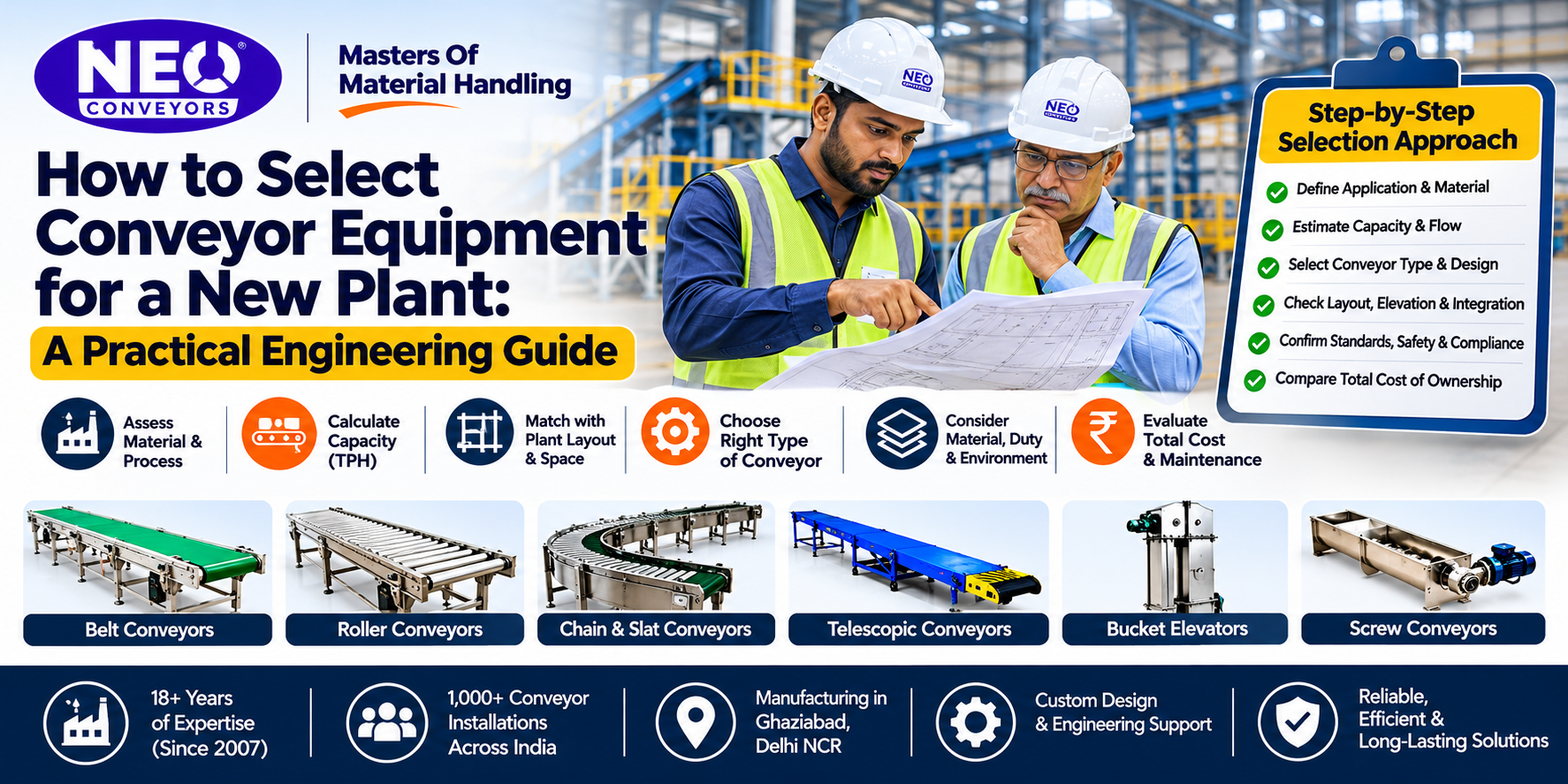
Selecting a conveyor system for a new plant is not simply a matter of deciding how to move material from one point to another. The conveyor must suit the material, required capacity, plant layout, operating conditions and future production plans.
A system that works well in one factory may not be suitable for another, even if both handle the same material. Differences in conveying distance, material weight, feeding arrangement, discharge height and available space can change the entire design.
At Neo Conveyors, we have been designing and manufacturing customised material handling systems since 2007. When a customer approaches us for a new conveyor, we first understand the application and plant requirements. Only then do we recommend the conveyor type and its specifications.
This guide explains the main points to consider before selecting conveyor equipment for a new plant.
1. Start With the Material Being Conveyed
The first question is always: what material will the conveyor handle?
Material characteristics directly affect conveyor selection, belt type, drive arrangement and construction material. Important details include:
Material name and type
Bulk density
Particle size and shape
Individual product or bag weight
Moisture content
Temperature
Abrasiveness and corrosiveness
Whether the material is free-flowing, sticky or fragile
For example, a conveyor handling cement powder requires a different arrangement from one carrying cartons or 50 kg bags. Similarly, coal and stone need a more heavy-duty construction than lightweight packaged products.
The following table gives a general starting point for selection.
| Material or product | Commonly considered conveyor |
|---|---|
| Cement, fly ash and fine powders | Screw conveyor |
| Grains and free-flowing granules | Belt conveyor or bucket elevator |
| Bags and cartons | Belt conveyor or roller conveyor |
| Coal, stone and abrasive materials | Heavy-duty belt conveyor |
| Loose material requiring vertical lifting | Bucket elevator |
| Products moving through packaging or assembly lines | Belt, roller or slat conveyor |
These are general recommendations. The final choice depends on capacity, distance, layout and operating conditions.
Explore Belt Conveyors, Screw Conveyors and Bucket Elevators.
2. Calculate the Required Capacity
Capacity is one of the most important inputs in conveyor design. An incorrectly selected capacity can affect the entire production line.
The capacity requirement should be provided in the unit relevant to the application:
Bulk material: tonnes per hour (TPH)
Bags: bags per hour
Cartons: cartons per hour
Individual products: pieces per minute or per hour
For bulk material, the bulk density must also be known. Two materials with the same weight may occupy very different volumes, so the conveyor cannot be sized on TPH alone.
For bag and carton handling, product dimensions, weight and spacing are important. These details help determine belt width, roller pitch, conveyor speed and drive requirements.
Also clarify whether the conveyor will operate continuously or in batches. A conveyor running for several hours continuously may require a different drive and service consideration from one used intermittently.
At Neo Conveyors, we generally consider an allowance of around 1.25 times the present capacity requirement when planning for future production. This is a practical design consideration, not a substitute for calculating the actual material flow and operating conditions.
3. Check the Plant Layout and Conveying Distance
A conveyor must fit the plant, not the other way around. This is why layout information is important before finalising the design.
We normally ask customers for:
Feeding height
Discharge height
Horizontal conveying distance
Available installation space
Floor and structural restrictions
Plant layout or GA drawing, if available
Feeding and discharge heights are often fixed by the existing equipment or building arrangement. Once these levels and the conveying distance are known, the required inclination can be calculated.
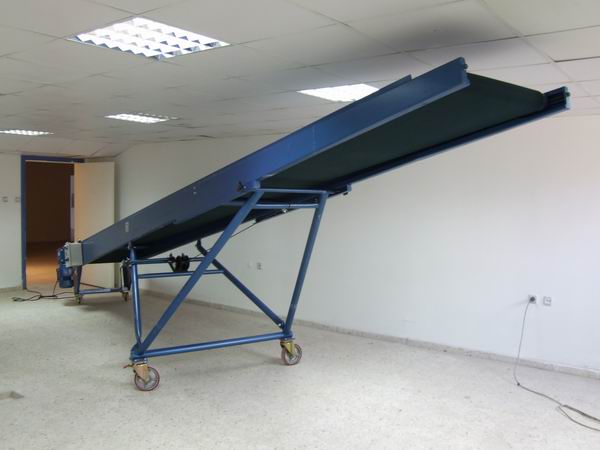
That inclination helps determine whether a standard belt is suitable or whether a cleated, chevron or other belt arrangement is needed.
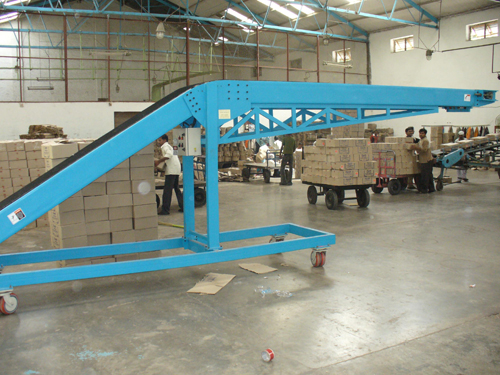
Available space also affects whether the job should use one conveyor or a combination of two or more conveyors. In some plants, a single long conveyor is practical. In others, multiple conveyors provide a better route around columns, machines and existing structures.
Do not overlook maintenance access. Space should be available for inspection, belt adjustment, component replacement and safe movement around the equipment. Walkways and service clearances should be considered during layout planning, rather than after installation.
For inclined applications, see Inclined Belt Conveyors.
4. Choose the Right Type of Conveyor
Once the material, capacity and layout are understood, the conveyor type can be shortlisted.
Belt Conveyor
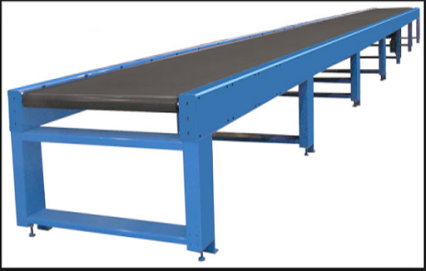
Belt conveyors are commonly used for transporting bulk materials, bags, cartons and products over horizontal or inclined routes. They are particularly useful when the conveying distance is relatively long.
The belt material and surface profile must be selected according to the product, load and inclination.
Screw Conveyor
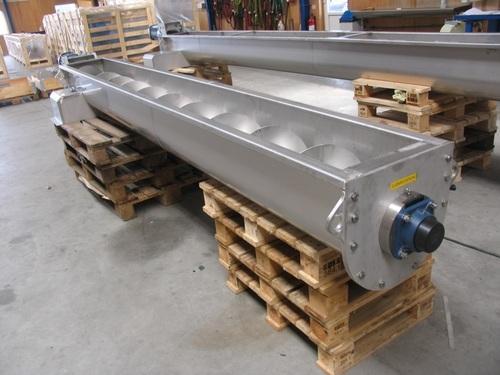
Screw conveyors are generally considered for powders, granules and bulk materials where an enclosed conveying arrangement is preferred. They are useful where dust containment and controlled material transfer are important.
Depending on the application, a U-trough, tubular, inclined, vertical or shaftless design may be considered.
Bucket Elevator
When loose material needs to be lifted vertically, a bucket elevator is often a suitable option. It is used for materials such as grain, cement, fertilizer and other bulk products.
The bucket size, spacing, belt or chain speed and discharge arrangement depend on the material and required capacity.
Roller Conveyor
Roller conveyors are commonly used for bags, cartons, crates, pallets and other products with a suitable base. They can be gravity-operated or powered, depending on the movement and control required.
Roller diameter and pitch must match the product dimensions and weight. The product should be supported by enough rollers throughout its movement.
Chain and Slat Conveyors
Chain and slat conveyors are considered for applications requiring a robust conveying surface or a specific product-support arrangement. They are used in several manufacturing, assembly and material handling applications.
A plant may also need a combination of conveyor types. For example, a belt conveyor may feed a bucket elevator, which then discharges material into another conveyor. The transfer points between machines must be considered as part of the complete system.
Explore the Neo Conveyors product range.
5. Consider the Operating Environment
The environment in which the conveyor operates affects material selection, sealing, construction and maintenance.
Some common considerations are:
Dusty applications: An enclosed conveying arrangement may be required to control dust leakage.
Wet or moisture-prone areas: Suitable sealing and protection should be considered.
Corrosive environments: Stainless steel, such as SS304, may be appropriate depending on the chemical exposure.
High-temperature materials: The belt and other components must be selected for the actual operating temperature. A suitable heat-resistant (HR) grade belt may be required.
Outdoor installations: Hood covers can help protect the conveyor and conveyed material from weather exposure.
Food and pharmaceutical applications: PU belts and SS304 construction may be considered where the process and hygiene requirements call for them.
The exact material of construction should be finalised after understanding the product, cleaning method, temperature, exposure and applicable industry requirements.
6. Select the Belt, Motor and Gearbox Correctly
A conveyor's performance depends on the selection of its main mechanical components. These should be selected as part of the complete design rather than treated as independent catalogue items.
Belt Selection
Belt selection depends on the application and required capacity. Material type, load, operating conditions, inclination and temperature all need to be considered.
A belt suitable for cartons may not be appropriate for coal or abrasive material. Similarly, an inclined conveyor may require a different belt surface from a horizontal conveyor.
Motor Selection
Motor power depends on the total load on the conveyor and the operating conditions. Conveying distance, elevation, belt speed, material load and running hours all influence the selection.
The motor should be selected after the conveyor's operating requirements have been calculated.
Gearbox Selection
The gearbox must be suitable for the required torque, load, speed and operating hours. These factors are used to determine the appropriate service factor.
Selecting a gearbox only by motor power can lead to an unsuitable drive arrangement.
Drive Arrangement
For many belt conveyor applications, a head drive is preferred because it provides a pulling action on the loaded belt. The final drive arrangement should still be checked against the conveyor layout, loading conditions and operating requirements.
Commonly Used Component Brands
Depending on the application and customer requirement, commonly considered brands include:
| Component | Brands |
|---|---|
| Bearings | SKF |
| Gearboxes | Bonfiglioli |
| Motors | BBL / CG |
| Conveyor belts | Hindustan / N N |
The brand and specification should be finalised according to the duty, availability and project requirement.
7. Plan for Maintenance and Safe Operation
A conveyor should be designed for regular operation as well as convenient maintenance.
Before finalising the layout, consider:
Access to the motor and gearbox
Belt tracking and tension adjustment
Bearing inspection and lubrication
Cleaning around loading and discharge points
Access to transfer chutes
Replacement of rollers and other wear components
Suitable guarding and emergency-stop arrangements
If a component cannot be accessed easily, even a small maintenance job may cause unnecessary production downtime.
Maintenance access should therefore be included in the initial plant layout and GA drawing.
8. Allow for Future Production Requirements
A new plant may increase its production capacity after commissioning. If the conveyor is designed only for the initial requirement, future expansion may require costly modification or replacement.
Discuss expected production growth with the conveyor manufacturer before finalising the design.
At Neo Conveyors, we generally consider approximately 25% additional capacity over the current requirement as an initial planning allowance. The final design must still be checked for material properties, actual loading, equipment limitations and operating duty.
Future requirements may also include additional feeding points, changes in discharge locations or integration with new equipment. These possibilities are worth discussing at the design stage.
9. Common Mistakes When Selecting Conveyor Equipment
Some problems begin before the conveyor is even manufactured. They usually arise when important application details are not available during selection.
Selecting equipment only on the basis of price: Two conveyors may look similar but use different belt specifications, drive components, structures and duty ratings.
Ignoring bulk density: Capacity in TPH alone is not enough to size a conveyor for loose material.
Not providing actual product dimensions: This can result in unsuitable belt width, roller pitch or product spacing.
Ignoring inclination: A belt that works horizontally may not carry the same material reliably at an angle.
Not sharing the plant layout: The proposed conveyor may not fit the available space or connect properly with existing equipment.
Overlooking maintenance access: Difficult access can increase maintenance time and production interruptions.
Designing only for present capacity: Future expansion may become expensive if it is not considered early.
Providing accurate information at the beginning helps the manufacturer recommend a more suitable system and reduces avoidable changes later.
10. Information to Share With Your Conveyor Manufacturer
Before requesting a quotation, keep the following details ready. A plant layout or drawing is particularly useful when the conveyor has multiple feeding and discharge points.
| Information required | Details to provide |
|---|---|
| Material or product | Name and type |
| Capacity | TPH, bags/hour, cartons/hour or pieces/hour |
| Material properties | Bulk density, size, weight, moisture and temperature |
| Conveying distance | Horizontal and inclined length |
| Feeding height | Height at the inlet |
| Discharge height | Required outlet height |
| Product dimensions | Length, width and height for unit loads |
| Operating hours | Hours per shift and shifts per day |
| Operating conditions | Indoor, outdoor, dusty, wet or corrosive |
| Material of construction | MS, SS304, SS316 or other requirement |
| Plant layout | GA drawing or available installation dimensions |
The more accurately these details are shared, the easier it is to select the correct conveyor type and prepare a practical engineering proposal.
Why Choose Neo Conveyors for Your Plant?
Neo Conveyors, a brand of Neo Packaging Industries, has been designing and manufacturing customised conveyor systems since 2007.
We work with customers to understand their material handling requirements, available space and production targets before recommending equipment. Our product range includes belt conveyors, telescopic belt conveyors, truck loading conveyors, roller conveyors, screw conveyors, bucket elevators, chain conveyors, slat conveyors and other customised material handling systems.
With more than 1,000 conveyor installations, we serve applications across manufacturing, packaging, warehousing, logistics, food processing, cement, pharmaceuticals and other industries.
Our approach is straightforward: understand the application, finalise the layout, select suitable components and manufacture a conveyor system around the customer's actual requirement.
Neo Conveyors — Masters of Material Movement.
Frequently Asked Questions
1. What information is required to select a conveyor system?
The basic information includes material type, required capacity, conveying distance, feeding and discharge heights, material weight or bulk density, product dimensions and available plant space. Operating conditions and working hours are also important.
2. Which conveyor is suitable for bulk material handling?
Belt conveyors, screw conveyors and bucket elevators are commonly used for bulk material handling. The selection depends on the material, capacity, conveying distance and direction of movement.
3. Which conveyor is suitable for vertical material handling?
Bucket elevators are commonly used for vertical lifting of loose bulk materials such as grain, cement and fertilizer. Vertical screw conveyors may also be considered for suitable applications.
4. How do I select the correct conveyor belt?
Belt selection depends on the material, load, capacity, speed, inclination and operating temperature. The belt surface and construction should be matched to the application.
5. Why is plant layout important in conveyor selection?
The plant layout establishes the available space, conveying route, feeding and discharge points, elevation and access requirements. It helps determine the conveyor type, length, inclination and whether multiple conveyors are needed.
6. Should conveyor capacity include an allowance for future expansion?
It is useful to discuss future production plans before finalising the design. An allowance of around 25% may be considered as an initial planning point, but the final capacity must be checked against the actual application and equipment duty.
7. Can one conveyor system handle different types of materials?
It depends on the materials and operating conditions. Differences in size, density, moisture, temperature and abrasiveness may require changes to the belt, construction or conveying arrangement. Each application should be evaluated before deciding.
8. Does Neo Conveyors manufacture customised conveyor systems?
Yes. Neo Conveyors designs and manufactures customised conveyor systems according to the customer's material, capacity, plant layout, conveying distance and operating requirements.
Discuss Your Conveyor Requirement With Neo Conveyors
Planning a new factory, warehouse or production line? Share your material details, required capacity, conveying distance and plant layout with our team.
Our engineers can review the application and help identify a suitable conveyor arrangement.
Neo Conveyors
Masters of Material Movement
Ghaziabad, Uttar Pradesh, India
Phone / WhatsApp: +91-9654112235
Website: https://www.neoconveyors.com
Email: info@neoconveyors.com