Telescopic Conveyor vs Manual Truck Loading: Which Actually Saves You More?
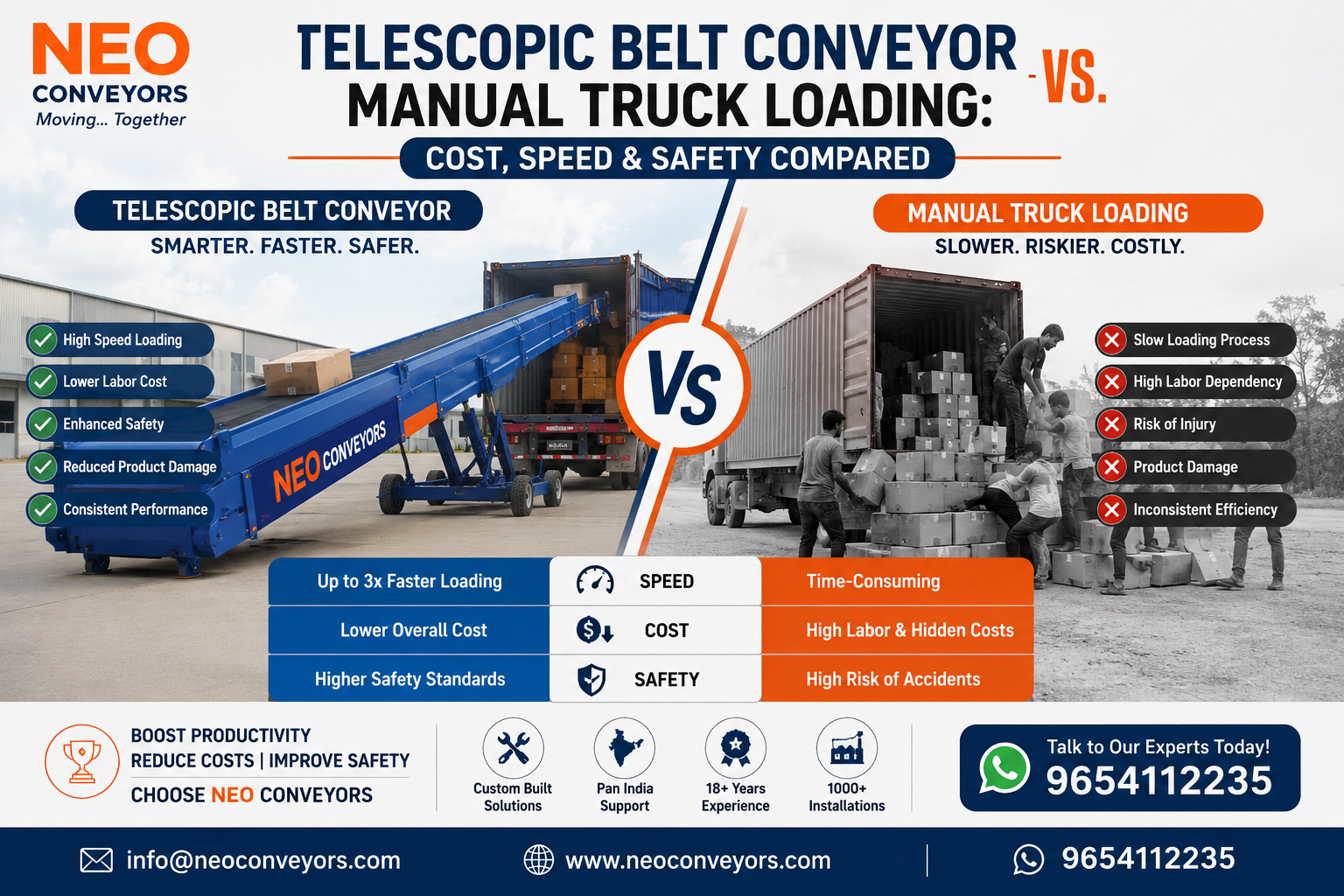
If your dock team is still hand-loading trucks with bags, cartons, or boxes, you've probably already had the conversation internally: is a telescopic conveyor worth the capital cost, or is manual loading "good enough" for now? This isn't a features list of what a telescopic conveyor does — you can find that on any manufacturer's product page. This is a straight comparison of what each method actually costs you, on the metrics that matter when you're the one signing off on the budget.
Where the Two Methods Actually Differ
| Factor | Manual Loading | Telescopic Belt Conveyor |
|---|---|---|
| Labor required per truck | 2-4 workers, full duration of loading | 1 operator to monitor/feed the line |
| Typical loading time (per 20ft truck, bagged/boxed goods) | 45-75 minutes, depending on crew size and fatigue | 15-25 minutes at steady throughput |
| Injury exposure | Repetitive lifting, awkward reach into truck depth, higher strain-injury risk over a shift | Minimal manual lifting; workers feed the belt at ergonomic height |
| Throughput consistency | Drops as shift fatigue sets in; varies by crew | Constant mechanical throughput regardless of shift hour |
| Damage/breakage rate | Higher on stacked or dropped goods during manual handling | Lower — controlled, continuous belt transfer |
| Upfront cost | None (existing labor) | Capital investment in equipment + installation |
| Ongoing cost | Labor cost scales with volume and overtime | Belt/motor maintenance; labor cost stays flat as volume grows |
| Space required at dock | Minimal | Requires dock clearance for extension/retraction |
Where Manual Loading Still Makes Sense
It's worth being honest about this rather than pretending automation is always the answer: if you're loading fewer than 2-3 trucks a day, have low headcount cost in your region, or handle irregular, non-uniform loads that don't suit a belt (large odd-shaped crates, for example), the capital cost of a telescopic conveyor may take longer to justify. Manual loading has no upfront cost and no maintenance requirement — for genuinely low volume, that can outweigh the labor savings.
Where the Numbers Start Favoring a Telescopic Conveyor
The case for switching gets stronger fast once volume climbs. A few patterns we see consistently in warehouses and dispatch yards that make the switch:
- Multiple trucks per shift. Once you're loading 5+ trucks a day, the cumulative labor-hours saved per truck compounds quickly — the same crew that used to load 5 trucks in a shift can often load significantly more once the conveyor removes the manual carry step.
- High labor turnover or overtime dependency. If you're regularly paying overtime to hit dispatch deadlines, a conveyor converts variable overtime cost into a fixed one-time capital cost.
- Injury-related downtime. Repetitive manual loading is a known driver of strain injuries in dispatch operations; fewer lost-time incidents means fewer disruptions to your loading schedule, on top of the direct cost of the incidents themselves.
- Seasonal or peak-volume spikes. If your dispatch volume spikes seasonally, a conveyor gives you throughput headroom without having to hire and train temporary labor under time pressure.
Estimating Your Own Payback Period
Rather than quoting a generic "X months payback" figure that won't match your operation, here's the calculation worth running with your own numbers:
- Current labor cost per truck = (crew size × hourly wage × loading time in hours)
- Conveyor-assisted labor cost per truck = (1 operator × hourly wage × reduced loading time)
- Labor cost saved per truck = step 1 minus step 2
- Monthly saving = labor cost saved per truck × trucks loaded per month
- Payback period = conveyor + installation cost ÷ monthly saving
Most operations loading double-digit trucks per week find the payback period lands well within the equipment's working life — but the only way to know for your specific volume, crew cost, and truck mix is to run your own numbers against a quotation, not a marketing estimate.
Getting a Number You Can Actually Use
If you want a payback estimate based on your actual truck volume, current crew size, and load type — rather than the general ranges above — Neo Conveyors' engineering team can walk through the numbers with you and recommend a telescopic belt conveyor configuration (boom length, belt width, drive type) sized to your dock and dispatch volume, not a one-size-fits-all model.
For a full technical breakdown of how telescopic conveyors work and what specifications to check before buying, see our telescopic belt conveyor manufacturer guide.
Recent Posts