Telescopic Belt Conveyor Manufacturer in India
Telescopic Belt Conveyor Manufacturer in India
Neo Conveyors builds extendable telescopic belt conveyors for loading docks, logistics hubs, FMCG warehouses, e-commerce fulfilment centres, and courier operations. Custom-built in Ghaziabad with 6–13 m extension, VFD speed control, and PAN India installation by our own engineers since 2007.
- Truck loading conveyor
- Container loading
- Dock automation
- VFD speed control
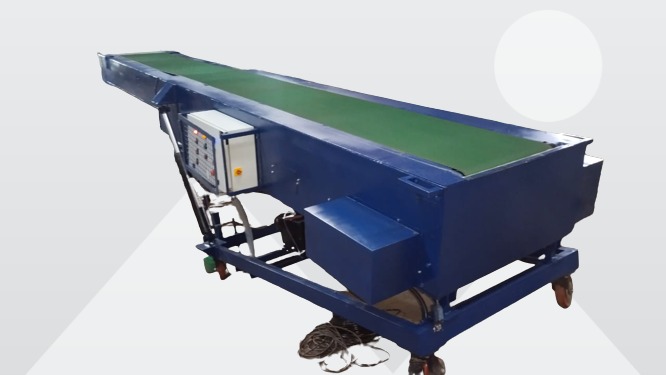
FIG. 01 — TELESCOPIC BELT CONVEYOR, TRUCK LOADING IN OPERATION
What Is a Telescopic Belt Conveyor?
A telescopic belt conveyor is an extendable conveyor whose boom slides into trucks, containers, and trailers, converting manual truck loading into a controlled, continuous belt-flow operation. Products are placed on the infeed end at dock level, the conveyor boom extends into the truck or container, aligns to the floor height, and carries cartons, bags, or parcels to the far end of the vehicle. One or two operators can replace a large manual carrying team while improving safety, speed, and product handling consistency.
Neo Conveyors has manufactured telescopic belt conveyors from its Ghaziabad facility since 2007, engineering each unit to the buyer's specific truck mix, dock height, belt width requirement, and daily vehicle count rather than shipping a fixed catalogue size. Every system is fabricated in-house and installed on-site by our own engineering team, not a third-party contractor.
How It Fits Into Your Loading Dock
Extend, align, load, retract: a telescopic belt conveyor extends directly inside the vehicle, so cartons, bags, and parcels move from the dock to the loading point without repeated manual carrying. This is most useful where dispatch teams handle frequent trucks, mixed carton sizes, peak-hour loading pressure, and limited dock space, exactly the conditions that make manual loading slow, labour-intensive, and prone to product damage.
Six Steps From Dock Arrival to Dispatch
Designed for Indian commercial trucks, 20-foot containers, 40-foot containers, and mixed loading dock heights.
Vehicle Docks
The truck backs to the loading bay and the boom extends 6–13 m into the cargo space.
Height Aligns
Manual or hydraulic height adjustment matches the conveyor end to the truck floor level.
Products Flow
Cartons, bags, and parcels move automatically through the vehicle instead of being carried by hand.
Boom Retracts
When loading is complete, the compact unit retracts and the next vehicle can dock quickly.
Speed Controls
Optional VFD control lets operators adjust belt speed for fragile goods or high-volume carton loading.
Reverse Runs
Bidirectional belt operation supports unloading and receiving workflows as well as dispatch.
Custom-engineered per dock: share your truck type, dock height, daily vehicle count, and product details. Our engineers will recommend the correct extension length, belt width, height adjustment, and control setup at no charge. Send layout details
Telescopic Belt Conveyor in Action
See a Neo Conveyors telescopic belt conveyor extending, aligning, and loading cartons at a customer dock.
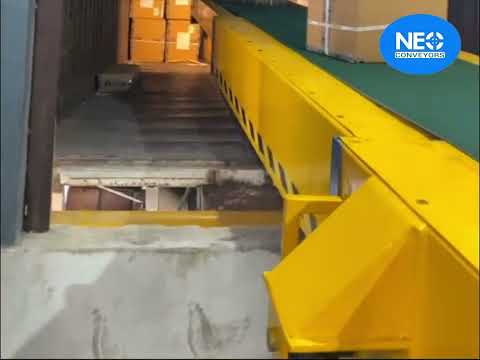
TRUCK LOADING OPERATION, CUSTOMER SITE
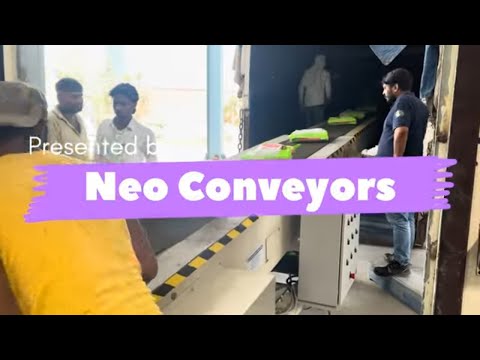
TELESCOPIC CONVEYOR, PRODUCT DEMONSTRATION
What Changes at the Loading Dock?
The decision criteria buyers care about: labour, speed, safety, and damage.
Manual Loading
- 8–10 workers needed per truck
- Slow 45–90 minute truck turnaround
- High fatigue and back injury risk
- Product damage from repeated manual handling
With Telescopic Conveyor
- 1–2 operators manage loading from dock level
- 2× to 3× faster vehicle loading
- No workers carrying goods inside the vehicle
- Smoother belt movement reduces damage claims
Telescopic Belt Conveyor vs Fixed Loading Conveyor
A fixed loading conveyor conveyor is cheaper up front, but a telescopic conveyor manufacturer will usually recommend the extendable version once you factor in mixed vehicle sizes, container depth, and dock footprint. Here's the honest comparison.
| Factor | Telescopic belt conveyor | Fixed loading conveyor |
|---|---|---|
| Upfront cost | Higher, extension mechanism adds cost | Lower, simpler fixed frame |
| Loading speed | Faster across mixed vehicle sizes | Fast only for the matched vehicle size |
| Labour required | 1–2 operators, any vehicle depth | 1–2 operators, but manual carry beyond fixed reach |
| ROI on mixed fleets | Higher, one unit serves all vehicle sizes | Lower, may need multiple dock configurations |
| Dock space required | Compact when retracted | Fixed footprint, permanently extended |
| Maintenance | Extension rollers and drive need periodic check | Simpler, fewer moving parts |
| Best fit | Mixed truck/container sizes, high dispatch volume | Single, standardised vehicle type at one dock |
If every vehicle at your dock is the same size and height, a fixed loading/unloading conveyor may be the more economical choice. For mixed truck and container fleets, the telescopic conveyor's flexibility typically pays back the extra upfront cost within the first year through reduced labour and faster turnaround.
Technical Specifications for Custom Dock Layouts
Every unit is engineered around your product size, truck type, dock height, daily vehicle count, and throughput target.
| Belt width | 500 mm to 1,200 mm |
|---|---|
| Extended length | 6 m to 13 m |
| Retracted length | Typically 40–50% of extended length |
| Load capacity | Up to 50 kg per item on belt |
| Vehicle support | 9 ft to 32 ft trucks, 20 ft and 40 ft containers |
| Motor | 5 HP standard, custom per load and length |
| Speed control | Fixed speed or VFD |
| Power supply | 415 V, 3 phase, 50 Hz |
Belt & Structure Options
Standard belt for general cartons, boxes, and packaged goods.
Grips bags, sacks, and cement bags on the incline sections at container entry.
For packed food, beverage, and cold-chain dispatch requiring hygienic, easy-clean surfaces.
Control & Drive Options
Standard local control for extension, retraction, and belt run/stop.
Wireless remote for operators working at the truck end rather than the control panel.
Corrosion-resistant frame built for continuous outdoor dock use.
Manual crank for lower-frequency docks, motorised extension for high-volume, multi-shift operations.
Extension Length vs Truck Type
| Vehicle type | Typical body length | Recommended extension |
|---|---|---|
| Tempo / mini truck (9–14 ft) | 2.7–4.3 m | 6 m |
| Medium commercial truck (17–22 ft) | 5.2–6.7 m | 8 m |
| Large commercial truck (24–32 ft) | 7.3–9.8 m | 10 m |
| 20 ft shipping container | 6 m | 8–9 m |
| 40 ft shipping container | 12 m | 13 m |
Belt Width vs Typical Capacity
| Belt width | Typical item size | Approx. throughput |
|---|---|---|
| 500 mm | Small cartons, parcels, courier bags | 400–600 cartons/hour |
| 600–700 mm | Standard FMCG cases, retail cartons | 600–900 cartons/hour |
| 800–900 mm | Large cartons, cement bags, mixed loads | 800–1,100 cartons/hour |
| 1,000–1,200 mm | Bulky cartons, sacks, palletised unit loads | 1,000–1,400 cartons/hour |
Actual throughput depends on belt speed, operator pace at the infeed, and carton weight; figures above are typical ranges, not guaranteed output.
Motor Power Recommendations
| Extension length | Typical load | Recommended motor |
|---|---|---|
| 6–8 m | Light cartons, parcels (<25 kg) | 2–3 HP |
| 8–10 m | Standard FMCG cases (25–40 kg) | 3–5 HP |
| 10–13 m | Heavy cartons, cement bags (up to 50 kg) | 5–7.5 HP |
Telescopic Belt Conveyor Price in India
Neo Conveyors does not publish fixed price lists, since every telescopic conveyor is built to order, but the variables below are what actually move the price up or down. Understanding them helps you compare quotes from any telescopic conveyor supplier on a like-for-like basis.
Extension Length
Longer booms, especially 40-ft container-length units at 13 m, need heavier structure and a stronger drive, raising cost over a standard 6–8 m truck loading unit.
Belt Width
Wider belts (1,000–1,200 mm) use more belting material and a larger frame than a narrow 500 mm parcel conveyor, increasing cost proportionally.
Motor Power
Heavier loads and longer extensions need a larger drive motor. A 7.5 HP motor for a 13 m unit costs more than a 2 HP motor for a 6 m parcel conveyor.
VFD Speed Control
Adding variable frequency drive control for adjustable belt speed is a moderate cost addition over a fixed-speed unit, but pays back quickly in mixed-product dispatch.
Hydraulic Height Lift
A hydraulic lift system for height adjustment costs more than a manual crank mechanism but reduces operator effort significantly on multi-shift, high-frequency docks.
Load Capacity
Specifying above the standard 50 kg per item rating requires a reinforced frame and stronger rollers, which increases both material and fabrication cost.
How to get an accurate number: the only reliable way to price a telescopic belt conveyor is against your actual truck mix, dock height, product weight, and daily volume. Neo Conveyors provides a firm, itemised quotation, not a rough estimate, once these details are shared. Request a quote
Built for High-Volume Dispatch and Receiving
Suitable for cartons, boxes, bags, sacks, parcels, courier shipments, FMCG cases, packaged food, and pharmaceutical cartons.
Logistics & 3PL
Standardise loading speed across mixed vehicle arrivals and contract labour constraints.
E-Commerce
Move high-SKU parcels through evening dispatch cut-off windows with fewer workers.
FMCG
Reduce product damage while loading cartons and cases at distribution centres.
Courier Hubs
Feed parcel flow from sortation lines directly into delivery vehicles.
Food & Beverage
Use hygienic belt options for packed food, beverages, and cold-chain dispatch.
Building Materials
Handle cement bags and packed construction material with cleated belt options.
| Industry | Typical belt type | Typical extension |
|---|---|---|
| Logistics & 3PL warehouse conveyor systems | Flat PVC | 8–10 m |
| E-commerce & courier hubs | Flat PVC | 6–9 m |
| FMCG distribution | Flat PVC / Cleated | 8–10 m |
| Food & beverage dispatch | Food-grade PU | 6–8 m |
| Building materials & cement | Cleated | 8–10 m |
| Container export loading | Flat PVC / Cleated | 12–13 m |
Running a mixed warehouse conveyor system with production, packaging, and dispatch stages? Our belt conveyor and packaging conveyor ranges cover the stages upstream of the loading dock.
Recent Telescopic Belt Conveyor Installations
Real dock upgrades with engineering parameters and results, demonstrating what a correctly specified telescopic conveyor achieves in daily operation.
E-commerce Fulfilment Centre — Bhiwadi
A regional fulfilment centre needed to load 40-foot containers at peak dispatch hours without adding headcount. A 13 m motorised telescopic conveyor with VFD speed control was installed with remote-control operation for a single operator per dock.
- Truck turnaround reduced from 70 to 25 minutes
- Loading team reduced from 9 workers to 1 operator per dock
- Running 2 shifts daily, 14 months without belt replacement
Building Materials Depot — Ghaziabad
A cement and building materials depot needed to load 50 kg cement bags into mixed truck sizes with fewer manual carries and reduced bag damage. A cleated-belt telescopic conveyor with manual height adjustment was specified.
- Bag damage claims reduced by over 60%
- Loading crew reduced from 8 to 2 workers per truck
- Payback achieved within 5 months of installation
FMCG Cold Storage Facility — Pune
A packaged food distributor needed hygienic, easy-clean belt loading for chilled cartons dispatched daily to retail routes. A food-grade PU belt telescopic conveyor with washdown-rated structure was installed at 2 dock positions.
- Dispatch cut-off window met consistently across 2 shifts
- Hygiene audit passed with no belt-related non-conformance
- Zero unplanned downtime in first 12 months
Courier Sortation Hub — Gurugram
A courier hub needed one conveyor to handle both inbound unloading and outbound dispatch loading across mixed van and truck sizes at a single dock. A bidirectional telescopic conveyor with push-button and remote control was installed.
- Single unit handles both inbound and outbound flow
- Parcel handling throughput increased approximately 2.5×
- Running 3 shifts daily since commissioning
How Each Telescopic Conveyor Is Built
Every unit goes through the same four-stage process at our Ghaziabad facility before it ships, from initial layout engineering to on-site commissioning.
Design & Engineering
Extension length, belt width, motor sizing, and control layout are calculated against your truck mix and dock height before fabrication begins.
Fabrication & Assembly
Structure, boom, rollers, and drive are fabricated and assembled in-house at our Ghaziabad workshop, not outsourced to a third-party welder.
Quality Testing
Every unit is run under load, extended and retracted through its full range, and checked for belt tracking and drive performance before despatch.
Installation & Commissioning
Our own engineers install, align, and commission the unit on-site, then train dock operators before handover.
BOOM EXTENSION MECHANISM, CLOSE-UP
CONTROL PANEL, EXTEND / RETRACT / SPEED
HYDRAULIC LIFT MECHANISM, SIDE VIEW
Engineering team: layouts are reviewed by our in-house mechanical engineering team, with combined experience across cement, FMCG, e-commerce, and logistics dock projects, before any unit is fabricated. Our full installation gallery and coverage across Indian states is available for reference.
★★★★★
"Truck loading time came down from around 65 minutes to 25 minutes after installation." — Logistics company, Delhi NCR (illustrative customer feedback; contact us for verified references)
★★★★★
"We went from an 8-person loading crew to 2 operators per shift on our container line." — FMCG distribution centre, Pune (illustrative customer feedback; contact us for verified references)
Why Choose Neo Conveyors for Your Loading Dock?
Every telescopic belt conveyor is designed around your truck mix and dock layout, fabricated in-house at our Ghaziabad manufacturing facility, and installed by our own engineers, not a sub-contractor.
Manufactured in Ghaziabad Since 2007
Every telescopic conveyor is designed, fabricated, and tested in-house at our Ghaziabad facility before despatch, not sourced or resold from a third party.
Custom Engineering at No Extra Cost
Extension length, belt width, height adjustment, and control setup are engineered around your dock and truck mix at no additional design charge.
PAN India Installation, Own Engineers
Site installation, commissioning, and operator training are handled by Neo Conveyors' own engineering team across all Indian states, not outsourced contractors.
Warranty & Spare Parts Support
Standard 1-year warranty on structure and drive components, with belts, rollers, and control panels stocked for rapid replacement after handover.
1,000+ Conveyor Installations
18+ years of conveyor manufacturing experience across logistics, FMCG, e-commerce, and building materials sectors, with references available on request.
AMC & After-Sales Response
Annual Maintenance Contracts and rapid-response service keep loading docks running with minimal unplanned downtime after installation.
Answers Procurement Teams Need Before Requesting a Quote
What is a telescopic belt conveyor?
It is an extendable conveyor whose boom slides into trucks, containers, and trailers. Products placed at dock level travel automatically to the far end of the vehicle, removing the need for workers to carry cartons inside the vehicle.
What is the maximum extension length?
Neo Conveyors manufactures 6–13 m systems. Standard truck units are commonly 8–10 m, while 40-foot container systems can extend up to 13 m.
Can belt speed be adjusted?
Yes. Optional VFD control allows belt speed adjustment during operation for fragile, heavy, or high-volume products.
What is the price of a telescopic belt conveyor in India?
Price depends on length, belt width, capacity, height adjustment, extension mechanism, and custom dock requirements. Neo Conveyors provides a quote after reviewing your layout and vehicle mix.
Do you install across India?
Yes. Neo Conveyors installs across Delhi NCR, Ghaziabad, Noida, Gurugram, Faridabad, Bhiwadi, Ahmedabad, Pune, Hyderabad, Bangalore, Chennai, Mumbai, and other industrial hubs.
How much manual labour does a telescopic conveyor replace?
A single unit typically replaces 8–10 manual loaders per truck with 1–2 operators managing loading from dock level, cutting vehicle turnaround time by 2 to 3 times compared with fully manual loading.
What truck and container sizes does it support?
Neo Conveyors telescopic belt conveyors are engineered for 9 ft to 32 ft commercial trucks as well as standard 20-foot and 40-foot shipping containers, with boom length and height adjustment matched to your typical vehicle mix.
Can it be used for unloading as well as loading?
Yes, bidirectional belt operation is standard, supporting both dispatch loading and inbound unloading or receiving workflows on the same unit.
What belt types are available for food or hygiene-sensitive loading?
Food-grade PU belt options are available alongside standard flat PVC and cleated belt, suitable for packed food, beverage, and cold-chain dispatch where hygiene and easy cleaning are required.
What is the delivery lead time?
Standard delivery is 4 to 6 weeks from order confirmation, depending on extension length, belt width, and control customisation, with the timeline confirmed in writing before order placement.
What is the difference between a telescopic and a fixed loading conveyor?
A telescopic loading conveyor extends and retracts to reach varying depths inside trucks and containers, while a fixed loading conveyor stays at a set length. Telescopic units suit mixed vehicle sizes and deep container loading; fixed units suit docks with a single, standardised vehicle type. See the comparison table below for a full breakdown.
Which industries use telescopic conveyors?
Logistics and 3PL warehouses, e-commerce fulfilment centres, FMCG distribution, courier and parcel hubs, food and beverage dispatch, and building materials depots for cement and packed construction goods.
How much electricity does it consume?
A standard 5 HP drive motor consumes roughly 3.7 kW at full load. Actual consumption depends on run time, belt speed, and whether motorised extension or hydraulic lift options are fitted; exact figures are confirmed at quotation stage.
Can it be integrated with dock levelers?
Yes, telescopic belt conveyors can be positioned and height-matched to work alongside dock levelers and dock shelters as part of a complete loading bay automation package.
What maintenance is required?
Routine maintenance includes checking belt tension and tracking, greasing extension rollers and bearings, inspecting the drive motor and gearbox, and checking hydraulic fluid levels on hydraulic-lift models, typically on a monthly schedule.
What factors affect the price beyond length and belt width?
Motor power, whether VFD speed control is fitted, manual versus hydraulic height lift, and load capacity all affect price. Longer extension, wider belts, and hydraulic lift increase cost over a basic manual-crank unit. See the pricing guide below for a full breakdown.
Is it suitable for outdoor loading docks?
Yes, with a powder-coated mild steel structure and weatherproof electrical enclosures, telescopic belt conveyors operate reliably at open, semi-covered, and fully enclosed loading docks.
Can the conveyor be customised with company branding or colour?
Yes, structure colour and basic branding can be specified at order stage at no significant extra cost, since every unit is fabricated to order rather than shipped from stock.
What is a container loading conveyor, and how is it different?
A container loading conveyor is typically built for longer extension, up to 13 metres, to reach the full depth of a 40-foot shipping container, while a standard truck loading conveyor is usually specified for 8 to 10 metres for commercial truck bodies.
Do you provide operator training after installation?
Yes, our installation engineers provide on-site operator training covering extension, retraction, speed control, and basic troubleshooting as part of the commissioning process.
Manufactured in Ghaziabad, Installed Across Major Logistics Hubs
- Delhi NCR
- Ghaziabad (HQ)
- Noida
- Gurugram
- Faridabad
- Bhiwadi
- Ahmedabad
- Pune
- Hyderabad
- Bangalore
- Chennai
- Mumbai
- UAE & Africa
More Truck Loading Conveyor Guides
We're building out a full set of guides around telescopic and truck loading conveyor buying decisions, each linking back to this page. Check our blog for these as they publish:
- How a Telescopic Belt Conveyor Works
- Telescopic Belt Conveyor Price Guide
- Truck Loading Conveyor Buying Guide
- Warehouse Loading Conveyor Systems
- Manual vs Telescopic Loading
- Dock Automation for Logistics Companies
- Loading Conveyor Maintenance Checklist
- Telescopic Conveyor ROI Calculator
Send Your Truck Type, Dock Layout & Product Details
Neo Conveyors engineers will recommend the right extension length, belt width, height adjustment, and control setup for your specific loading dock.