Wire mesh conveyor Manufacturer in India
Stainless steel wire mesh belt conveyors for food processing, drying, cooling, washing, and heat treatment, wherever the process needs to reach the product through the belt, not just across its surface. Belt alloy, mesh pattern, and wire diameter are matched to your actual temperature and load, not sold off a single spec sheet.
- SS304 / SS316 / carbon steel
- Airflow & drainage through belt
- Custom mesh & wire diameter
What Is a Wire Mesh Conveyor?
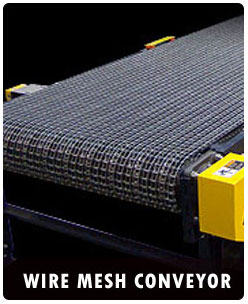
A wire mesh conveyor swaps the solid rubber or plastic belt for a woven metal one, so air, water, and heat can pass through the product from underneath, not just from above. That's the whole reason it exists: baking, drying, cooling, washing, and heat treatment all need the process to reach the product on every side, and a solid belt gets in the way of that.
It's a specific tool for a specific job. If your line just needs to move cartons from one machine to the next, a wire mesh belt is usually more than you need, a standard belt or roller conveyor does that more simply and for less money. Where it earns its keep is exactly where airflow or drainage through the belt actually matters to the process.
What the Mesh Actually Does
Wire Mesh Belt Selection
Ten decisions go into specifying a wire mesh conveyor properly. We work through these with you before quoting; none of them are one-size-fits-all.
| Parameter | Set by |
|---|---|
| Product | Food, pharma, automotive, or metal parts |
| Product temperature | Ambient, hot, or furnace-level |
| Process | Baking, drying, washing, cooling, or heat treatment |
| Mesh opening | Your smallest product dimension |
| Wire diameter | Load and temperature together |
| Belt material | SS304, SS316, carbon steel, or high-alloy |
| Belt width | Product arrangement and required throughput |
| Conveyor speed | Process dwell time |
| Conveyor length | Length of the process zone |
| Drive position | Head, centre, or sprocket drive, per layout |
On temperature specifically: how hot a wire mesh belt can run depends on the alloy, wire diameter, weave, and how it's supported and tensioned, not one number that applies everywhere. Standard SS304 covers moderate process heat; higher-alloy or refractory mesh is used for furnace-level work. Tell us your actual process temperature and we'll size the belt to it.
Technical Specifications
These are the ranges we've engineered within, not fixed limits. Final width, drive power, and temperature capability depend on belt construction, product load, process temperature, and conveyor layout.
| Belt material | SS304, SS316, carbon steel, or high-alloy, per application |
|---|---|
| Frame material | MS / SS304 / SS316 |
| Belt width | Typically 200–2,000 mm, engineered per project |
| Drive | Geared motor, VFD available |
| Power supply | 415 V, 3 phase, 50 Hz |
Wire Mesh vs PVC Belt vs Modular Belt vs Roller
Each of these does something the others don't. The right one depends on what your process actually needs, not which is generally "better."
| Requirement | Wire mesh | PVC belt | Modular belt | Roller |
|---|---|---|---|---|
| High temperature | Yes, alloy dependent | Limited | Limited to moderate | Depends on application |
| Airflow through product | Yes | No | Limited | No |
| Water drainage | Yes | Limited | Yes | Yes |
| Baking | Yes | No | Limited | No |
| Washing | Yes | Limited | Yes | Yes |
| General carton transport | Possible, usually overkill | Yes | Yes | Yes |
| Furnace-level heat | Yes, with the right alloy | No | No | Application-specific |
If your line is really just moving product from A to B with no airflow, drainage, or heat requirement, a standard belt conveyor or roller conveyor will usually do the job for less.
Where It's Used
Food Processing
Baking, frying, blanching, and cooling lines where air needs to reach the product from below.
Drying & Cooling
Product cooling tunnels and dryers where airflow through the belt speeds the process.
Washing Lines
Component or product washing where liquid needs to drain straight through.
Heat Treatment
Furnace and heat-treatment lines, with belt alloy matched to actual process temperature.
Pharmaceutical
SS304/SS316 construction for hygiene-sensitive processes; suitability confirmed against your specific requirements.
Automotive & Metal Parts
Parts washing, drying, and heat treatment lines in metalworking plants.
For food-contact applications specifically: SS304 and SS316 belts can be specified for food processing, but whether a given conveyor meets your food-contact requirements comes down to the full build, belt spec, lubricants, weld finish, and your cleaning procedure, not the belt material on its own. Happy to talk through what your process actually needs.
Why Choose Neo Conveyors
Sized to Your Process
Mesh, wire diameter, and belt alloy chosen from your actual temperature and load, not a standard catalogue spec.
In-House Fabrication
Frame and drive built at our Ghaziabad facility.
PAN India Installation
Our own engineers handle site survey, install, and commissioning.
18+ Years, 1,000+ Installations
Manufacturing conveyor systems since 2007.
FAQs
What is a wire mesh conveyor?
A wire mesh conveyor uses a woven metal belt instead of solid rubber or plastic, so air, water, and heat can pass through the product as it travels. That makes it a common choice for baking, drying, cooling, washing, and heat treatment lines where the process needs to reach the product from underneath as well as above.
How hot can a wire mesh conveyor run?
It depends entirely on the belt alloy, wire diameter, weave, and how the belt is supported and tensioned. Standard SS304 belts handle moderate process heat; higher-alloy or refractory mesh is used for furnace-level temperatures. We size the belt to your actual process temperature rather than quoting one number for every application.
Is a wire mesh conveyor food-grade?
SS304 and SS316 construction can be specified for food processing applications. Whether a specific conveyor meets your food-contact requirements depends on the full build: belt spec, lubricants used, weld finish, and your cleaning procedure, not the belt material alone. We can talk through what your process needs.
How does it compare to a PVC or modular belt conveyor?
Wire mesh allows airflow and drainage through the belt, which PVC belts don't, and handles higher temperatures than PVC or most modular plastic belts. Modular belts are often easier to service in sections. PVC or roller conveyors are usually the simpler, cheaper choice for general carton or product transport where none of that matters.
What mesh opening and wire diameter do I need?
Mesh opening is set by your smallest product dimension, small enough that it won't fall through or catch. Wire diameter is set by the load and temperature. We'll work this out with you rather than sell off a standard spec sheet.
Can it be customised for my process?
Yes, belt width, length, speed, mesh pattern, wire diameter, frame material, drive position, and inclination are all specified around your product and process.
Do you install wire mesh conveyors across India?
Yes, PAN India installation by our own engineers, alongside our other conveyor installations.
Get a Wire Mesh Conveyor Sized to Your Process
Share your product, process temperature, and what the belt needs to do, bake, dry, cool, wash, or heat-treat. We'll recommend the mesh, alloy, and drive that actually fit.