Assembly Line Conveyors: Types, Layout and How to Choose
Neo Conveyors, Ghaziabad · Published 19th OCT 2026
A conveyor decides the pace of an assembly line. If it moves too fast, operators miss steps. If it moves too slow, people stand idle. If the wrong type is chosen, parts get scratched, pallets jam or the line can't be changed when the product changes. This guide covers how to match a conveyor to your product and your line, and what to settle before you ask for a quote.
What an assembly line conveyor does
It carries a product, or a pallet holding the product, from one work station to the next at a controlled pace. On a good line it also does three other jobs:
- holds the product at a fixed height so operators don't bend or reach
- buffers work in progress so one slow station doesn't stop the whole line
- delivers finished units to testing, packing or dispatch
Conveyor types used on assembly lines
| Type | Works well for | Watch out for |
|---|---|---|
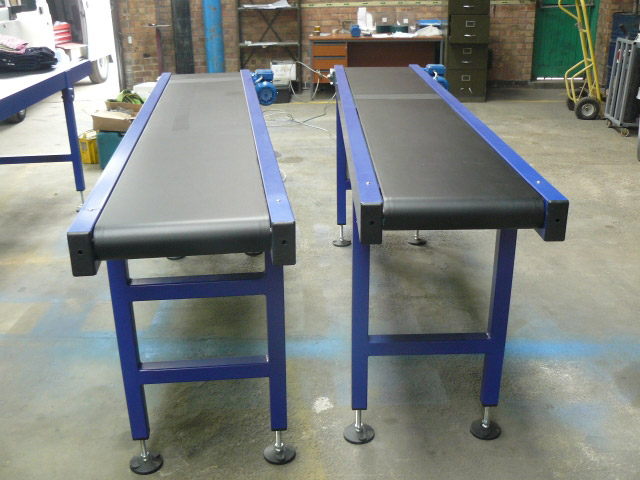
| Flat belt conveyor | Light products, electronics, small appliances, packed goods | Heavy or sharp parts can damage the belt |
| Modular plastic belt | Products that need a non-marring surface, washdown areas, curves | Higher belt cost than PVC |
| Roller conveyor (gravity) | Boxes and flat-bottom parts moved by hand between stations | Needs a slight slope, no speed control |
| Powered roller conveyor | Cartons, totes, accumulation between stations | Not suited to loose or soft items |
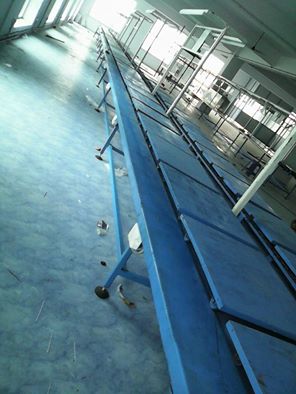
| Slat or chain conveyor | Heavy assemblies, engines, panels, items with uneven bases | Heavier frame, more maintenance |
| Pallet or twin-chain conveyor | Products on fixtures or pallets that must stop for precise work | Needs stoppers and a return path |
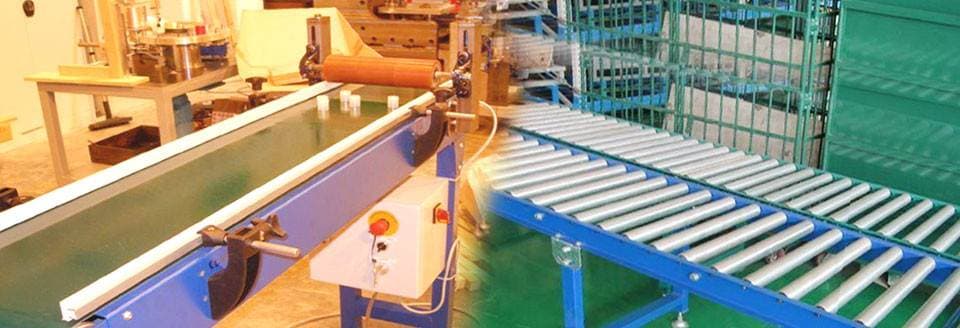
Most lines mix two or three of these. A powered roller infeed, a belt through the work stations, and a roller accumulation zone at the end is a common pattern. You can see our range on the belt conveyor and roller conveyor pages.
Start with takt time, not belt speed
Takt time is the time available per unit to meet demand.
Takt time = available working time ÷ units required
Example: a shift has 8 hours, with about 7 hours of real working time after breaks. That is 25,200 seconds. If you need 840 units a shift, takt time is 30 seconds. Each station must finish its task within 30 seconds, and the conveyor must present a new unit every 30 seconds.
Belt speed then follows from station pitch:
Belt speed = station pitch ÷ takt time
With stations 1.5 m apart and a 30-second takt, the belt runs at 3 m/min. Manual assembly lines usually run slowly, often in the range of a few metres per minute, because operators work on the product while it moves. Fast belts are for transfer and packing, not for hands-on assembly.
Station layout
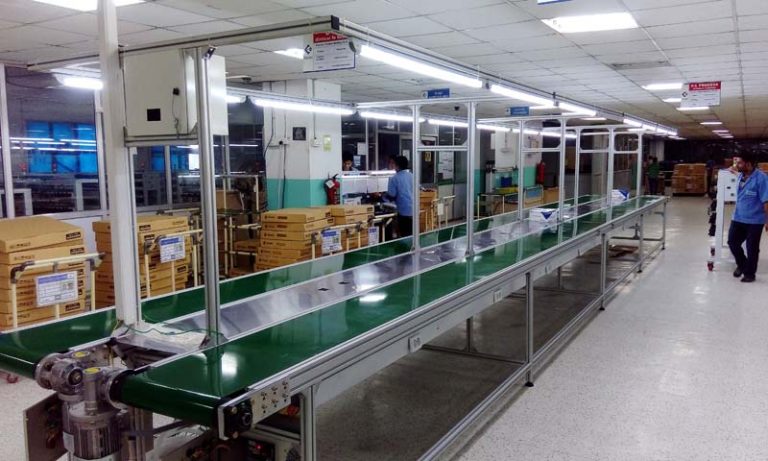
- Station pitch: allow roughly 1.2 to 2 m per operator, more for bulky products or if tools and bins sit beside the line.
- Working height: most seated or standing assembly work is comfortable at about 750 to 900 mm. Pick the height for your tallest regular operator and add a platform for shorter ones.
- Belt width: product width plus clearance, and no wider than an operator can comfortably reach across, usually under 700 to 800 mm for two-sided work.
- Side access: keep one side free for material feeding and one for the operator, with a clear aisle behind.
- Accumulation: a short buffer zone before test or packing stations keeps a slow inspection from backing up the whole line.
Fixed speed or variable speed
A fixed-speed drive is cheaper and fine if your product and demand are stable. If you run several models or your volumes change by season, ask for a VFD (variable frequency drive). It lets you adjust speed without changing the conveyor. We also recommend a start/stop at each station on lines where operators need to pause the belt.
Controls and safety
- emergency stop pull cord or buttons along the line
- guards on drive and tail pulleys
- stoppers and sensors if you use pallets or fixtures
- cable and light fittings mounted on the frame so the work surface stays clear
Mistakes we see often
- Choosing speed first. Work out takt time and station pitch, then set the speed.
- Ignoring the return path. Pallet and fixture lines need a way back to the start.
- Frame height wrong for the operator. Fixing this later means modifying legs on every section.
- No room to grow. Leave space at the end of the line and choose a frame that accepts extra sections.
- Wrong belt surface. Painted parts, glass, electronics and food all need different belt materials.
What to send us for a quote
To get a layout and price instead of a generic reply, send:
- product size, weight and base shape
- target units per shift and shift length
- number of operators and stations
- line length available and floor type
- any special need such as ESD safe, washdown, or heat
Cost factors
Price depends on the line length, frame material (mild steel, powder coated or stainless), belt or roller type, drive and control package, and the number of accessories such as stoppers, lights and work tables. Installation and site conditions also affect the final figure.
FAQs
What is the best conveyor for an assembly line?
It depends on the product. Belt conveyors suit light and medium parts, roller conveyors suit cartons and totes, and slat or pallet conveyors suit heavy items or fixture-based work.
How fast should an assembly line conveyor run?
Work it out from takt time and station pitch. Manual assembly is usually slow, a few metres per minute, while transfer sections can run faster.
Can the conveyor speed be adjusted?
Yes, with a VFD on the drive motor.
What working height should I choose?
Around 750 to 900 mm suits most manual work. Adjust for the operators and the product.
Can you extend the line later?
Yes, if the frame is built in sections and the drive is sized with spare capacity. Tell us your growth plan up front.
Do you install in other cities?
We install across India with our own team.
Next step
Share your product details, target output and floor space and we'll suggest a layout, conveyor type and drive. Contact us or message us on WhatsApp.
Recent Posts