Belt Bucket Elevator Conveyor Manufacturer in India: Efficient Vertical Material Handling Solutions
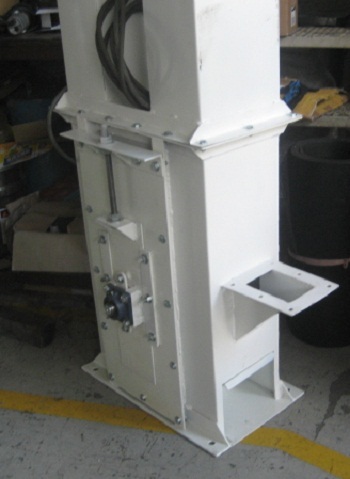
Most bucket elevators sold in India are belt type — not because it's the only option, but because for the majority of materials it's the most economical way to lift bulk product vertically without over-engineering the job. Understanding what actually goes into a belt-type elevator, rather than treating "belt" as just a cheaper alternative to chain, is what separates a unit that runs for a decade from one that needs its belt replaced every year.
This is a closer look at the mechanics: how belt-type elevators are built, what determines belt life, and where the design starts to run into its limits.
What sets a belt-type bucket elevator apart
In a belt bucket elevator, buckets are bolted directly to a rubber-reinforced conveyor belt running over head and boot pulleys, rather than mounted on chain and sprockets. That single difference in drive medium changes almost everything downstream — cost, weight, noise level, and the maintenance profile of the whole machine.
Why belt over chain, where the material allows it:
- Lower capital cost — a rubber belt is significantly cheaper to manufacture and install than a forged steel chain and sprocket assembly of equivalent capacity
- Lighter overall structure — less dead weight on the head and boot pulleys means smaller bearings, lighter support steel, and a lower foundation load
- Quieter operation — belts run smoother and quieter than chain over sprockets, which matters in plants where noise levels are a workplace consideration
- Simpler maintenance — belt splicing and bucket replacement are more straightforward field operations than chain link replacement, and don't require specialised chain-pulling tools
The trade-off is straightforward too: belt-type elevators are generally limited to ambient-temperature applications up to around 80°C, and to material that isn't severely abrasive. Push past either limit and the belt degrades faster than the cost savings justify — which is exactly where chain-type construction takes over.
Belt selection: the decision that determines service life
Not all conveyor belting is interchangeable, and the belt is the single component most responsible for how long a belt-type elevator runs without unplanned downtime.
- Ply rating and carcass construction — determines tensile strength and how well the belt resists stretch under load; under-specified for the lift height and bucket loading, and the belt will elongate and require constant re-tensioning
- Cover compound — abrasion-resistant, oil-resistant, or heat-resistant covers exist for a reason; a standard cover on an abrasive material like sand or cement wears through at the bucket bolt line long before the carcass fails
- Belt thickness and width — sized against bucket width and spacing, not chosen independently — an undersized belt width relative to bucket size creates uneven loading across the belt face
Ask a manufacturer which belt grade they specify by default versus what's available as an upgrade. A manufacturer defaulting to the cheapest general-purpose belt on every project, regardless of material, is optimising for their margin rather than your uptime.
Bucket attachment: bolted vs. vulcanized
Buckets on a belt-type elevator are attached one of two ways, and the choice affects both initial cost and long-term maintenance:
- Bolted attachment — buckets are bolted through the belt with backing plates. Easier to replace individual damaged buckets in the field, but bolt holes are a stress point where the belt can eventually tear if over-tensioned or overloaded.
- Vulcanized/moulded attachment — buckets are bonded to the belt during manufacture. Stronger overall belt integrity with no bolt-hole stress points, but replacing a single damaged bucket typically means replacing that section of belt rather than just the bucket.
Neither is universally "better" — bolted attachment suits applications where individual bucket damage from oversized lumps is a realistic risk, while vulcanized construction suits cleaner, more consistent material flow where the belt's structural integrity matters more than field-repairability.
Splicing, tensioning, and tracking — the three things that actually fail
Almost every belt-type bucket elevator problem traces back to one of these three areas:
Splice quality. The belt joint is the weakest point on any belt-type elevator. A poorly executed splice — whether mechanical fastener or vulcanized — is where premature failure usually starts, often well before the belt body itself would need replacing.
Take-up tensioning. The take-up pulley at the boot maintains correct belt tension. Too loose, and the belt slips at the head pulley under load, losing throughput and accelerating pulley lagging wear; too tight, and bearing load and belt stretch both increase. Tension should be checked on a schedule, not only when slippage becomes visible.
Tracking and alignment. A belt that isn't tracking centrally over the head and boot pulleys wears unevenly at one edge and can eventually run off the pulley face entirely. Pulley alignment, not just belt condition, is usually the actual root cause when tracking drifts over time. (For a broader look at the maintenance habits that prevent exactly this kind of issue across any conveyor — not just bucket elevators — see Top 7 Tips to Keep Your Conveyor System Running.)
Where belt-type elevators are the right call
Belt-type construction, generally paired with centrifugal discharge for free-flowing material, covers the majority of standard industrial lifting needs:
- Grain, rice, and pulses in agro-processing
- Cement powder and fly ash at ambient temperature
- Fertilizer granules such as urea, DAP, and potash
- Sugar, salt, and general food-grade powders (in SS belt variants)
Where belt-type reaches its limit
Two conditions push a design out of belt-type territory and into chain-type construction instead:
- Temperature above roughly 80°C — rubber belting degrades progressively at sustained high heat, which is why hot clinker, high-temperature ash, and similar material require a forged steel chain drive rated up to 250°C instead
- Heavy abrasion or large, sharp-edged lumps — material like raw limestone or pet coke wears through belt cover and bucket-mounting points far faster than a chain-driven system, where wear is absorbed by replaceable chain links rather than the belt itself
A manufacturer recommending belt-type construction for a hot-clinker or heavy-mineral application is either underselling the application's demands or trying to win the quote on price rather than engineering fit — worth pushing back on either way.
Final thoughts
Belt-type bucket elevators are the right, cost-effective choice for the large majority of ambient-temperature, moderately abrasive bulk materials — but only when the belt grade, bucket attachment method, and tensioning system are specified against your actual material and duty cycle, not pulled from a standard size chart. The belt is simultaneously the cheapest part of the system to under-specify and the most expensive part to keep replacing if that happens.
Neo Conveyors manufactures belt-type bucket elevators engineered around your material's bulk density, temperature, and required capacity, alongside chain-type construction for applications that exceed belt-type limits. Get in touch with your material and lift requirements for a free capacity calculation and belt/chain recommendation.
Related reading
- Bucket Elevators Explained: Types, Components & How to Choose the Right Manufacturer
- Bucket Elevator Manufacturer in India: Types, Applications & Capacity Guide
- Benefits of Bucket Elevators for Bulk Materials Handling
Recent Posts