Conveyor Manufacturer in India: Complete Buyer's Guide

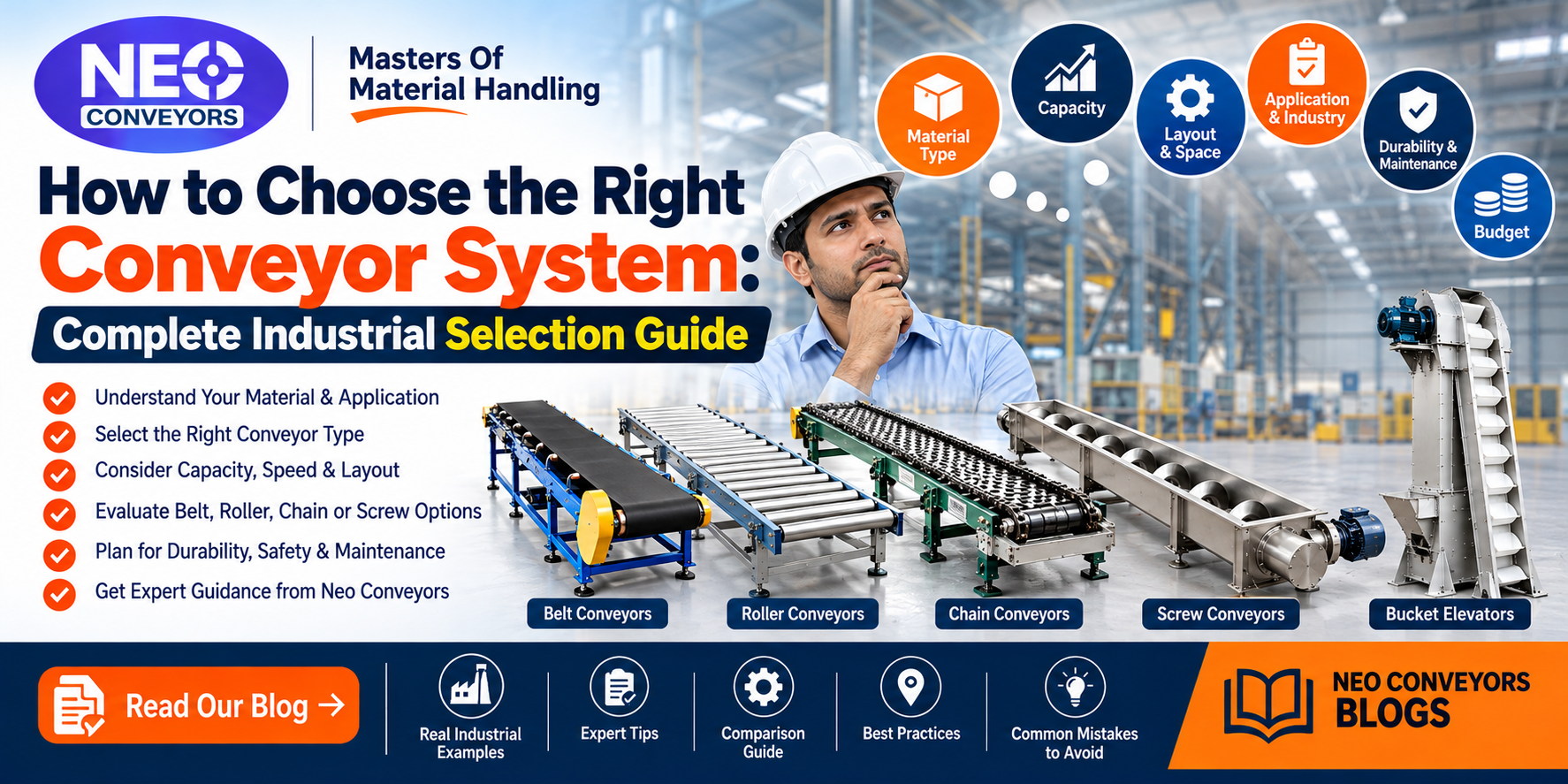
"Conveyor" covers more ground than most buyers realise. A conveyor moving 40-kg cartons across a warehouse floor and a conveyor lifting red-hot clinker out of a cement kiln are solving completely different problems — different belts, different drives, sometimes no belt at all. Searching for "conveyor manufacturer in India" without first knowing which category you need is how buyers end up with a quote for the wrong machine.
This guide walks through every major conveyor type manufactured in India today, what each is actually built for, and what separates a manufacturer worth trusting with your plant from one that will just quote off a catalogue. Use it as a map, then go deeper on the specific product page that matches your application.
How to use this guide
Jump to the category that matches your material and application:
- Belt conveyors — general-purpose horizontal and inclined movement
- Roller conveyors — pallets, cartons, drums
- Chain and drag chain conveyors — heavy loads, enclosed bulk handling
- Screw conveyors — powders and granules, horizontal to vertical
- Slat chain conveyors — hot, heavy, or sharp-edged products
- Apron conveyors — extreme-duty bulk material
- Bucket elevators — vertical lifting of bulk material
- Conveyor components — pulleys, idlers, and other parts
- How to choose a manufacturer
Belt conveyors
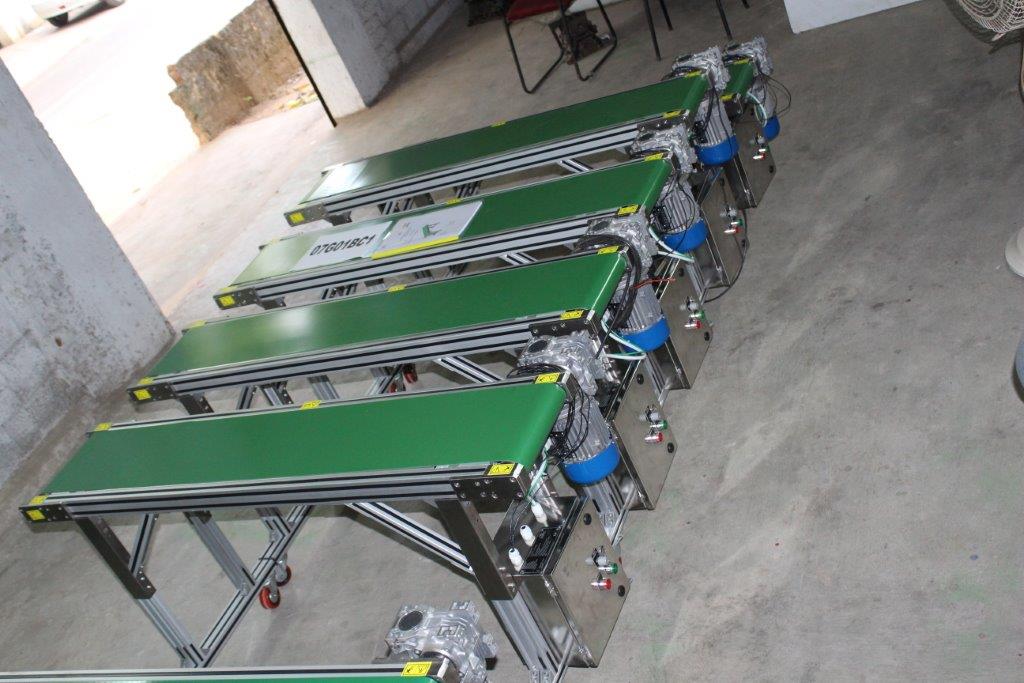
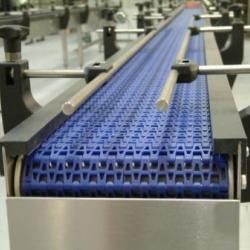
The default choice for moving bulk or packaged material horizontally or at a moderate incline. A rubber, PVC, or fabric belt runs over pulleys and idlers, carrying material or cartons from one point to another.
Within belt conveyors, Neo Conveyors builds several sub-types for specific jobs:
- Horizontal and inclined belt conveyors — the general-purpose workhorse across FMCG, food, cement, and chemical plants
- Trough belt conveyors — troughed profile for high-tonnage bulk material like coal, ore, or limestone
- Telescopic belt conveyors — extendable boom conveyors for loading trucks and containers
- Loading/unloading (truck loader) conveyors — mobile or fixed units for dispatch bays
- Radial stackers — for stockpiling sand, aggregate, and gravel
Best for: general material movement, FMCG, warehousing, cement, chemicals, food processing. Not ideal for: very hot materials, large sharp-edged lumps, or loads that would damage a belt surface — that's where chain, slat, or apron conveyors take over.
Roller conveyors
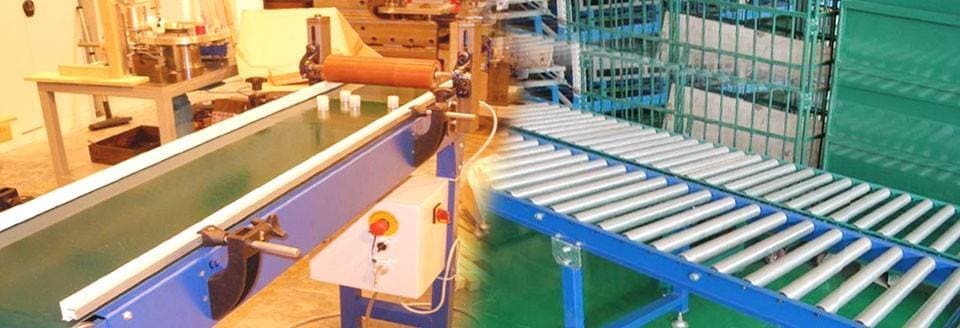
Built around a series of rotating rollers rather than a continuous belt, roller conveyors are the standard for moving cartons, pallets, drums, and other unit loads through warehouses and production lines.
- Powered roller conveyors — driven rollers for heavier pallet and drum handling, typically fed by a forklift or automated system
- Free (gravity) roller conveyors — non-powered, for lighter loads moved manually or by gravity on an incline
Best for: pallets, cartons, drums, warehouse and dispatch operations. Not ideal for: loose bulk material or powders — that needs belt, screw, or drag chain systems instead.
Chain and drag chain conveyors
Where a belt would slip, burn, or wear out, chain-driven systems take over. Chain conveyors use a positively driven chain to move heavier unit loads — engine blocks, transmissions, pallets — without relying on friction.
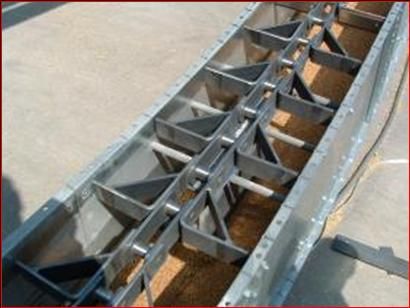
Drag chain conveyors go a step further for bulk solids: material moves through an enclosed trough, dragged by a chain fitted with flights, which keeps dust and spillage contained. These are common in cement, coal, and fertiliser plants handling clinker, ash, or powdered material.
Best for: heavy unit loads (chain conveyor) or enclosed, dust-controlled bulk handling (drag chain conveyor). Not ideal for: light packaged goods, where a roller or belt conveyor is cheaper and simpler.
Screw conveyors
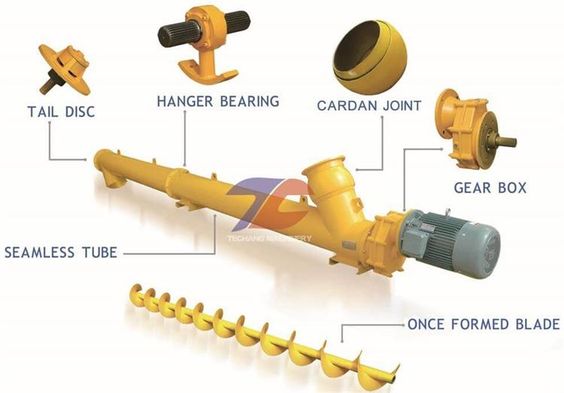
A rotating helical screw inside a tube or trough moves powders, granules, and semi-solids — horizontally, on an incline, or fully vertical. Screw conveyors are compact and fully enclosed, which makes them the standard choice wherever dust control matters.
- U-trough screw conveyors — for horizontal and lightly inclined runs
- Vertical screw conveyors — for lifting bulk material where floor space for a bucket elevator isn't available
Best for: cement, food processing, chemicals, pharma, and any powder or granule that needs enclosed, dust-free transport. Not ideal for: large lumps or abrasive material at high tonnage — screw flights wear quickly under that load.
Slat chain conveyors
Built with metal (MS or SS) slats mounted on roller chain, slat chain conveyors handle products that would damage a belt — bottles, cans, hot components, or sharp-edged auto parts moving through an assembly line.
Best for: bottling lines, can handling, automotive assembly, hot or abrasive unit loads. Not ideal for: loose bulk powders or granules.
Apron conveyors
The heavy-duty end of the spectrum. Apron conveyors carry material on overlapping steel pans bolted to forged chain — no belt to burn, puncture, or tear. This is the go-to choice for iron ore, limestone, cement clinker straight off a kiln, hot castings, and other loads that would destroy a rubber belt within a shift.
Best for: high-temperature, large-lump, or highly abrasive bulk material. Not ideal for: lighter loads or budget-sensitive projects, where a belt or drag chain conveyor does the job for less.
Bucket elevators
For moving bulk material straight up — into a silo, hopper, or overhead bin — bucket elevators are the standard solution across grain, cement, chemical, and mineral handling.
- Centrifugal discharge bucket elevators — for free-flowing granular material like grain, sand, and small aggregates
- Continuous discharge bucket elevators — gentler handling for fragile or friable material like sugar and fine chemicals
Best for: vertical lifting of bulk material in a small floor footprint. Not ideal for: horizontal transport over distance — that's a belt, chain, or screw conveyor's job.
(For a full breakdown of types and how to choose a supplier, see our dedicated guide: Bucket Elevators Explained.)
Conveyor components: idlers and pulleys
Beyond the conveyor itself, the components holding it together determine most of its reliability:
- Conveyor pulleys — head, tail, snub, bend, and take-up pulleys that drive and guide the belt
- Conveyor idlers — carrying, return, impact, and self-aligning idlers that support and align the belt along its run
A conveyor system is only as reliable as its weakest pulley or idler, so it's worth sourcing these from the same manufacturer engineering the conveyor itself, rather than mixing in generic parts. (See our buyer's checklist for selecting a conveyor pulley for what to check before you buy.)
Neo Conveyors also manufactures several additional systems not covered in depth above, including wire mesh conveyors, magnetic conveyors, modular slat chain conveyors, and ribbon blenders — see the full product range for the complete list.
How to choose a conveyor manufacturer in India
Once you know which category fits your application, the manufacturer decision comes down to a few consistent factors regardless of conveyor type:
1. Application-specific engineering, not catalogue sizing. A manufacturer who asks about your material's bulk density, particle size, temperature, and required throughput before quoting is a better sign than one who quotes off a single phone call.
2. Track record in your industry. Grain handling, cement, and chemical plants each have different regulatory, hygiene, or abrasion-resistance requirements. Ask for references specific to your sector.
3. Component quality. Belt grade, chain strength, pulley lagging, and bearing seals determine service life more than the overall structure does. Ask what's used by default, not just what's available as an upgrade.
4. Customisation capability. Plant layouts, heights, and material characteristics vary — a manufacturer building to a fixed size chart will fit your space poorly. Look for a design process that starts with your requirements.
5. After-sales support and spares. Conveyors run continuously in most plants. Confirm installation support, spares lead time, and whether the manufacturer offers commissioning assistance.
6. Certifications and compliance. ISO certification and adherence to recognised design standards (CEMA, DIN, or equivalent) are reasonable proxies for engineering discipline, especially on pulleys, drives, and structural components.
Industries Neo Conveyors serves
Neo Conveyors, established in 2007 and based in Ghaziabad, Uttar Pradesh, designs and manufactures across this full range for industries including cement, food processing, chemicals, fertilisers, mining and minerals, FMCG, warehousing, and automotive — supplying clients across India and exporting to markets including Dubai, Uganda, Costa Rica, and Nigeria.
Frequently asked questions
Which conveyor type is cheapest? Roller and basic belt conveyors are typically the lowest-cost options for standard applications. Cost rises with enclosure requirements (screw, drag chain), heat/abrasion resistance (apron, slat chain), or vertical lift (bucket elevator).
Can one manufacturer supply multiple conveyor types for a single plant? Yes — most plants combine several types (e.g., a bucket elevator feeding a screw conveyor feeding a belt conveyor), and sourcing them from one manufacturer simplifies component compatibility and after-sales support.
How do I know if I need a belt conveyor or a screw conveyor? If the material is a free-flowing powder or granule and dust control matters, a screw conveyor's enclosed design usually wins. For unit loads, mixed materials, or longer horizontal runs, a belt conveyor is typically more practical and cheaper.
Final thoughts
There's no single "best" conveyor — only the right type for your material, layout, and duty cycle. Use the category breakdowns above to narrow down what you actually need, then bring your material specifics (bulk density, temperature, throughput, particle size) to a manufacturer conversation rather than asking for a generic quote.
Neo Conveyors designs and manufactures across the full conveyor range covered in this guide — explore the complete product catalogue or get in touch with your application details for a proper recommendation.