How Chain Conveyors Improve Efficiency in Industrial Processes — A Complete Guide
Introduction — The Quiet Workhorse of Indian Industry
Walk through almost any major industrial plant in India — a cement facility in Rajasthan, a car assembly plant in Manesar, a grain processing unit in Punjab, or a distribution warehouse in Greater Noida — and you will find chain conveyors working silently in the background, moving heavy materials continuously, reliably, and automatically.
Yet chain conveyors rarely receive the recognition they deserve. In the material handling industry, the spotlight tends to fall on high-speed sortation systems, telescopic loading conveyors, or automated assembly lines. The chain conveyor — the system that often makes all of these possible by moving raw material, bulk product, or heavy components into and out of every stage of the process — gets treated as infrastructure rather than innovation.
This guide by Neo Conveyors — manufacturers of industrial conveyor systems in Ghaziabad since 2007, with over 1,000 installations across India — explains exactly how chain conveyor systems improve efficiency, which industries benefit most, what types of chain conveyors are available, and how to choose the right system for your plant. Need the full picture of all our material handling solutions? Browse our complete product range →
1. What Is a Chain Conveyor? — And Why Is It Different from a Belt Conveyor?
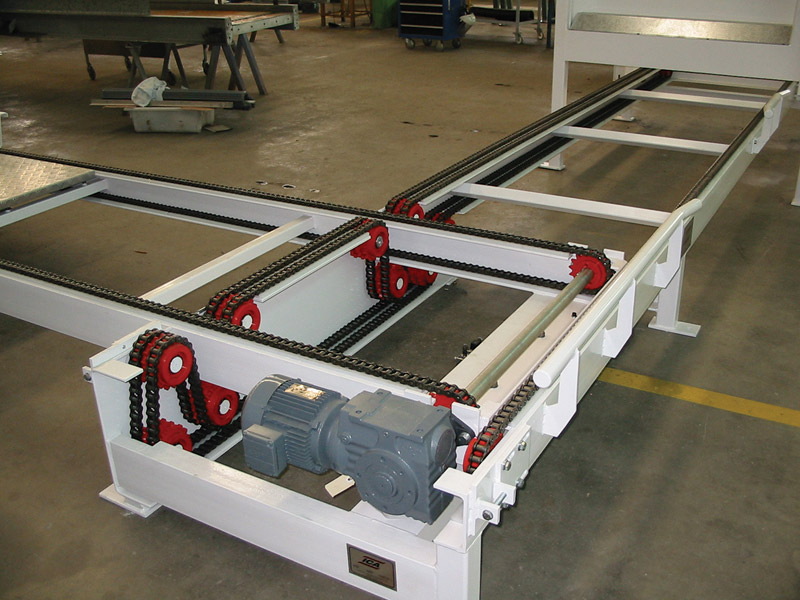
A chain conveyor is a material handling system that uses one or more chains — either a single strand, double strand, or multiple parallel strands — as the carrying mechanism, instead of the continuous flexible belt used in a belt conveyor system. Attachments such as flights, slats, pans, or hooks are fixed to the chain links to carry the material, while the chain itself is driven by a powered sprocket at the head end and returns on the underside of the conveyor frame.
The fundamental advantage of this construction over a belt is strength. A well-engineered chain can exert far greater tensile force than any belt, making chain conveyors the natural choice wherever loads are heavy, abrasive, hot, or irregular in shape — conditions that would rapidly destroy a standard rubber or PVC belt. While belt conveyors and roller conveyors are ideal for packaged goods and moderate loads, chain conveyors dominate in the heaviest and most demanding industrial applications.
Key Technical Characteristics of Chain Conveyors
|
Parameter |
Typical Chain Conveyor Specification |
|
Chain type |
Roller chain, leaf chain, drag chain, slat chain |
|
Load capacity |
500 kg/m to 5,000+ kg/m depending on chain grade |
|
Operating temperature |
–20°C to 350°C (with appropriate chain material) |
|
Speed range |
0.05 – 1.0 m/s (typically slower than belt conveyors) |
|
Drive motor |
VFD-controlled for variable speed and soft start |
|
Frame material |
Mild steel, galvanised, or SS for corrosive environments |
|
Typical length |
2 m to 100 m+ depending on application |
💡 Neo Conveyors Expert Tip: At Neo Conveyors, we size every chain conveyor to the actual load conditions of your plant — not to a standard catalogue specification. Oversized chain is wasted cost; undersized chain fails prematurely. Correct engineering from the start is the difference. Contact our engineers →
2. Types of Chain Conveyors — Choosing the Right Variant for Your Application
The term 'chain conveyor' covers a family of distinct designs, each optimised for different materials, loads, and environments. Understanding the differences is essential for correct specification. Visit our chain and slat conveyor product page for full technical specifications and customisation options.
2.1 Drag Chain Conveyor
A drag chain conveyor uses one or more chains with attached flights or scrapers to drag bulk material along the bottom of an enclosed trough. There is no separate carrying surface — the material itself sits in the trough and is pushed forward by the chain flights. This makes drag chain conveyors exceptionally well-suited for granular and powder bulk materials such as grain, fertiliser, fly ash, coal fines, and cement clinker. The enclosed design prevents dust emission and protects the material from contamination. For comparison with another bulk material handling option, see our guide: What Are Bucket Elevators? →
2.2 Slat Chain Conveyor
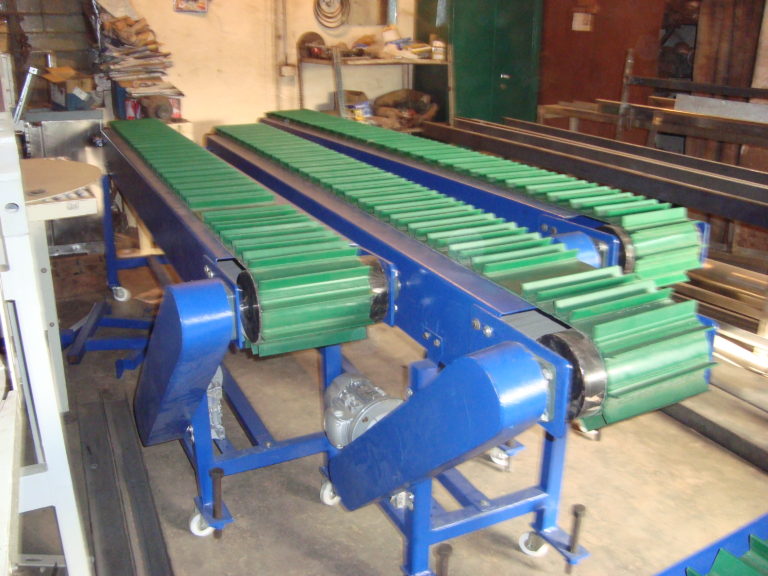
A slat chain conveyor uses chains with rigid slat panels (typically steel, aluminium, or plastic) attached between the chain links to form a flat or slightly contoured carrying surface. The slats provide a stable, solid platform for carrying discrete items — heavy boxes, automotive engine blocks, drums, pallet loads, or bottles and cans in food and beverage lines. Our slat chain conveyors are available in widths from 300 mm to 1,200 mm and are a standard solution in automotive assembly and food production applications.
2.3 En-Masse Chain Conveyor
An en-masse conveyor uses a chain with overlapping paddles or flights moving through a closely fitted casing. Rather than dragging material, the chain moves slowly through the bulk material, carrying the entire mass of material forward in one body (en masse). This design is particularly gentle on friable materials, very energy-efficient, and can transport on inclines up to 75 degrees. En-masse conveyors are widely used in grain handling, seed processing, and milling operations. For more on efficient bulk material handling, read our blog on the right type of heavy duty conveyor for industrial applications →
2.4 Apron (Pan) Chain Conveyor
An apron conveyor uses overlapping metal pans or plates carried on chains to form a continuous carrying surface. The overlapping pans prevent material falling through the conveyor, making apron conveyors suitable for very coarse, sharp, or hot materials — including freshly crushed ore, castings from foundry operations, and hot clinker from cement kilns. Apron conveyors can handle loads that would rapidly destroy any belt conveyor and operate reliably at temperatures that would melt conventional belting.
3. How Chain Conveyors Improve Industrial Efficiency — 6 Proven Ways
The case for chain conveyor adoption in heavy industrial applications goes beyond simple material movement. Here is how chain conveyors deliver measurable efficiency improvements across the plants where Neo Conveyors has installed them. For broader context on choosing the right system, read our guide: How to Choose the Right Conveyor Solution →
3.1 Eliminating Bottlenecks in Heavy Material Flow
In plants handling bulk or heavy materials — cement, aggregate, grain, castings — manual handling or inadequate conveyor capacity creates bottlenecks that limit the throughput of the entire plant. A correctly specified chain conveyor system provides continuous, controlled material flow at the exact rate the process demands, eliminating the queue-and-burst cycle that characterises under-automated facilities. The result is higher and more consistent plant output — directly increasing revenue per operating hour.
3.2 Reducing Labour Dependency and Cost
Chain conveyors automate the movement of materials that would otherwise require multiple workers to lift, carry, or wheel through the facility. For heavy bags, drums, auto components, or bulk grain, this is not just a cost saving — it is a safety improvement. In our experience across warehousing, automotive, and FMCG installations, chain conveyor automation typically reduces material handling labour requirements by 40–60% within the conveyor's zone of operation.
3.3 Surviving Conditions That Destroy Other Conveyors
Hot clinker, sharp aggregate, abrasive coal, chemical-contaminated waste, wet foundry sand — these are materials that destroy belt conveyors and roller conveyors rapidly. Chain conveyors, engineered with the appropriate chain grade, material-contact surface, and lubrication system, operate continuously in these conditions for years with minimal wear. The longer service life directly reduces maintenance cost and the capital cost of premature replacement.
3.4 Enabling Precise Process Integration
Modern chain conveyors are equipped with variable-frequency drives (VFDs) that allow the conveyor speed — and therefore the material feed rate — to be adjusted precisely and continuously under PLC or DCS control. This allows chain conveyors to function not just as transport systems but as active components in process control, feeding material into mills, mixers, kilns, or packaging stations at exactly the rate the process requires. For a related perspective on integration in bulk material systems, see our blog: Advantages of Screw Conveyor →
3.5 Minimising Maintenance Downtime
Compared to belt conveyors of equivalent capacity, chain conveyors require simpler maintenance: chain lubrication, periodic sprocket inspection, and chain tension adjustment. There is no belt to re-splice, no lagging to replace, and no alignment system to manage. With a structured preventive maintenance programme — or an AMC from Neo Conveyors — chain conveyors in normal industrial service operate reliably for 10–15 years with minimal unplanned downtime.
3.6 Space-Efficient Layout Options
Chain conveyors can be designed to carry material horizontally, on inclines, on declines, around corners (with appropriate sprocket arrangements), and even vertically in some configurations. This layout flexibility allows plant designers to route material handling systems through available space rather than redesigning the building around the conveyor. The combination of chain conveyors with bucket elevators for vertical elevation and screw conveyors for enclosed horizontal transport gives process engineers a complete bulk material handling toolkit.
4. Industries Where Chain Conveyors Deliver the Greatest Efficiency Gains
|
Industry |
Primary Application |
Chain Conveyor Type |
Key Efficiency Gain |
|
Cement & Mining |
Clinker, limestone, coal transport |
Apron conveyor, drag chain |
Handles hot/abrasive loads; continuous operation |
|
Automobile Manufacturing |
Engine blocks, body panels, heavy components |
Slat chain conveyor |
Precision indexing; assembly line synchronisation |
|
FMCG & Food Processing |
Packaged goods, cans, bottles, trays |
Slat chain conveyor (SS) |
Hygienic; handles irregular shaped items |
|
Warehousing & Distribution |
Pallet and heavy carton transport |
Slat/apron chain conveyor |
Handles 500–2,000 kg loads reliably |
|
Grain & Agricultural Processing |
Grain, seeds, pulses, flour |
Drag chain, en-masse |
Enclosed; gentle on fragile grain |
|
Steel & Foundry |
Hot castings, scrap, slag |
Apron conveyor (heavy duty) |
Survives extreme heat and abrasion |
|
Waste & Recycling |
Municipal solid waste, RDF, biomass |
Drag chain conveyor |
Handles irregular, mixed, and sticky materials |
5. How to Choose the Right Chain Conveyor for Your Plant
Selecting a chain conveyor correctly requires answers to five questions. Get them right before approaching any manufacturer, and you will receive quotations that match your actual requirements rather than generic catalogue specifications. For a broader decision-making guide, read: How to Choose the Right Conveyor Solution →
• What material are you conveying? Bulk granular, discrete heavy items, hot materials, or sticky/wet product each point to different chain conveyor types.
• What is the required throughput? Tonnes per hour for bulk materials; items per minute for discrete loads. Over-specify by 15–20% for future growth.
• What is the conveyor layout? Length, incline angle (if any), number of corners, and feed/discharge point locations determine chain type and drive configuration.
• What are the environmental conditions? Temperature, dust, moisture, and chemical exposure determine chain grade, frame material, and lubrication system.
• What are your after-sales requirements? Spare parts availability, AMC coverage, and service response time determine the total cost of ownership over the conveyor's working life. Ask Neo Conveyors about our AMC plans →
💡 Neo Conveyors Expert Tip: Neo Conveyors provides a free engineering consultation for all new chain conveyor projects. Our Graduate Engineer team assesses your material, layout, and process requirements and recommends the optimal chain conveyor specification — at no cost and with no commitment. Book your free consultation →
6. Related Products & Further Reading
Explore the complete Neo Conveyors material handling range to find the best combination for your plant:
Related Products
• Chain & Slat Conveyors — View Specifications & Request a Quote →
• Apron Conveyors — For Hot, Abrasive & Very Heavy Materials →
• Screw Conveyors — Enclosed Bulk Powder & Granule Transport →
• Bucket Elevators — Vertical Transport for Bulk Materials →
• Belt Conveyors — Flat, Inclined, Modular & Cleated Designs →
• Loading & Unloading Conveyors — Dock-Side Material Handling →
• Browse All Conveyor Products →
Related Blogs
• The Right Type of Heavy Duty Conveyor for Industrial Applications →
• Advantages of Screw Conveyor — When to Choose a Screw →
• How to Choose the Right Conveyor Solution →
• What Are Bucket Elevators? →
• Why Does a Bucket Elevator Throw Back or Return Excess Material? →
• Telescopic Belt Conveyor Manufacturer in India →
• Truck Loader Conveyor — Loading and Unloading Guide →
• Inclined Belt Conveyor — Efficient Vertical Material Movement →
• View All Blogs & Technical Resources →
Conclusion — Chain Conveyors Are Not Just Machines. They Are Efficiency Multipliers.
Chain conveyors have earned their place at the heart of India's most demanding industrial processes — not through clever marketing, but through decades of reliable performance in conditions that defeat every other conveyor technology. From drag chain systems moving grain in Punjab to heavy-duty apron conveyors carrying hot clinker in Rajasthan's cement plants to slat chain lines running automotive components through Manesar's assembly facilities — chain conveyors are the infrastructure of industrial efficiency.
At Neo Conveyors, we have designed, manufactured, and installed chain conveyor systems across India since 2007. Our team of Graduate Engineers begins every project with your material, your layout, and your operational goals — and designs a chain conveyor system that delivers measurable, long-term performance.
We offer a free site survey, a fully engineered quotation, professional installation, and ongoing maintenance support through our Annual Maintenance Contract (AMC) programme. Download our full product catalogue or contact us today to get started.
📞 Contact Neo Conveyors: G-414, UPSIDC Phase II, Ghaziabad, UP | Call / WhatsApp: +91-9654112235 | neoconveyors.com/contact | neoconveyors@yahoo.com | View Chain Conveyor Products →
Recent Posts