Belt Conveyor Systems: Types, Working Principle, Design, Capacity & Applications
The belt conveyor is the default answer to "how do we move this from A to B" across nearly every industry — because for most materials and most layouts, it's simply the most flexible and cost-effective way to do it. But "belt conveyor" isn't one machine; it's a category covering flat, inclined, troughed, and roller bed designs, each suited to a different material and layout, sized against capacity and belt width calculations that determine whether the conveyor you buy actually does the job.
This guide covers how belt conveyors work, the main types, the calculations behind capacity and belt width, motor selection, applications, maintenance, and what actually drives the price — everything you need before a belt conveyor manufacturer conversation.
What is a belt conveyor?
A belt conveyor is a continuous loop of belting stretched between two or more pulleys, driven by a motor, that carries material or packaged goods along its length. It's the most widely used conveying method in industrial material handling because a single design principle — a moving belt surface — adapts to an enormous range of materials, loads, and layouts simply by changing belt type, width, incline, and support structure.
Belt conveyor working principle
A drive pulley, powered by a motor and gearbox, rotates and grips the belt through friction, pulling it forward. A tail pulley at the opposite end returns the belt, while idlers or a slider bed support the belt's carrying and return runs along its length. Material is loaded onto the belt — usually at the tail end via a chute or hopper — and travels with the belt to the discharge point at the head pulley, where it either falls off the end or is diverted by a plough or chute along the way.
Belt tension is maintained by a take-up assembly, typically at the tail end, which keeps the belt taut enough to grip the drive pulley without slipping, while not so tight that it overloads bearings and accelerates wear.
Main components
- Belt — the load-carrying surface; rubber, PVC, PU, or fabric-reinforced depending on material and environment
- Pulleys — head (drive), tail, and snub/bend pulleys that drive and guide the belt
- Idlers — carrying and return idlers that support the belt along its length (or a slider bed in place of carrying idlers on lighter-duty conveyors)
- Drive unit — motor and gearbox that power the head pulley
- Take-up assembly — maintains correct belt tension, usually at the tail section
- Frame/structure — the supporting steel structure, in MS or SS depending on the application
- Loading and discharge chutes — control how material enters and exits the belt
Types of belt conveyors
Flat belt conveyor
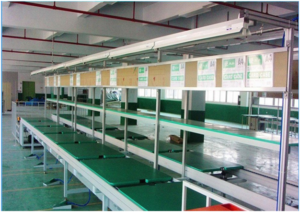
The simplest configuration — a flat belt running horizontally over a slider bed or idlers, used for packaged goods, cartons, and general unit-load transport where the product needs a flat, stable surface rather than a troughed bulk-carrying profile.
Inclined belt conveyor
Moves material or product between floor levels or elevations, at angles typically up to 30–35° for standard belts, higher with cleated or sidewall belts. Common wherever floor space rules out a full vertical lift like a bucket elevator but material still needs to gain height. See our inclined belt conveyor range, available with food-grade and stainless options.
Horizontal belt conveyor
The general-purpose workhorse — moving material or packaged goods along a level or near-level path between production stages, storage, and dispatch. Our horizontal belt conveyor line covers the majority of standard FMCG, food, and industrial transport applications.
Troughed belt conveyor
Belt supported on angled idler sets (typically 20–45° trough angle) that curve the belt into a U-shaped profile, increasing the cross-sectional area of material it can carry per unit of belt width. This is the standard configuration for high-tonnage bulk material — Neo Conveyors' trough belt conveyors are built for cement, sand, limestone, coal, ores, gypsum, and fertilizer at long distances and high speed.
Roller bed belt conveyor
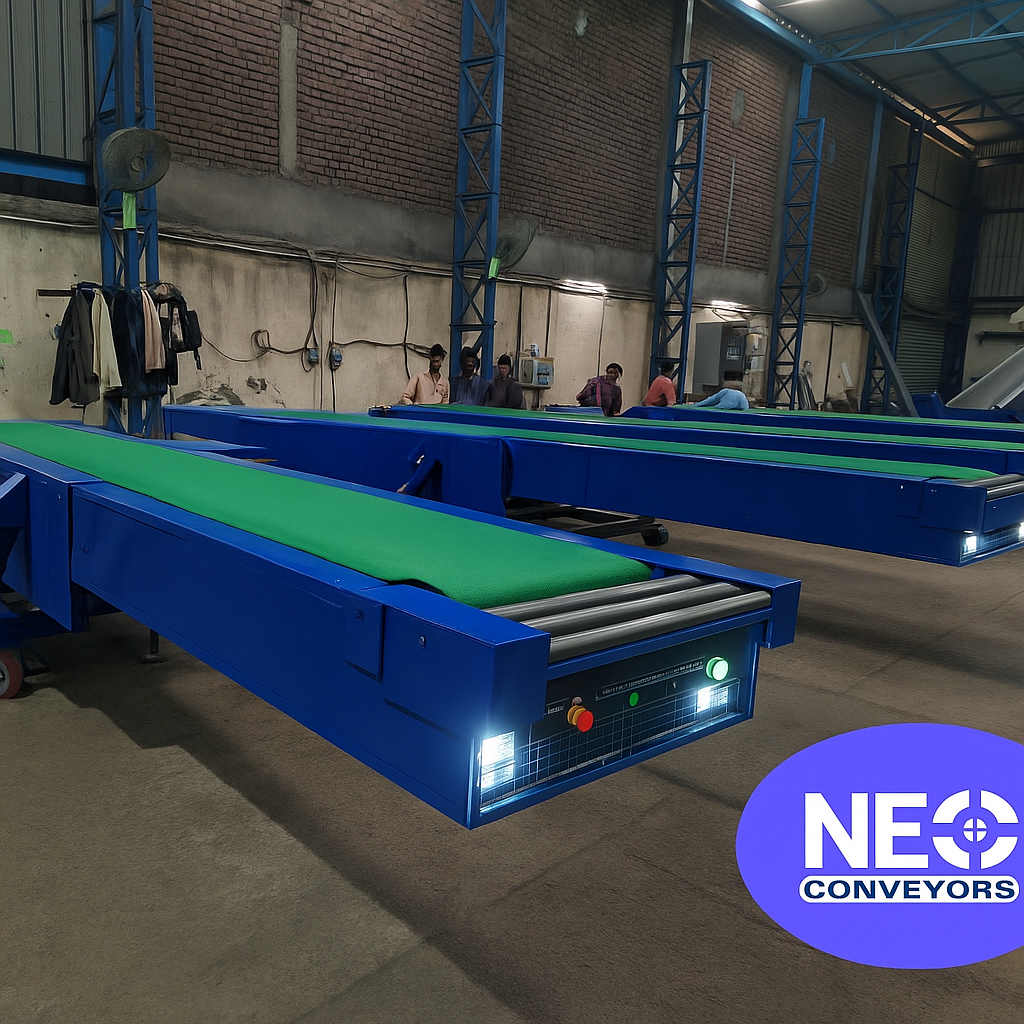
Uses rollers instead of a slider bed to support the belt's carrying run, reducing friction and running smoother under heavier point loads than a slider bed design. Suited to medium-to-heavy unit loads where slider-bed friction would cause excess wear or drive load. See our roller bed belt conveyor design.
Belt conveyor capacity
Capacity depends on the cross-sectional area of material the belt carries, how fast the belt moves, and the material's bulk density:
Q (TPH) = 3.6 × A × v × ρ
Where:
- Q = capacity in tonnes per hour
- A = cross-sectional area of material on the belt (m²) — determined by belt width and trough angle (flat belts carry far less cross-sectional area than troughed belts of the same width)
- v = belt speed (m/s)
- ρ = material bulk density (t/m³)
The cross-sectional area (A) isn't something you calculate from scratch on every project — it's read from standard capacity charts based on belt width and trough angle, which is exactly why trough angle is chosen early: a 35° trough angle carries meaningfully more material per unit of belt width than a 20° angle or a flat belt.
How to select belt width
Belt width is set by two independent checks, and the larger of the two governs:
- Capacity requirement — using the capacity formula above, work backward from your required TPH to find the minimum belt width and trough angle combination that delivers it at a practical belt speed
- Lump size requirement — as a rule of thumb, belt width should be at least 2 to 2.5 times the largest expected lump size, regardless of what the capacity calculation alone suggests, since an undersized belt relative to lump size causes spillage and uneven loading even if total throughput is technically sufficient
Standard commercial belt widths typically run from 300 mm to 1,800 mm, though this is fully customisable to your application and required capacity.
Motor and gearbox selection
Motor power for a belt conveyor is driven by three components: overcoming friction along the belt's length, lifting material if the conveyor is inclined, and belt tensioning losses. A simplified estimate:
P (kW) = [Q × (H + f × L)] / (367 × η)
Where:
- Q = capacity (TPH)
- H = lift height (m) — zero for a horizontal conveyor
- f = friction factor (typically 0.02–0.03 for well-maintained idlers)
- L = horizontal conveying length (m)
- η = mechanical efficiency (typically 0.80–0.85)
This gives an approximate running power; final motor selection adds a starting-torque safety margin (typically 1.3–1.5×) and rounds up to the next standard motor rating. Gearbox reduction ratio is then sized to deliver the target belt speed from the motor's rated output RPM. Real design should also account for belt tension analysis specific to your belt type and idler spacing — this formula is a working estimate, not a substitute for full engineering calculation.
Belt conveyor applications
- FMCG and warehousing — carton, case, and packaged goods movement through production and dispatch
- Food and beverage processing — moving packaged or raw product between processing stages, often with food-grade belt options
- Cement, sand, and aggregates — troughed belt conveyors moving high-tonnage bulk material over long distances
- Chemicals and fertilizer — bagged and bulk material handling
- Automotive and assembly — component and sub-assembly transport between workstations
- Mining and minerals — troughed belt conveyors for ore, coal, and mineral transport
Belt conveyor maintenance
Belt conveyors need consistent attention to a small number of recurring points: correct belt tensioning (too loose causes slip, too tight overloads bearings), pulley and idler alignment (the most common cause of belt mistracking), regular lubrication of bearings and gearboxes on schedule rather than reactively, and clean loading/transfer points to prevent material buildup that adds load and accelerates wear. (For the full set of habits that keep any conveyor running without unplanned downtime, see Top 7 Tips to Keep Your Conveyor System Running.)
Belt conveyor price factors
Belt conveyor pricing varies with:
- Length and belt width — the two biggest drivers of steel, belt, and idler quantity
- Belt type and grade — standard rubber vs. food-grade, oil-resistant, or heat-resistant covers
- Frame material — MS powder-coated vs. SS304/SS316 for hygienic or corrosive environments
- Incline vs. horizontal — inclined conveyors need higher-grip belts (cleated, chevron) and structural support for the angle
- Drive and automation level — fixed-speed motor vs. VFD, plus any PLC/sensor integration
- Component quality — pulley and idler grade materially affect both upfront cost and years of service life
The cheapest quote on paper is rarely the cheapest option once you factor in belt life, downtime, and component replacement frequency over the conveyor's working life.
How to choose a belt conveyor manufacturer in India
The same fundamentals apply here as across any conveyor category: look for a manufacturer who calculates capacity, belt width, and motor power against your actual material and layout rather than quoting a standard size chart; check what belt and component grade they specify by default; confirm customisation capability for your specific incline, length, and frame material requirement; and verify installation support and spares availability, since belt conveyors — like any continuously running equipment — eventually need a belt splice, bearing, or pulley replaced. (For the broader manufacturer-evaluation checklist that applies across every conveyor type, see our Conveyor Manufacturer in India: Complete Buyer's Guide.)
Final thoughts
A belt conveyor's simplicity is exactly what makes it adaptable to so many applications — but that same simplicity means getting the type, belt width, and motor power wrong is easy to do without the right calculation behind it. Match trough profile and incline to your material, size belt width against both capacity and lump size, and confirm motor power with a proper safety margin, and a belt conveyor will run reliably for years with routine maintenance.
Neo Conveyors has manufactured belt conveyor systems — flat, inclined, horizontal, troughed, and roller bed — since 2007, engineered from your material, capacity, and layout rather than a standard size chart. Get in touch with your requirements for a free capacity and motor sizing calculation.
Related reading
Recent Posts