Apron Conveyor Manufacturer in India
Apron conveyors that handle the hottest, heaviest materials your process can throw at them
Steel-plate apron conveyors on forged chain — engineered for iron ore, limestone, cement clinker, hot castings, steel scrap and large-lump bulk materials that destroy rubber belts inside a shift.
- 18+ years — Manufacturing
- 1,000+ — Installations
- Up to 800°C — Hot material duty
- PAN India — Supply & service
What Is an Apron Conveyor?
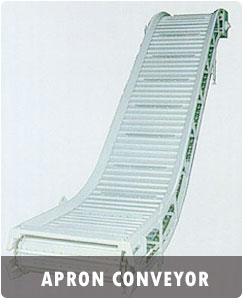
An apron conveyor moves bulk material on a series of overlapping steel plates (pans, or pans-and-flanges) bolted across heavy-duty roller chain running between two sprockets. Unlike a rubber belt, there is no flexible surface to burn, puncture or tear — the steel plate surface withstands direct contact with red-hot clinker, sharp-edged ore, heavy castings and large-lump abrasive material that would destroy a belt conveyor in hours.
The overlapping plate design prevents material from falling through between plates, making the apron conveyor suitable for fine and coarse materials alike. Side flanges on each plate create a contained trough, increasing carrying capacity and preventing spillage even on inclines up to 30°. Neo Conveyors manufactures apron conveyors from 300 mm to 2,000 mm pan width, in mild steel, stainless steel and heat-resistant steel plate, with forged chain or roller chain drives and geared motor, VFD or PLC-controlled drive systems.
When to specify an apron conveyor over a belt conveyor: material temperature above 80°C, lump size above 200 mm, bulk density above 2.0 t/m³, abrasive material such as ore or clinker, or any application where a single belt failure causes an extended production shutdown. Get engineering advice →
300 mm – 2,000 mm
Up to 50 m (modular)
Up to 1,500 TPH
Up to 600 mm
Up to 800°C (special builds)
Up to 30° (flanged pans)
MS / SS / Heat-resistant steel
Forged / Roller / Heavy duty
IS / CEMA / DIN
How an Apron Conveyor Works
Positive chain drive — no belt, no friction dependence, no heat or impact limit.
Material Loading
Bulk material is fed onto the overlapping steel pans at the tail end — directly from a hopper, crusher discharge or furnace tap-out.
Chain Drive
Drive sprockets pull two parallel forged roller chains. Steel pans bolted across the chains are carried forward positively — no slip under any load.
Plate Overlap
Each pan overlaps the next, sealing the carrying surface. Material cannot fall through between plates even at low speeds or during starting.
Discharge
At the head sprocket, plates turn and material discharges by gravity into a chute or stockpile below. Return plates travel back below the frame.
Types of Apron Conveyors
Six configurations spanning general industrial to extreme heavy-duty and high-temperature duty.
Heavy Duty Apron Conveyor
Reinforced flanged pans on forged chain for iron ore, large lump limestone and crusher discharge applications. Handles up to 600 mm lump at up to 1,500 TPH.
Steel Apron Conveyor
Standard mild steel flat or flanged pans for general bulk material handling — coal, sand, aggregate, foundry sand and large-lump industrial scrap.
Overlapping Plate Apron Conveyor
Flanged pans with extended overlap for hot clinker, sinter and coke — prevents material bridging and fallthrough at high temperature and high speed.
Inclined Apron Conveyor
Flanged and cleated pan design up to 30° inclination — lifting ore, clinker or foundry sand between floor levels without material slide-back.
Industrial Apron Conveyor
Medium-duty build for automotive scrap yards, metal recycling facilities and engineering plants — handling mixed-size ferrous and non-ferrous scrap.
Heat-Resistant Apron Conveyor
Special-grade heat-resistant steel pans and bearings rated to 800°C for direct contact with foundry castings, hot billets and sintered ore directly from furnaces.
Advantages of Apron Conveyors
Heavy Load Carrying Capacity
Rigid steel pans on forged chain carry up to 1,500 TPH — no sagging, no slip, regardless of material density or lump size.
Heat Resistant Design
Heat-resistant steel grades handle direct contact with clinker, castings and sinter at temperatures a rubber belt cannot survive.
Positive Chain Drive
Sprocket-and-chain drive requires no friction coefficient from the material surface — no slip under impact or surge load.
Minimal Material Spillage
Overlapping flanged pans contain fine and coarse materials without spillage, even on inclines up to 30°.
Long Service Life
Heavy-duty chain, forged pins and bushings built for 10–15 years of continuous operation with scheduled lubrication.
Low Maintenance
Simple chain-and-sprocket drive with individual plate replacement — no full belt change, no vulcanising.
Applications of Apron Conveyors
Deployed wherever rubber belt conveyors fail — high temperature, heavy impact, sharp material, or a combination of all three.
- Mining Industry
- Cement Plants
- Steel Plants
- Foundries
- Recycling Plants
- Power Plants
- Heavy Engineering
- Scrap Handling
Materials Handled
- Iron Ore
- Coal
- Limestone
- Cement Clinker
- Hot Castings
- Steel Scrap
- Foundry Sand
- Heavy Components
Technical Specifications
All apron conveyors specified from your material, capacity, temperature and conveyor layout.
| Parameter | Standard range | Notes |
|---|---|---|
| Conveyor width (pan) | 300 mm – 2,000 mm | Matched to material lump size and capacity |
| Conveyor length | Up to 50 m | Modular sections for longer runs |
| Plate thickness | 4 mm – 20 mm | Heavier for large lump and impact duty |
| Capacity | Up to 1,500 TPH | Function of pan width, speed and material density |
| Max lump size | Up to 600 mm | Heavy-duty builds accommodate primary crusher output |
| Chain type | Forged / Roller / Heavy duty | Forged for high temperature and high-impact duty |
| Drive system | Geared motor / VFD / PLC | VFD for variable speed; PLC for automated plant integration |
| Speed range | 0.1 – 0.5 m/s | Slow speed is key advantage for heavy materials |
| Inclination | Up to 30° (flanged pans) | Beyond 20° requires cleated or deeper-flanged pans |
| Temperature rating | Ambient to 800°C | Heat-resistant steel + ceramic insulation for high-temp duty |
Mild Steel Plates (IS 2062)
Stainless Steel Plates (304 / 316)
Heat Resistant Steel Plates (up to 800°C)
Forged Chain (heavy impact / high temp)
Roller Chain (standard duty)
Heavy Duty Conveyor Chain
Geared Motor
Variable Frequency Drive (VFD)
PLC Controlled System
How to Select the Right Apron Conveyor
Eight parameters that determine pan width, plate thickness, chain grade and drive specification.
Material Type
Ore, clinker, scrap or castings — drives plate material, chain grade and lubrication specification.
Lump Size
Maximum lump size sets minimum pan width and plate thickness to prevent jamming and deformation.
Material Temperature
Above 200°C needs heat-resistant steel. Above 600°C needs ceramic insulation and special chain lubrication.
Required Capacity (TPH)
Determines pan width and conveyor speed. Slower speed preferred for heavy, abrasive material.
Conveyor Length
Sets chain breaking load, drive power and number of modular sections.
Inclination Angle
Up to 20° — standard flanged pans. 20°–30° — deep flanged or cleated pans to prevent rollback.
Abrasiveness
Highly abrasive material (ore, clinker) requires thicker pans and hardened chain components.
Operating Environment
Outdoor, wet, coastal or hazardous area requirements change frame coating and motor specification.
Apron Conveyor vs Belt Conveyor
| Feature | Apron conveyor | Belt conveyor |
|---|---|---|
| Hot material (>80°C) | Excellent — up to 800°C | Poor — belt burns above 80°C |
| Heavy loads | Excellent — up to 1,500 TPH | Good — limited by belt rating |
| Abrasive material | Excellent — steel plate | Moderate — belt wear |
| Large lump size (>200 mm) | Excellent — up to 600 mm | Moderate — impacts damage belt |
| Impact resistance | Excellent | Moderate — requires impact idlers |
| Maintenance | Moderate | Low |
| Initial cost | Higher | Lower |
Apron Conveyor vs Slat Conveyor
| Feature | Apron conveyor | Slat conveyor |
|---|---|---|
| Bulk materials (ore, coal, clinker) | Excellent — flanged pans contain material | Moderate — spillage risk |
| Heavy discrete components | Excellent | Excellent |
| High temperature (>200°C) | Excellent | Good |
| Scrap & recycling | Excellent — overlapping plates trap scrap | Moderate |
| Inclination | Up to 30° | Up to 20° |
Recent Apron Conveyor Installations
Four recent projects demonstrating hot, heavy and abrasive material handling across Indian industrial sectors.
Cement Plant — Clinker Discharge Conveyor
Clinker at 350°C from the cooler outlet was destroying rubber belt conveyors every 3–4 months. An overlapping heat-resistant steel plate apron conveyor with forged chain was specified as a direct replacement.
- Belt replacement cost eliminated — zero belt replacements in 24 months
- Production stoppages from belt failure: zero in 24 months (vs. 4 in previous 24 months)
- Clinker spillage under conveyor reduced by 90%
Steel Plant — Iron Ore Reclaim Conveyor
Primary crusher discharge with 600 mm lump iron ore at 2.6 t/m³ bulk density required an apron conveyor capable of absorbing direct crusher discharge impact without structural damage.
- Operating continuously for 30 months without structural failure
- Maximum lump handled without incident: 580 mm
- Achieved design capacity of 1,200 TPH at 0.3 m/s
Foundry — Hot Casting Conveyor
Sand-mould shakeout conveyor carrying hot iron castings directly from the shakeout machine — the existing roller conveyor was deforming at operating temperature. Replaced with heat-resistant steel plate apron conveyor with ceramic insulated chain.
- Operating at 700°C casting temperature for 20+ months without deformation
- Casting damage from shakeout: zero (vs. occasional damage on roller conveyor)
- Manual casting handling eliminated — full automation of shakeout-to-cooling circuit
Mining Project — ROM Coal Handling
Run-of-mine coal at 22° inclination from feeder to primary crusher — the belt conveyor was slipping on the incline at high tonnage during monsoon season. Deep-flanged apron conveyor with VFD drive installed.
- Zero incline slip events since installation, including monsoon season
- ROM capacity achieved: 850 TPH design at 22° inclination
- VFD allows controlled acceleration — eliminates chain shock on startup
Why Choose Neo Conveyors?
18+ Years Heavy Conveyor Experience
Apron conveyors designed and built for the real loads — not rated on paper and then underspecified in fabrication.
Custom Engineering Every Order
Pan width, plate thickness, chain breaking load and drive power calculated from your material, capacity and temperature specification.
Heat-Resistant Build Options
Standard MS builds to special heat-resistant steel builds rated to 800°C for direct foundry and clinker contact.
In-House Fabrication
Plate cutting, pan fabrication, chain assembly and drive integration all completed at our Ghaziabad facility.
PAN India Installation
On-site installation, alignment, trial run and commissioning support across India with dedicated site teams.
After-Sales & Spare Parts
Replacement pans, chain links and sprockets supplied from Ghaziabad. Emergency breakdown support across India.
Apron Conveyor FAQs
What is an Apron Conveyor?
An apron conveyor moves bulk material on a series of overlapping steel plates (pans) attached across two parallel forged roller chains running between drive and tail sprockets. The steel plate surface allows it to handle hot, heavy, sharp and abrasive materials that would destroy a rubber belt conveyor — including cement clinker, iron ore, foundry castings and large-lump crushed rock.
What materials can an Apron Conveyor handle?
Iron ore, coal, limestone, cement clinker, hot castings, steel scrap, foundry sand and heavy industrial components. Apron conveyors are specifically chosen for materials that are too hot (above 80°C), too sharp, too heavy or too large-lump for a rubber belt conveyor to handle reliably.
What industries use Apron Conveyors?
Mining (iron ore, coal, copper), cement plants (clinker and raw material), steel plants (ore and scrap), foundries (hot castings and foundry sand), power plants (coal), recycling facilities (metal scrap) and heavy engineering plants.
What is the difference between an Apron Conveyor and Belt Conveyor?
A belt conveyor uses a flexible rubber or fabric belt that cannot withstand temperatures above 80°C, abrasive ore, large lump sizes above 200 mm, or direct impact from crusher discharge without significant wear and frequent replacement. An apron conveyor uses overlapping steel plates on forged chain with no rubber surface to wear, burn or puncture — handling material a belt conveyor cannot, at a higher initial cost but far lower operating cost in severe-duty applications.
Can Apron Conveyors handle hot materials?
Yes — standard mild steel plate apron conveyors handle material to 200°C. Heat-resistant steel builds handle direct contact with clinker, sinter and castings to 600°C. Special ceramic-insulated builds for furnace discharge can handle material to 800°C. The chain, bearings and lubrication system are all specified to the operating temperature.
What is the maximum inclination for an Apron Conveyor?
Standard flat pans handle up to 20°. Deep-flanged pans handle up to 25°. Deep-flanged pans with cleats handle up to 30°. Beyond 30° a bucket elevator is typically recommended. The flanged pan design prevents bulk material slide-back on the incline, a key advantage over inclined belt conveyors for heavy bulk materials.
Can Neo Conveyors customise Apron Conveyors?
Yes. Neo Conveyors builds apron conveyors to your exact pan width (300–2,000 mm), plate thickness (4–20 mm), chain type (forged, roller or heavy duty), temperature rating (ambient to 800°C), capacity (up to 1,500 TPH) and drive specification (geared motor, VFD or PLC).
Do you provide installation across India?
Yes. Neo Conveyors manufactures at our Ghaziabad facility and provides supply, installation, alignment, trial run and commissioning of apron conveyors across India — cement plants, steel plants, mining sites, foundries and industrial facilities.
Related Conveyor Products
Belt Conveyor
For material below 80°C and lump sizes below 200 mm — lower capital cost than an apron conveyor for standard bulk material handling.
Slat Conveyor
For heavy discrete components — engine blocks, gearboxes, castings — where a flat steel surface is needed without the bulk containment of flanged apron pans.
Drag Chain Conveyor
Enclosed drag chain conveyor for abrasive, dusty or enclosed bulk material handling where spillage containment is critical.
Chain Conveyor
Standard chain conveyors for industrial assembly, part handling and production line integration.
Bucket Elevator
Vertical elevation of bulk materials where an inclined apron conveyor cannot achieve the required lift angle.
Conveyor Pulleys & Idlers
Drive pulleys, tail pulleys and conveyor idlers — components for belt and chain conveyor systems.
Our Manufacturing Facility
Neo Conveyors Pvt. Ltd.
- Address
- G-414, UPSIDC Phase-II, Masoori Gulawati Road, Industrial Area, Ghaziabad, Uttar Pradesh — 201001
- Phone
- +91-9654112235
- sales@neoconveyors.com
- Chat on WhatsApp →
- Service area
- PAN India — manufacturing, supply & on-site installation
- Working hours
- Mon – Sat, 9:00 AM – 6:30 PM IST
Get a Free Apron Conveyor Quote
Share your material type, temperature, lump size, required capacity (TPH) and conveyor length. Our engineers will specify pan width, plate thickness, chain grade and drive — with a GA drawing at no charge.