Troughed Belt Conveyor Manufacturer in India
Neo Conveyors manufacturer of Custom troughed belt conveyors for bulk material handling — cement, coal, limestone, ore, biomass, grain, fertilizer, and sand. 500 mm to 1200 mm belt width. 20°, 30°, and 35° trough angles. Up to 500 TPH. Custom lengths and inclinations. Fabricated in Ghaziabad. PAN India installation.
What is a Troughed Belt Conveyor?
A troughed belt conveyor uses angled idler sets to form the flat belt into a trough cross-section — dramatically increasing carrying capacity per unit of belt width compared to a flat belt, while containing bulk material securely during transport.
The trough — what it does
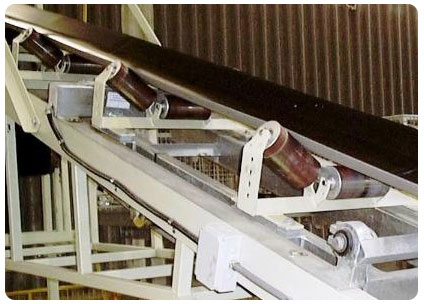
A standard three-roll idler set positions one horizontal centre roller and two angled wing rollers (at 20°, 30°, or 35° to horizontal) across the belt width. As the belt rests on these three rollers, it naturally forms a trough — curving upward on both sides to contain material in the centre. This trough cross-section can carry 2–3× the volume of material that would sit safely on a flat belt of the same width, without spillage at the sides.
The belt is continuous and endless — running over the loaded carrying run (upper) on the trough idler sets, then returning empty on the return run (lower) on flat return rollers before reloading at the tail end.
When a trough belt is the correct choice
The troughed belt conveyor is the correct choice for any dry bulk material that must be transported horizontally or on an incline — wherever the material volume, lump size, or spillage risk makes a flat belt impractical. It is the standard conveyor type in cement plants, stone crushers, coal handling, grain silos, fertilizer plants, and biomass fuel handling — wherever high-volume bulk material must be moved reliably with minimum spillage and low energy cost per tonne.
For packaged or discrete products (cartons, bottles, components), a flat belt or roller conveyor is the correct choice instead.
How a Troughed Belt Conveyor Works
Mechanically straightforward — but belt width, trough angle, belt speed, idler spacing, and belt tension must all be precisely calculated for your material to achieve rated TPH without spillage, belt slip, or idler overload.
Bulk material is fed onto the belt at the tail (infeed) end via a loading chute. Loading skirts on both sides of the belt at the loading point prevent material from falling off during the initial surge before the belt forms its trough shape.
As the loaded belt travels on the carrying run, three-roll trough idler sets spaced at regular intervals support and maintain the trough shape — keeping material contained in the cross-section from loading point to head (discharge) end.
A geared motor drives the head (drive) pulley via V-belt or direct coupling. The belt tension is set via a take-up arrangement at the tail end — screw take-up for short conveyors, gravity take-up for longer runs requiring automatic tension adjustment.
Material discharges over the head pulley into a discharge chute. The empty belt returns on the underside on flat return rollers. Belt cleaners (primary and secondary scrapers) at the head end remove material adhering to the belt face before return.
Engineering note: Capacity (TPH) = cross-sectional area of trough × bulk density × belt speed × fill factor. Trough cross-section area increases with belt width² — doubling belt width increases capacity approximately 4×. Send your material data for a free calculation.
Advantages of Troughed Belt Conveyors
Five engineering advantages that make the troughed belt conveyor the standard bulk material handling system across Indian cement, mining, power, and agriculture industries.
High Conveying Capacity
The trough cross-section carries 2–3× more material per metre of belt width than a flat belt — enabling 50 TPH to 500 TPH capacities on a single conveyor unit without increasing belt speed to impractical levels.
Reduced Material Spillage
The trough profile contains material within the belt cross-section on straight runs and controlled curves. Loading skirts at infeed and belt scrapers at discharge eliminate the primary spillage points — keeping the conveyor gallery clean.
Long Distance Conveying
Troughed belt conveyors handle conveying distances from a few metres up to several kilometres on a single flight — making them the preferred choice for cement plant inter-unit transfer, mine-to-crusher, and port-to-storage applications.
Lower Operating Cost
Cost per tonne conveyed is significantly lower than truck, loader, or pneumatic conveying for most bulk material applications — continuous operation with minimal manpower and lower energy consumption per TPH than alternative systems.
Suitable for Bulk Materials
Handles virtually any dry bulk material — fine powders (fly ash, cement), granular materials (fertilizer, grain, sand), and coarse lumps (coal, limestone, ore) — simply by selecting the correct trough angle, belt type, and idler spacing.
Handles Inclines Up to 20°
Standard rubber belts handle material inclinations up to 18–20° (depending on material's angle of repose). Cleated belts extend this to 30°+ for fine materials — enabling vertical elevation without a separate bucket elevator in many plant layouts.
Industries Using Troughed Belt Conveyors
The troughed belt conveyor is the backbone of bulk material transport in every major Indian industrial sector — wherever dry bulk material must move reliably, at high volume, with minimum spillage and low cost per tonne.
Cement Industry
Raw material (limestone, clay, sand) from crusher to raw mill. Clinker from kiln to cement mill. Cement powder to packing plant. Fly ash handling. 30° trough belt conveyors on all transfer points — running 24×7 at capacities of 100–500 TPH.
Mining & Quarrying
Crushed stone, iron ore, coal, and minerals from crushing and screening plants to stockpiles, bins, and processing units. Heavy-duty 30°/35° trough conveyors with reinforced idlers and abrasion-resistant belt for high-lump, high-abrasion materials.
Biomass Industry
Rice husk, wood chips, bagasse, biomass pellets, and agricultural waste from storage to boiler feed points. 35° trough conveyors for fine, light biomass materials that would fluidise and spill on lower trough angles.
Power Plants
Coal and pet coke handling from unloading yard to crusher, crusher to bunkers, and fly ash / bottom ash from ESP hoppers to silos. Thermal power plant trough belt systems running at 300–500 TPH across long transfer distances.
Fertilizer Plants
Urea, DAP, MOP, NPK, and granulated fertilizer from production to storage and bagging. 30° trough conveyors with sealed casing options for hygroscopic materials that must be protected from moisture during conveying.
Agriculture & Grain Handling
Wheat, rice, maize, soybean, and milled grain between silos, dryers, cleaners, and processing units. 30° trough conveyors with smooth rubber belt — food-safe, non-contaminating, gentle on grain to minimise breakage during transfer.
Troughed Belt Conveyor Specifications
All troughed belt conveyors are made-to-order. Capacity, belt width, trough angle, and drive are calculated from your material bulk density, required TPH, and conveyor geometry.
| Parameter | Specification |
|---|---|
| Conveyor type | Troughed belt conveyor (3-roll idler) |
| Capacity | Up to 500 TPH (calculated per material and belt width) |
| Inclination | Horizontal to 20° (cleated belt: up to 30°+) |
| Idler type | 3-roll trough carrying idler + 2-roll return idler |
| Idler spacing (carrying) | 1.0 m to 1.5 m (closer near loading point) |
| Idler spacing (return) | 2.0 m to 3.0 m |
| Belt type | EP (Fabric ply) / NN / Steel cord rubber belt |
| Belt speed | 0.5 m/s to 3.5 m/s (calculated per capacity) |
| Frame construction | MS fabricated channel / RHS — hot-dip galvanised or epoxy-painted |
| Drive arrangement | Geared motor + V-belt or direct coupling at head end |
| Take-up type | Screw take-up (short) / Gravity take-up (long conveyors) |
| Ancillaries | Loading skirts, belt scraper (primary + secondary), plough scraper, belt scale |
| Power supply | 415 V, 3 Phase, 50 Hz |
Belt Width Options
* Capacities at 30° trough, 1.6 t/m³ bulk density, 1.5 m/s belt speed. Actual capacity calculated per your material.
Trough Angle Options
Download Trough Belt Conveyor Catalogue
Specifications, capacity tables, and installation case studies — PDF, free.
Download PDFHow to Select the Right Troughed Belt Conveyor
Five parameters determine the correct specification. Provide these to our engineers and we calculate belt width, trough angle, belt speed, motor power, and idler spacing — at no charge with the quotation.
Determines belt width and motor power. Denser materials need wider belt or lower speed for the same TPH.
Determines minimum belt width (min. 3× max lump size) and idler shell diameter.
Capacities at 30° trough, 1.6 t/m³ density, 1.5 m/s. Recalculated for your material.
Length and inclination determine belt tension, motor power, and take-up type.
Troughed Belt Conveyors — Live at Customer Plants
Real Neo Conveyors troughed belt conveyor systems in operation — cement plant, biomass, and bulk material handling installations across India.
More installation videos: youtube.com/@neoconveyors
Recent Troughed Belt Conveyor Installations
Four representative projects with full engineering parameters — demonstrating real-world capacity, belt width, trough angle, and results achieved at customer plants across India.
A rice processing plant needed rice husk (bulk density 0.12 t/m³) conveyed from husk storage to boiler infeed hopper. Rice husk's extremely low density and tendency to fluidise required 35° trough angle to prevent spillage over wing idlers at 30°.
Biomass power plant needed wood chips and agricultural waste (mixed bulk density 0.25 t/m³) conveyed from outdoor storage yard to boiler feed point at 12 TPH. Outdoor installation required galvanised frame and UV-resistant belt. 35° trough with loading skirts and plough scraper installed.
Cement plant needed crushed limestone (bulk density 1.5 t/m³, 0–50 mm lump) conveyed from primary crusher to raw mill feed bin at 200 TPH continuous. Heavy-duty 30° trough conveyor with impact idlers at loading point, primary and secondary belt scrapers, and gravity take-up for belt tension control on the 85 m run.
Fertilizer manufacturer needed urea granules (bulk density 0.75 t/m³, highly hygroscopic) conveyed from prilling tower outfeed to storage silo at 120 TPH, 3-shift operation. Urea's hygroscopic nature required fully covered conveyor gallery with moisture strip seals at all joints, plus sealed head and tail end enclosures.
Troughed Belt vs Flat Belt Conveyor
The trough belt conveyor and the flat belt conveyor are both powered belt systems — but they serve entirely different materials and applications.
| Factor | ✅ Troughed Belt (This page) | Flat Belt Conveyor |
|---|---|---|
| Material type | Bulk, granular, lump — dry materials | Packaged / discrete products |
| Carrying capacity | 2–3× more per belt width | Limited to flat belt surface area |
| Material containment | Trough profile contains bulk material | Material would spill off flat belt |
| Inclination handling | Up to 20° standard, 30°+ cleated | Up to 10–15° (product-dependent) |
| Best applications | Cement, coal, ore, grain, biomass, fertilizer | Cartons, bottles, bags, components |
| Belt type | EP / NN / Steel cord rubber belt | PVC / PU / food-grade belt |
| Typical industries | Cement, mining, power, agriculture | FMCG, pharma, food, logistics |
Need packaged product conveying? Horizontal Belt Conveyor → | Need vertical elevation? Bucket Elevator →
Why Choose Neo Conveyors
Every troughed belt conveyor is designed from your material data, fabricated in-house at our Ghaziabad plant, and installed by our own engineers. No dealers. No sub-contractors. Full accountability.
Every conveyor starts with your material's bulk density, lump size, angle of repose, and abrasiveness — then belt width, trough angle, belt speed, and idler type are calculated. Not guessed.
18+ years of troughed belt conveyor projects across cement, mining, power, biomass, agriculture, and fertilizer industries. References from clients in your sector available on request.
GA drawing, belt width, trough angle, motor power, and idler schedule included with every quotation at no charge. No hidden engineering fee charged at order stage.
Installation, alignment, belt tracking, take-up adjustment, and commissioning by Neo Conveyors' own team across all Indian states. No third-party erection contractors.
Troughed belt conveyor systems exported to UAE, Bangladesh, Nepal, Sri Lanka, Africa, and Southeast Asia — documentation, packing, and supervision available for international projects.
Idler sets, belting, pulleys, scrapers, and drive components stocked and supplied for the full life of the conveyor. Annual Maintenance Contracts and inspection visits available PAN India.
Related Conveyor Solutions
The troughed belt conveyor is part of a complete bulk material handling solution — explore the vertical, inclined, and loading conveyors that connect to your trough belt system.
Frequently Asked Questions
Troughed Belt Conveyor — Service Locations Across India
Manufactured at our Ghaziabad facility — designed, installed, and commissioned by our own engineers at cement plants, mines, power plants, fertilizer units, biomass plants, and grain silos across all Indian states. International export capability.
Request a Free Quote — Capacity Calculation Included
Share your material name, bulk density, required TPH, conveyor length, and inclination. Our engineers calculate belt width, trough angle, and motor power — and send a GA drawing with quotation at no charge within 24–48 hours.