Bucket Elevator: Types, Components, Working & How to Choose the Right Manufacturer (2026)

Bucket Elevator: Types, Components & How It Works (2026 Guide)
If you've ever watched grain, cement, or chemical powder move straight up into a silo without a single conveyor belt in sight, you've seen a bucket elevator at work. It's one of the oldest and most reliable pieces of bulk material handling equipment, and also one of the most misunderstood, judging by how often people search "what is bucket elevator" without finding a straight answer.
This guide covers what a bucket elevator actually is, how it works stage by stage, the main types and bucket designs you'll come across, where each one fits by industry, and how to tell a well-engineered elevator from a risky one. If you already know what you need and want product specifications, see Neo Conveyors' bucket elevator range.
What Is a Bucket Elevator?
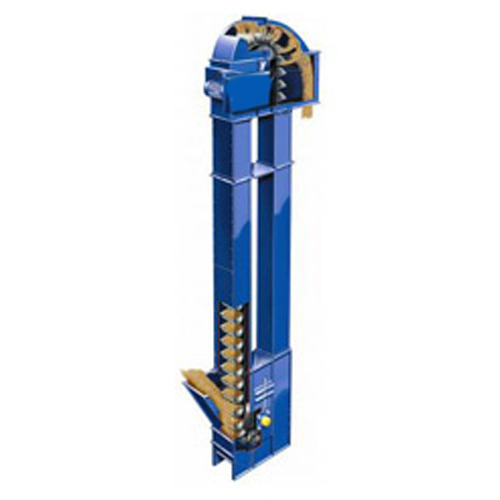
A bucket elevator is a mechanical conveying system that moves bulk materials vertically using a series of buckets attached to a belt or chain. The buckets scoop material at the bottom, called the boot, carry it upward inside an enclosed casing, and discharge it at the top, called the head, into a chute, bin, or silo. It is, in essence, a conveyor rotated ninety degrees: instead of covering distance across a floor, it covers height, often between two entirely different levels of a plant.
Unlike a horizontal conveyor, which needs floor space to cover distance, a bucket elevator moves material straight up, making it the go-to choice wherever plant layout is tight but material still needs to be lifted several metres, whether that is from a pit into a hopper or from ground level into an overhead storage tank. This is why bucket elevators are so common in cement plants, grain silos, and fertilizer blending stations: the footprint of a bucket elevator for a 30-metre lift is a fraction of what an inclined belt conveyor would need to cover the same height.
FIG. 01 — BUCKET ELEVATOR, BOOT TO HEAD
How It Fits Into Bulk Material Handling
Most industrial material flows combine horizontal and vertical movement: material arrives by truck, moves horizontally on a belt conveyor or is fed by a screw conveyor, then needs to be lifted into storage. That lift is where the bucket elevator does its work. Because the buckets are enclosed in a sealed casing, it also keeps dusty or hygroscopic materials contained during the lift, which matters for cement, fly ash, and fertilizer as much as it does for food-grade grain handling.
Where Bucket Elevators Are Used
You'll find bucket elevators used across a wide range of industries: grain and agro-processing, where they move wheat, rice, maize, and pulses between cleaning, storage, and packaging stages; cement and construction materials, lifting clinker, fly ash, and aggregates; chemicals and fertilizers, handling granular and powdered materials without excessive dust or spillage; food processing, moving sugar, flour, and other free-flowing ingredients; and mining and minerals, where ore, ash, and crushed material all need vertical lift between processing stages.
Key Components of a Bucket Elevator
Regardless of type, most bucket elevators share the same core parts. Getting any one of these wrong for your material, say, using flat buckets for a sticky, high-density powder, is usually the root cause of jams, spillage, or premature wear.
Buckets
The load-carrying element, bolted or welded to a belt or chain. Bucket shape, depth, and spacing change based on the material being handled and the discharge type selected.
Belt or Chain
The driving medium. Belts suit lighter, non-abrasive materials; chains handle heavier, hot, or abrasive loads and last longer under harsh conditions.
Head Section
Houses the drive pulley or sprocket and discharges material at the top, either by centrifugal throw or gravity tipping, depending on elevator type.
Boot Section
The loading point at the bottom, where the elevator picks up material, usually fitted with a take-up device to keep belt or chain tension correct.
Casing
The enclosed housing that protects the moving buckets, contains dust, and keeps the material path sealed from the surrounding environment.
Drive Unit
The motor and gearbox that power the belt or chain, sized to the material's bulk density, required capacity, and lift height.
Why this matters: the boot, casing, and bucket combination determines fill factor, spillage risk, and dust containment far more than the drive unit does. A correctly sized motor on a poorly designed boot will still spill material.
How a Bucket Elevator Works
Every bucket elevator, whatever its discharge type, moves material through the same four stages. What changes between types is how gently or aggressively each stage is engineered.
Boot — Material Infeed
Material enters the boot section through a feed inlet or is scooped directly from a pit. Buckets pass the boot pulley or sprocket and fill with a metered charge of material.
Vertical Lift — Carrying Run
Loaded buckets travel upward inside the sealed casing. The enclosed design prevents dust emission and protects the material from the environment during the lift.
Head — Discharge
At the head pulley or sprocket, material leaves the bucket, either thrown clear by centrifugal force at high speed, or tipped gently by gravity at low speed, depending on the elevator type, and falls into the discharge chute.
Return — Empty Buckets
Empty buckets travel back down inside the same sealed casing to the boot, where the cycle repeats continuously as long as the elevator runs.
Types of Bucket Elevators
The single most important design decision for a bucket elevator is discharge type, and this depends almost entirely on your material's fragility, lump size, and flow characteristics.
Centrifugal Discharge Bucket Elevator
The most common type for free-flowing, granular materials like grain, sand, and small aggregates. Buckets are spaced apart on a belt or chain moving at higher speed, typically 1.0–2.0 m/s, and material is thrown out by centrifugal force as the bucket rounds the head pulley. Compact, cost-effective, and well suited to high-throughput applications where the material isn't fragile or sticky.
Read the centrifugal discharge guide →Continuous Discharge Bucket Elevator
Buckets are mounted close together with no gap, and the elevator runs at a slower speed, typically 0.3–0.8 m/s. Instead of being flung out, material spills from one bucket into the next as it rounds the head, guided by a discharge chute. This gentler handling makes continuous elevators the better choice for fragile, friable, or semi-fluid materials, think grain, seeds, sugar, fine chemicals, or materials prone to degradation.
Read the continuous discharge guide →Single Bucket Elevator
A single strand of spaced buckets on one belt or chain, typically used for lower-capacity applications or where space constraints rule out a double-strand design. It's simpler to maintain but has a lower throughput ceiling than double-strand configurations.
Grain Bucket Elevator
Purpose-built for the agricultural sector, grain bucket elevators are usually continuous or gentle centrifugal discharge units engineered to minimise grain breakage, with construction that meets the dust and hygiene requirements of food-grade handling.
Bucket Types Explained
The bucket itself is the single most material-specific part of the whole system. Shape, depth, and material of construction are all chosen to match how your product behaves as it's scooped, carried, and discharged.
Shallow Buckets
Wide, shallow profile for fine, free-flowing, and slightly sticky materials. Empties more completely than a deep bucket at moderate speed.
Deep Buckets
Deeper profile for maximum volume per bucket, used with dry, free-flowing materials like grain where discharge is easy and clean.
Pointed / AC Buckets
Pointed bottom edge for closely spaced, continuous discharge elevators, allowing buckets to sit close together without interference during the lift.
Bucket Materials
Mild steel for abrasive industrial materials; HDPE for grain, fertilizer, and food where metal contact must be avoided; nylon or food-grade polymer for pharma and high-temperature duties.
Belt Type vs Chain Type Bucket Elevators
Both centrifugal and continuous discharge elevators can be built as belt type or chain type. The choice is driven by material temperature, abrasiveness, and required service life, not by discharge mechanism.
| Factor | Belt type (rubber EP/NN) | Chain type (forged steel) |
|---|---|---|
| Material temperature | Up to 80°C (standard) | Up to 250°C (heat-resistant) |
| Abrasiveness | Low to medium abrasion | High abrasion, chain outlasts belt |
| Capital cost | Lower | Higher |
| Maintenance | Belt replacement, straightforward | Chain lubrication and link inspection |
| Best materials | Grain, cement, fertilizer, fly ash | Hot clinker, abrasive ore, coal above 80°C |
| Noise level | Quieter | Higher |
Continuous vs Centrifugal Discharge
Choosing the wrong discharge type is the most common and most expensive bucket elevator specification mistake. Here's the decision at a glance.
| Factor | Continuous discharge | Centrifugal discharge |
|---|---|---|
| Fragile materials | Excellent, no centrifugal impact | Moderate, may cause breakage |
| Chain/belt speed | Slow (0.3–0.8 m/s) | High (1.0–2.0 m/s) |
| Dust at discharge | Very low | Higher |
| Large-lump material (>50 mm) | Handles well, chain type | Risk of breakage |
| TPH per casing size | Lower | Higher |
| Typical materials | Grain, rice, fertilizer, clinker | Cement, fly ash, sand, coal fines |
For a full breakdown of each type, see the dedicated guides on centrifugal discharge bucket elevators and continuous discharge bucket elevators.
Bucket Elevator vs Screw Conveyor vs Belt Conveyor
A bucket elevator is often one part of a larger material flow that also includes horizontal conveyors. Here's when each is the right tool.
| Factor | Bucket elevator | Screw conveyor | Belt conveyor |
|---|---|---|---|
| Vertical lift (>10 m) | Excellent, purpose-built | Limited, inefficient above 10 m | Requires long incline, large footprint |
| Horizontal transport | Not suitable | Good, short to medium runs | Excellent, any distance |
| Dust containment | Excellent, sealed casing | Excellent, fully enclosed | Poor, open belt |
| Floor footprint | Smallest for equivalent lift | Small | Largest for equivalent lift |
| Best materials | Grain, cement, fertilizer, bulk powders | Powders, fine granules | Lump materials, packaged goods |
See screw conveyors and belt conveyors for the horizontal side of your material flow, and drag chain conveyors for enclosed, gentle horizontal transfer feeding into an elevator boot.
In practice, most plants use all three in combination rather than choosing just one. A typical layout might use a drag chain or screw conveyor to move material a short horizontal distance from a process outlet to the elevator boot, the bucket elevator to lift it vertically into storage, and a belt conveyor further downstream to move packed or palletised product to dispatch. Thinking of these as a single connected system, rather than isolated equipment purchases, is what actually determines whether a plant layout runs smoothly or develops bottlenecks at each transfer point.
Industry Applications of Bucket Elevators
The correct discharge type, bucket material, and casing design change significantly from one industry to the next. Here's how bucket elevators are typically specified across six common sectors.
Cement Plants
Raw meal, cement powder, and limestone dust elevation between grinding mills, preheaters, silos, and packing lines. Usually centrifugal discharge, belt type for powder, chain type for abrasive raw meal, at 50–200 TPH.
Rice Mills & Grain Processing
Paddy intake, cleaning, husking, and milled rice elevation. Continuous discharge is standard here, since broken grain percentage directly affects milling grade and market value.
Pet Coke Handling
Pet coke fines are abrasive and dust-prone; a sealed chain type centrifugal elevator with AR-lined buckets handles the abrasiveness while containing dust for pollution control compliance.
Fertilizer Plants
Urea, DAP, MOP, and NPK granule elevation at blending and bagging plants. Continuous discharge reduces granule breakage and dust that would otherwise clog bagging nozzles.
Fly Ash Handling
ESP and bag filter fly ash at thermal power plants. Low bulk density and fine particle size mean the casing must be fully sealed against airborne dust; centrifugal discharge is typical.
Chemical Industry
Chemical powders, pigments, and granules elevation at production and blending facilities. SS304/SS316 casing and explosion-proof motor options for hazardous area classification.
How to Choose the Right Bucket Elevator
Once you know which discharge type suits your material, the harder decision is who builds it. A few things worth checking before you sign off on a supplier.
Plenty of fabrication workshops can weld a casing and mount a motor. Fewer understand bucket spacing, fill ratios, and discharge geometry for your specific material, and it's this engineering judgment, not the welding itself, that determines whether the elevator you receive runs for a decade with routine maintenance or becomes a recurring headache within the first year. Ask for references in your industry specifically; grain handling and cement handling call for genuinely different engineering choices, even though both use the same basic bucket elevator concept.
Common Bucket Elevator Problems & Fixes
Most bucket elevator downtime traces back to one of four recurring issues. Catching them early during routine inspection avoids unplanned stoppages.
Belt Slip at the Head
Usually caused by insufficient belt tension or a worn drive pulley lagging. Check take-up adjustment first, then inspect pulley lagging condition.
Bucket Wear or Cracking
Abrasive materials wear buckets faster than expected when the wrong bucket material was specified. Switching to AR-lined steel or a thicker HDPE bucket usually resolves recurring cracking.
Spillage at the Boot
Often caused by incorrect boot geometry for the material's flowability, an over-filled boot pit, or worn buckets not clearing material properly during the scoop.
Backstop Failure
A backstop prevents the elevator running in reverse under load if power is lost. Test it on a fixed maintenance schedule; a failed backstop on a loaded elevator can cause serious damage.
Frequently Asked Questions
What is a bucket elevator used for?
A bucket elevator is used to move bulk materials, such as grain, cement, fly ash, fertilizer, or chemical powder, vertically between two levels, from a pit or floor level up into a hopper, bin, or silo, using buckets attached to a moving belt or chain.
What is the capacity of a bucket elevator?
Industrial bucket elevators typically range from a few tonnes per hour up to 200 TPH, depending on bucket size, spacing, belt or chain speed, and the bulk density of the material. Capacity is calculated from bucket volume, fill factor, buckets per minute, and material density.
What is the difference between belt type and chain type bucket elevators?
Belt type elevators use a rubber belt and suit lighter, non-abrasive materials at temperatures up to about 80°C. Chain type elevators use a forged steel chain and handle heavier, hotter, or more abrasive materials, at higher cost and with more maintenance.
What is the price of a bucket elevator in India?
Price depends on lift height, capacity, discharge type, drive type, bucket material, and casing material. A detailed quotation requires your material name, bulk density, required capacity, and lift height.
What maintenance does a bucket elevator need?
Routine maintenance includes checking belt or chain tension, inspecting buckets for wear or cracking, greasing bearings, checking backstop function, and clearing any material build-up in the boot section on a scheduled basis.
What safety features should a bucket elevator have?
Key safety features include a backstop device to prevent reverse running under load, belt slip or speed sensors, motion sensors, properly guarded moving parts, and explosion relief panels where combustible dust is present.
Can a bucket elevator handle fragile materials?
Yes, a continuous discharge bucket elevator is designed for fragile materials. Closely spaced buckets move at low speed and tip gently by gravity rather than being thrown by centrifugal force, which significantly reduces breakage in grain, seeds, and similar products.
How tall can a bucket elevator be?
Standard industrial bucket elevators are commonly built up to 40 metres lift height, with custom-engineered designs available for taller installations where plant layout requires it.
Is a bucket elevator suitable for cement plants?
Yes, bucket elevators are widely used in cement plants to lift raw meal, cement powder, and limestone dust between grinding, storage, and packing stages, typically using the centrifugal discharge type for these free-flowing materials.
What is used for fly ash handling?
Fly ash is commonly elevated using a centrifugal discharge bucket elevator with a fully sealed casing, since fly ash is fine, low in bulk density, and prone to becoming airborne if the casing is not properly sealed.
How does a bucket elevator differ from a screw conveyor?
A bucket elevator lifts material vertically using buckets on a belt or chain and is efficient for large vertical lifts, while a screw conveyor uses a rotating helical blade and is generally better suited to horizontal or moderately inclined runs, or shorter vertical lifts.
What bucket material should I choose?
Mild steel buckets suit abrasive industrial materials such as cement, coal, and minerals. HDPE buckets suit grain, fertilizer, and food applications where metal contamination must be avoided. Nylon or food-grade buckets suit pharma and high-temperature applications.
What causes spillage at the boot of a bucket elevator?
Boot spillage is usually caused by incorrect boot design for the material's flowability, insufficient bucket fill clearance, worn buckets, or an over-filled boot pit. Correct boot geometry and scheduled inspection prevent most spillage issues.
How do I choose between centrifugal and continuous discharge?
Choose centrifugal discharge for fine, free-flowing materials like cement or fly ash where maximum throughput per casing size matters. Choose continuous discharge for fragile, granular, or large-lump materials like grain, seeds, fertilizer, or clinker, where breakage or dust must be minimised.
Get a Free Bucket Elevator Recommendation
Share your material, required capacity, and lift height, and we'll confirm the correct discharge type, bucket design, and drive configuration at no charge.
Recent Posts