Chain Conveyor Manufacturer in India
Neo Conveyors manufacturer of Custom amde chain conveyors — drag chain, slat chain, pallet chain, twin strand, and heavy-duty types — for automotive components, pallets, drums, crates, cement bags, and industrial products. Up to 2,000 kg point load. VFD + PLC ready. MS and SS construction. PAN India installation.
What is a Chain Conveyor?
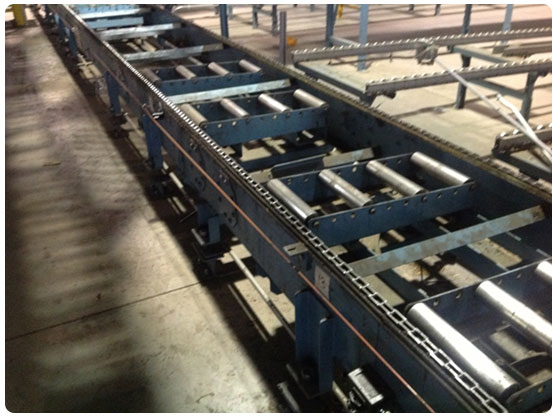
A chain conveyor uses one or more continuous roller or forged steel chains running on a steel frame to move products along a fixed path — with products supported on slats, pallets, or bars attached to the chain, or pushed by chain-mounted pushers. The positive chain drive makes chain conveyors uniquely capable of moving heavy, hot, abrasive, or irregularly shaped products that would damage or slip on a rubber belt.
Positive drive — why chain outperforms belt for heavy loads
A belt conveyor drives products by friction between the belt surface and the product base — acceptable for moderate loads and even surfaces, but subject to slippage under heavy point loads, at inclines, and when products have irregular bases. A chain conveyor engages products positively — slats, pallet supports, or pushers attached directly to the chain hold and move products regardless of weight, surface roughness, or incline angle.
This positive engagement makes chain conveyors the only reliable choice for pallets (500–2,000 kg), industrial drums, automotive body panels, heavy machine components, hot castings, and any product where belt slippage or belt damage is unacceptable.
Heat resistance and hostile environments
Rubber belts degrade in high-temperature environments (above 80°C continuous), in environments with oils, chemicals, and abrasive dust, and under heavy impact from falling products. Forged steel chain conveyors handle temperatures up to 300°C, are unaffected by oils and chemicals, and withstand heavy impact loads from casting, forging, and foundry operations.
In foundries, forge shops, cement plants, and outdoor industrial environments where rubber belts would fail within months, chain conveyors run reliably for years. Our engineers specify the correct chain type and lubrication system for your temperature and environment at no charge.
How a Chain Conveyor Works
Four stages — from motor drive through chain, to product movement and discharge — all controlled by positive chain engagement rather than belt friction.
A geared motor drives the head (drive) sprocket — the sprocket's teeth positively engage the chain links, pulling the chain around the drive sprocket. Unlike belt drives that rely on friction, the sprocket teeth lock into the chain links — no slippage possible regardless of load.
Products are supported on slats, pallet support bars, or pusher attachments bolted to the chain. On the carrying (upper) run, the chain travels forward and products move with it at the set conveyor speed. Chain speed is controlled precisely by the drive sprocket — adjustable via VFD.
Pneumatic stops, PLC-controlled gates, or sensors can stop products at workstations while the chain continues moving underneath. For pallet conveyors with accumulation, pneumatic chain lifters raise sections to allow product accumulation without stopping the chain.
After product discharge at the head, the empty chain runs back on the lower return run (underneath the carrying run) to the tail sprocket and back to the loading point. Chain tension is maintained by a take-up arrangement at the tail — screw take-up for short conveyors, gravity take-up for long chains.
Advantages of Chain Conveyors
Five engineering advantages that make chain conveyors the preferred material handling system for heavy, hot, and abrasive products across India's automotive, cement, engineering, and logistics industries.
Heavy Load Handling
Point loads up to 2,000 kg per pallet — far beyond the capability of belt or roller conveyors. Twin strand and heavy-duty chain configurations handle automotive sub-assemblies, engine blocks, heavy castings, and loaded pallets that would deflect and damage belt conveyor frames.
Positive Drive System
Sprocket teeth engage chain links positively — no slippage, no speed variation, no product slipping backward on inclines. The chain speed is exactly the motor speed divided by the drive ratio — consistent and precise at every operating condition, independent of product weight or incline angle.
Reliable Performance
Heavy-duty forged chain, hardened sprockets, and steel frame construction deliver years of reliable operation in harsh environments — foundry heat, cement dust, outdoor weather, and oil-contaminated automotive plant environments — where belt conveyors fail within months.
Long Service Life
Properly lubricated roller chain lasts 5–10 years in normal industrial environments. Chain wear is gradual and predictable — periodic chain tension adjustment maintains performance as the chain stretches, and chain replacement is straightforward with standard tools.
Low Maintenance Design
No belt to track, no belt tension to adjust continuously, no belt to replace. Chain tensioning is a periodic operation (every 3–6 months) — adjust the take-up unit until the correct chain sag is achieved. Chain lubrication via drip oiler or spray lubrication system.
Heat & Abrasion Resistance
Forged chain operates at temperatures up to 300°C — foundries, forge shops, and high-temperature process conveyors. Hardened chain links resist wear from abrasive cement, ore, and mineral materials that cut and degrade rubber belts in weeks.
Types of Chain Conveyors
Five chain conveyor configurations — each suited to a specific product type, load range, and application. Our engineers specify the correct type for your product and environment.
A heavy-duty chain with attached flight bars (drag flights) pulls bulk material along an enclosed trough — similar in principle to a screw conveyor but using a chain-and-flight mechanism. Handles hot clinker, coal, heavy ore, and bulk materials that would damage a belt. Fully enclosed for dust control.
Best for: clinker, coal, hot ore, bulk mineralsFlat steel slats (plates) bolted across two parallel chains form a continuous platform — products rest on the slats and move with the chain. Handles products that cannot span roller gaps (bottles, cans, pouches) and products requiring a flat, rigid conveying surface at controlled speed. Common in food, beverage, FMCG, and automotive paint lines.
Best for: bottles, cans, FMCG, auto paint linesTwo parallel chains with pallet support bars carry loaded pallets (500–2,000 kg) along the conveyor — the chain positively engages the pallet base, moving it at set speed. Stop stations, pallet transfers, and lifts integrate with PLC for automated pallet routing. Standard for warehouse automation and manufacturing pallet lines.
Best for: warehouse pallets, manufacturing, logisticsTwo parallel roller chains spaced to match the product's base width — drums, barrels, crates, and cylindrical containers rest across both chains. Chain spacing adjustable for different product sizes. Used for steel drums, paint cans, LPG cylinders, barrels, and industrial containers in filling, labelling, and dispatch lines.
Best for: drums, barrels, crates, cylindersForged chain, heavy-duty frame, and high-torque drive for automotive sub-assemblies, engine blocks, castings, and heavy engineering components exceeding 1,000 kg per point load. Custom designed for each application — chain pitch, strand spacing, stop station positions, and PLC integration specified for your assembly line layout.
Best for: automotive, engine blocks, castingsApplications of Chain Conveyors
Chain conveyors are deployed wherever heavy loads, positive drive, or heat resistance makes belt conveyors unsuitable — from automotive assembly lines to cement plants and warehouse pallet systems.
Automotive Industry
Body panel conveyors in paint shops, engine sub-assembly lines, chassis conveyor lines, component washing and assembly sequences. Heavy-duty twin strand and pallet chain — PLC-controlled stop stations at each assembly position, integration with overhead conveyors and lifts.
Warehouse & Logistics
Pallet chain conveyors for FMCG, retail, e-commerce, and industrial distribution — connecting receiving docks, storage, picking, packing, and despatch through automated pallet routing systems with VFD speed control and PLC integration.
Cement Industry
Drag chain conveyors for hot clinker, coal, and mineral handling at cement plants — where belt conveyors fail due to temperature (clinker up to 200°C) and abrasiveness. Enclosed drag chain trough provides dust-free conveying of abrasive clinker from cooler to silo.
Food & Beverage Industry
Slat chain conveyors for glass bottles, PET bottles, cans, and pouches — between filling, capping, labelling, and packing machines at 200–600 products/minute. SS304 construction with food-grade lubricant. Variable speed via VFD for production matching.
Packaging Industry
FMCG and retail packaging end-of-line systems — cartons, cases, and trays on slat chain between case packer, checkweigher, and palletiser. Heavy pallet chain for slip-sheet pallet build and stretch-wrapping stations.
Engineering Industry
Heavy component conveyors for foundries, forge shops, and engineering plants — castings, forgings, machined parts on twin strand or slat chain between machining centres, heat treatment, and assembly. High-torque drive for heavy irregular components.
Technical Specifications
All chain conveyors are made-to-order. Chain type, strand spacing, drive specification, and automation provisions are calculated from your product weight, required speed, and automation level.
| Parameter | Specification |
|---|---|
| Conveyor types | Drag chain, slat chain, pallet chain, twin strand, heavy duty |
| Chain type | Roller chain (standard/heavy) / forged chain (extreme load/heat) |
| Frame width | 300 mm to 2,000 mm (custom) |
| Conveyor length | Any length — single or multi-section |
| Point load capacity | 100 kg to 2,000 kg per pallet (custom for higher) |
| Temperature range | Ambient to 300°C (forged chain) |
| Chain speed | 0.05 m/s to 0.5 m/s (VFD adjustable) |
| Frame material | MS (standard) / SS304 (food/pharma) / SS316 (corrosive) |
| Slat material | MS / galvanised / SS / UHMWPE (food grade) |
| Chain lubrication | Manual / drip oiler / automatic spray — per environment |
| Automation | VFD, PLC I/O, proximity sensors, stop stations, reject gates |
| Power supply | 415 V, 3 Phase, 50 Hz |
Load Capacity Options
Chain Type Options
Drive Systems
Download Chain Conveyor Catalogue
Types, chain specs, load tables, case studies — PDF, free.
Download PDFHow to Select the Right Chain Conveyor
Five parameters our engineers use to specify chain type, strand configuration, drive system, and automation level for your application.
Chain Conveyors — Live at Customer Plants
Real Neo Conveyors chain conveyor systems in operation — automotive, warehouse pallet, and industrial installations across India.
More installation videos: youtube.com/@neoconveyors
Chain Conveyor vs Belt Conveyor
Both conveyors move products along a fixed path — the product weight, temperature, and surface characteristics determine which is the correct choice.
| Feature | ✅ Chain Conveyor (This page) | Belt Conveyor |
|---|---|---|
| Heavy load (500–2,000 kg) | Excellent — forged chain handles 2,000 kg+ | Moderate — belt and frame limit heavy loads |
| Pallet handling | Excellent — standard pallet chain specification | Moderate — belt sag under heavy pallets |
| Heat resistance | Excellent — forged chain up to 300°C | Moderate — belt degrades above 80°C |
| Abrasive materials | Good — hardened chain outlasts rubber belt | Belt wear is rapid with abrasive materials |
| Drive type | Positive — no slippage on inclines or heavy loads | Friction — slippage risk on steep inclines |
| Bulk material (powder) | Good (drag chain) | Excellent — troughed belt standard for bulk |
| Maintenance | Moderate — chain lubrication + tensioning | Low — belt tracking, no lubrication |
| Noise level | Higher — chain-sprocket engagement | Lower — rubber belt quieter |
| Best applications | Pallets, automotive, heavy products, hot materials | Bulk material, FMCG cartons, light products |
Need bulk material or lighter product conveying? Belt Conveyor → | Troughed Belt Conveyor →
Recent Chain Conveyor Installations
Four recent projects — automotive, pallet, cement bag, and engineering — with full engineering parameters and results achieved.
Automotive tier-1 supplier needed engine sub-assemblies (60–120 kg per tray) conveyed 25 m through 6 assembly workstations with PLC-controlled stops at each station. Twin strand forged chain with 8 stop stations, proximity sensors at each station, and integration with assembly line PLC for takt time control.
FMCG distribution centre needed 60 m of pallet chain conveyor routing 800 kg loaded pallets from receiving dock through storage, picking, and despatch — 4 transfer lifts, 3 90° transfers, VFD speed zones, and WMS integration for pallet routing by barcode. Pallet attachment chain on MS heavy frame.
Cement plant packing section needed 50 kg cement bags conveyed 20 m from packing machine to truck loading point — bags travel on flat slats, heavy abrasive dust environment, 3-shift operation. Heavy-duty slat chain with galvanised slats, sealed chain pins, auto-lubrication system, and dust-sealed frame covers for cement dust environment.
Industrial lubricant manufacturer needed steel drums (200-litre, up to 220 kg filled) moved through drum filling, bunging, and labelling stations — 3 process stops, precise positioning under filling head. Twin strand chain with drum support bars, 3 pneumatic stop stations, proximity sensors, and VFD for 4 drums/minute throughput.
Why Choose Neo Conveyors?
Every chain conveyor is engineered for your product, load, temperature, and automation requirement — fabricated in-house at Ghaziabad and installed by our own engineers across India.
Chain type, strand spacing, sprocket specification, and drive torque calculated from your product weight and environment. Not adapted from a standard catalogue — designed for your exact load and application.
18+ years of chain conveyor projects across automotive, warehouse, cement, food, beverage, and engineering industries. References from clients in your sector available on request.
Drag, slat, pallet, twin strand, and heavy-duty chain conveyors all manufactured in-house — the correct type for your application specified and fabricated without third-party subcontracting.
VFD zones, PLC stop stations, proximity sensors, and reject gates designed into the conveyor from the start — enabling full integration with WMS, SCADA, and production control systems.
Installation, chain fitting, alignment, take-up adjustment, and commissioning by Neo Conveyors' own team. No third-party erection contractors for any chain conveyor installation.
Replacement chain lengths, sprockets, slats, and bearings stocked for all standard chain conveyors. Annual Maintenance Contracts and rapid-response service available PAN India.
Related Conveyor Solutions
Chain conveyors are typically part of a larger material handling system. Explore the belt, roller, and assembly line conveyors that connect to or complement your chain conveyor system.
Frequently Asked Questions
Chain Conveyor — Service Locations Across India
Manufactured at our Ghaziabad facility — installed and commissioned by our own engineers at automotive plants, warehouses, cement plants, food and beverage facilities, and engineering plants across all Indian states.
Request a Free Quote — System Design Included
Share your product weight, dimensions, conveyor length, temperature, and automation requirement. Our engineers specify chain type, strand spacing, and drive — and send a GA drawing with quotation at no charge within 24 hours.