Roller on Bed Flat Belt conveyor Manufacturer in India
Neo conveyors are manufacturer of custom roller bed belt conveyors for heavy loads and long runs — warehousing, logistics, manufacturing, packaging, and distribution. Spaced idler rollers under the belt reduce friction, cut motor power, and extend belt life. MS and SS frames. Custom widths and lengths. PAN India installation.
What Is a Roller Bed Belt Conveyor?
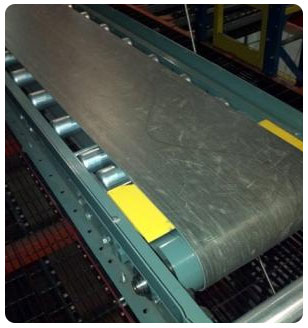
A roller bed belt conveyor supports the carrying run of the belt on spaced idler rollers rather than a flat plate — dramatically reducing friction, extending belt life, and cutting motor power for heavy loads and long conveyor runs.
The roller bed — what it is
Spaced cylindrical idler rollers are mounted across the width of the conveyor frame at regular intervals — typically every 150 mm to 600 mm depending on product weight. The carrying run of the belt rests on these rollers rather than sliding along a flat plate.
Because the belt rolls over the rollers rather than dragging along a plate, friction is reduced by 60–80% compared to a steel slider plate. This is the defining engineering advantage: at heavy loads and long lengths, this friction reduction translates directly into smaller motors, lower energy bills, and significantly longer belt life.
When a roller bed is the right choice
The roller bed is the engineer's choice whenever a slider bed would require an oversized motor — typically when product load exceeds approximately 50 kg per metre of conveyor, or when the conveyor is longer than 15 metres.
On a 40 m conveyor carrying 200 kg/m loads, the difference in required motor power between slider bed and roller bed can be 2–3× — making the roller bed not just preferable but necessary for practical, energy-efficient operation.
Key Components at a Glance
PVC / PU / Rubber
MS / GI / SS
MS / SS304 / SS316
Geared + VFD
Drive + Tail
Belt return support
Free conveyor sizing included: Share your product or load weight per metre, belt width, and conveyor length. Our engineers calculate roller spacing, motor power, and belt tension — and confirm whether roller bed or slider bed is the correct choice — at no charge, with a GA drawing attached to the quotation. Send load details →
How Does a Roller Bed Conveyor Work?
The principle is the same as any flat belt conveyor — but the idler roller support system changes the friction physics entirely for heavy loads and long runs.
Load placed at infeed
Product or load is placed on the belt at the infeed end. The belt is tensioned between the drive pulley (head) and tail pulley — with idler rollers spaced to match the product base and load weight.
Belt rolls over idler rollers
As the motor drives the head pulley, the belt moves forward. The carrying run rolls over each idler roller in sequence — bearing friction is minimal, far below the drag of a slider plate under heavy load.
Return rollers support return run
The empty return run of the belt is supported by spaced return rollers below the carrying run — preventing belt sag on long conveyors and maintaining correct tension throughout the belt loop.
Discharge at outfeed
Products discharge over the head pulley into a chute, stacking area, or downstream conveyor. Diverters, side transfers, and integrated weighing scales can be mounted at any point along the roller bed run.
Engineering note: Roller spacing = product base length ÷ 3 (minimum 3 rollers under any product at all times). Motor power = (belt weight + load weight) × friction factor × speed ÷ efficiency. Send your load data for a free calculation.
Benefits of Roller Bed Belt Conveyors
Five engineering advantages that make the roller bed the right choice whenever load, length, or energy efficiency is the primary constraint.
Reduced Belt Friction
Belt rolls over idler rollers rather than dragging on a plate — reducing running friction by 60–80%.
Suitable for Heavy Loads
Roller bed conveyors handle loads from 50 kg/m to 500 kg/m or more — comfortably covering heavy cartons, industrial parts, bags, drums, and pallets.
Long Belt Life
On a slider bed running a heavy load over 30 m, belt replacement may be needed annually. The same load on a roller bed typically sees belt life of 3–5 years.
Energy Efficient Operation
Lower friction = smaller motor = lower electricity consumption. On a 40 m heavy-duty conveyor, motor size difference can be 2–3×.
Low Maintenance Requirements
Individual idler rollers are replaced independently without removing the belt. Sealed bearings require no greasing for 12–18 months.
Long Runs Without Intermediate Drives
Low friction allows single-drive motor configurations for conveyor runs up to 100 m+ that would require multiple drives on a slider bed.
50–500+ kg/m
200–2000 mm
15–100 m+
0.1–60 m/min
Applications of Roller Bed Conveyors
The roller bed is the preferred conveyor wherever heavy loads, long runs, or energy efficiency makes a slider bed impractical — across warehousing, logistics, manufacturing, and distribution.
Warehouse Material Handling
Heavy carton and case movement from receiving docks through storage and picking zones — long roller bed runs across mezzanine floors and dock levellers.
Packaging Lines
Heavy filled cases, master cartons, and shrink-wrapped multipacks from end-of-line packing machines to palletisers — 20–50 m runs.
Manufacturing Plants
Heavy components, sub-assemblies, castings, and industrial parts between machining, washing, inspection, and dispatch.
Logistics Centers
Parcel and cargo movement through sortation, scan, weigh, and despatch at speeds up to 60 m/min with VFD-controlled zones.
Distribution Warehouses
FMCG, retail, and e-commerce distribution centres — heavy pallet and case movement integrated with sortation and truck-loading conveyors.
Assembly Operations
Heavy product assembly lines carrying engine blocks, large sub-assemblies, or industrial equipment between stations.
Technical Specifications
All roller bed conveyors are made-to-order. Roller spacing, belt width, motor size, and frame construction are calculated based on your actual load per metre and conveyor length.
| Parameter | Specification |
|---|---|
| Conveyor type | Roller bed horizontal belt conveyor |
| Belt width | 200 mm to 2000 mm (custom) |
| Conveyor length | 15 m to 100 m+ (single or multi-section) |
| Load capacity | 50 kg/m to 500+ kg/m (calculated per roller spacing) |
| Belt speed | 0.1 m/min to 60 m/min (VFD adjustable) |
| Working height | 700 mm to 1000 mm (adjustable leg options) |
| Idler roller dia. | 50 mm, 63 mm, 76 mm, 89 mm (as per load) |
| Idler roller spacing | 150 mm to 600 mm (calculated per product base and load) |
| Return roller dia. | 50 mm to 76 mm — spaced at 1.5–3 m |
| Belt material | PVC general / PU / Rough-top / Rubber heavy-duty |
| Side guides | Fixed / adjustable MS or SS side rails |
| Power supply | 415 V, 3 Phase, 50 Hz |
Roller Material
Mild Steel Rollers
Standard industrial option — powder-coated or epoxy-painted. Best for dry, ambient-temperature environments. Most economical.
Galvanised Rollers
Hot-dip galvanised steel — for humid, outdoor, or slightly corrosive environments. Dairy, beverage, cold storage.
Stainless Steel Rollers (SS304 / SS316)
For food, pharma, chemical, and washdown environments. SS316 for aggressive chemicals or coastal installations.
Drive System
Direct Drive System
Motor shaft directly coupled to drive pulley via flexible coupling — lowest mechanical complexity, for short conveyors.
Gear Motor Drive
Helical or worm gearbox between motor and pulley — torque multiplication for heavy-load roller bed conveyors. Most common.
Variable Frequency Drive (VFD)
Speed adjustable from 0.1 m/min to full rated speed — standard on all Neo Conveyors roller bed systems.
Roller bed frames are fabricated from MS channel or RHS section — sized based on conveyor length, span between legs, and maximum load. MS frames are powder-coated or epoxy-painted for corrosion resistance. SS304/SS316 frames are available for food, pharma, and corrosive environments. All joints are fully welded with ground flush — no exposed bolt heads inside the conveyor path.
Products & Loads We Handle
- Heavy Cartons
- Filled Cases
- Pallets
- Drums & Barrels
- Bags (50 kg)
- Industrial Parts
- Auto Components
- Castings
- Metal Fabrications
- Wooden Crates
- E-comm Parcels
- Master Cartons
- FMCG Shipper
- Shrink Packs
- Stretch-Wrapped
- Jumbo Bags
Roller Bed Conveyor vs Slider Bed Conveyor
Both use the same belt, motor, and frame. The difference is what supports the belt underneath — and that single decision determines the correct choice for your load and length.
| Feature | Roller bed (this page) | Slider bed |
|---|---|---|
| Under-belt support | Spaced idler rollers | Flat continuous plate |
| Heavy loads (>50 kg/m) | Excellent — low friction | Motor oversizes — belt wears fast |
| Long lengths (>15 m) | Efficient — single drive | Multiple drives often needed |
| Belt friction | 60–80% lower than slider | Higher — plate drag |
| Belt life | 3–5 years typical | 1–2 years on heavy loads |
| Energy use | Lower — smaller motor | Higher for same load |
| Small product base | Must bridge roller gaps | Any product size — gap-free |
| Capital cost | Slightly higher — roller components | Lower for short light runs |
| Maintenance | Replace individual rollers | Belt only — simpler |
| Best application | Heavy / long — warehousing, logistics, manufacturing | Light / short — pharma, FMCG, food |
Need light product, short run, food or pharma? Slider Bed Belt Conveyor →
Roller Bed Belt Conveyors — Live at Customer Plants
Real Neo Conveyors roller bed belt conveyor systems in operation — heavy load and long-run installations at warehousing, logistics, and manufacturing facilities across India.

Roller Bed Conveyor Systems in Operation
More installation videos: youtube.com/@neoconveyors
Recent Roller Bed Conveyor Installations
Three representative roller bed conveyor projects across warehousing, packaging, and distribution — different loads, lengths, and industries.
Warehouse Conveyor — Roller Bed MS, 60 m Heavy Carton Line
FMCG distribution warehouse needed a 60 m roller bed belt conveyor carrying filled master cartons (18–24 kg each) across a mezzanine floor. Slider bed trialled previously — motor overheated and belt replaced every 8 months. Roller bed with spaced MS idler rollers at 200 mm pitch and single 5.5 kW geared motor with VFD installed.
- Motor reduced from 15 kW (slider) to 5.5 kW
- 60 m at 25 m/min — single drive unit
- Belt life: 18 months and running vs 8 months previously
Packaging Conveyor — Roller Bed MS, End-of-Line Case Packing
FMCG manufacturer needed a 35 m roller bed conveyor carrying shrink-wrapped multi-packs (12–30 kg) from case packer to palletiser. Roller bed with 250 mm idler pitch and intermediate gravity accumulation section installed — allows palletiser to run independently of case packer speed.
- Accumulation zone — decouples packer from palletiser
- 35 m, 4 kW motor — energy saving vs 7.5 kW slider
- 3-shift sustained — zero belt change in 14 months
Distribution Centre Conveyor — Roller Bed MS, Parcel Sortation
E-commerce distribution centre needed 45 m of roller bed belt conveyor for parcels up to 25 kg across a split-level facility. Roller bed on main run with powered roller divert belts at 5 sortation points. VFD with speed zones at merge points to prevent parcel pile-up.
- 45 m main line + 5 divert stations integrated
- 4,200 parcels/hour peak — sustained 3 shifts
- Running 22 months — no belt replacement required
Why Choose Neo Conveyors
Every roller bed conveyor is designed, fabricated, and tested in-house at our Ghaziabad plant — then installed by our own engineers. No dealers. No sub-contractors.
In-house manufacturing — established 2007
Every conveyor fabricated at our Ghaziabad plant — frame cutting and welding, roller fitting, belt installation, and VFD commissioning all done in-house.
1,000+ conveyor installations
Over 1,000 belt conveyor systems installed across Indian industry since 2007 — warehousing, logistics, FMCG, manufacturing, and distribution.
Load-first roller selection — not catalogue selling
We calculate roller spacing, motor size, and belt tension based on your actual load per metre — then confirm whether roller bed or slider bed is correct, at no charge.
PAN India — own installation engineers
Installation, commissioning, VFD setup, and belt tracking by Neo Conveyors' own team across all Indian states.
MS, galvanised, SS304 & SS316 rollers in-house
All roller materials fabricated or sourced in-house — no waiting for special roller orders.
Spare rollers & AMC — full operational life
Replacement idler rollers, return rollers, belts, and pulleys stocked for all conveyor sizes. AMC available PAN India.
Roller Bed Belt Conveyor FAQs
What is a roller bed belt conveyor?
A roller bed belt conveyor supports the carrying run of the belt on spaced idler rollers — rather than a flat plate as in a slider bed conveyor. The belt rolls over the rollers rather than dragging on a plate, reducing friction by 60–80%. This makes it the preferred choice for heavy loads above 50 kg/m and long conveyor runs above 15 metres.
When should I choose a roller bed over a slider bed belt conveyor?
Choose roller bed when your load exceeds approximately 50 kg per metre of conveyor length, your conveyor is longer than 15 metres, energy efficiency is important, or you need to minimise belt replacement frequency. For light products under 50 kg/m and short runs under 15 m, a slider bed is simpler and more economical. See our Slider Bed Belt Conveyor page.
What materials can roller bed conveyors handle?
Roller bed belt conveyors handle heavy cartons, filled master cases, pallets, drums, 50 kg bags, industrial parts, automotive components, castings, metal fabrications, wooden crates, FMCG master shippers, e-commerce parcels, and any medium to heavy product with a flat base.
What roller materials are available?
Neo Conveyors supplies roller bed conveyors with mild steel rollers for dry indoor environments, galvanised steel rollers for humid or slightly corrosive environments, SS304 rollers for food and pharma, and SS316 rollers for aggressive chemical or coastal environments.
What is the maximum load capacity and conveyor length?
Neo Conveyors manufactures roller bed belt conveyors up to 500 kg/m distributed load as standard, with higher-capacity designs available for special applications. Conveyor lengths from 15 m to 100 m+ as single or multi-section runs.
Can roller bed conveyors handle food or pharma applications?
Yes — for food and pharma applications requiring a roller bed, Neo Conveyors manufactures roller bed conveyors with galvanised or SS304/SS316 idler rollers, SS frame, food-grade belt, and IP65 motor. For light pharma products such as blister packs, a slider bed conveyor is usually more suitable.
Can Neo Conveyors customise conveyor dimensions?
Yes — every roller bed conveyor is made-to-order. Belt width from 200 mm to 2000 mm, any conveyor length with no catalogue limit, roller diameter and spacing calculated for your specific load. All dimensions confirmed in a GA drawing with the quotation, at no charge.
What is the price of a roller bed belt conveyor in India?
Price depends on belt width, conveyor length, idler roller material, roller diameter, frame material, belt type, and motor/VFD specification. Contact Neo Conveyors at +91-9654112235 for a no-obligation quotation.
What is the delivery and installation lead time?
Standard MS roller bed belt conveyors: 3–5 weeks from order confirmation. SS and galvanised roller bed conveyors: 5–7 weeks. Installation by Neo Conveyors' own engineers — typically 2–5 days depending on length and number of sections.
Roller Bed Belt Conveyor — Service Locations Across India
Manufactured at our Ghaziabad facility — installed and commissioned by our own engineers across all major industrial states and cities in India.
Uttar Pradesh & Delhi NCR
Ghaziabad (HQ & Plant), Noida, Greater Noida, Lucknow, Kanpur, Agra, Meerut, Moradabad, Mathura, Aligarh, Bareilly, Gorakhpur, Varanasi, Sahibabad, New Delhi, Gurugram, Faridabad, Manesar, Bhiwadi, Bawal, Neemrana, Sonipat, Kundli, Rohtak
Haryana, Punjab, Himachal Pradesh & Uttarakhand
Panipat, Ambala, Hisar, Karnal, Yamunanagar, Rewari, Palwal, Kurukshetra, Ludhiana, Amritsar, Jalandhar, Patiala, Bathinda, Mohali, Phagwara, Baddi, Solan, Shimla, Haridwar, Roorkee, Rudrapur, Dehradun, Kashipur
Rajasthan & Gujarat
Jaipur, Jodhpur, Udaipur, Kota, Ajmer, Alwar, Bhiwadi, Chittorgarh, Sikar, Ahmedabad, Surat, Vadodara, Rajkot, Gandhinagar, Bharuch, Anand, Vapi, Morbi, Mundra
Maharashtra & Madhya Pradesh
Mumbai, Pune, Nagpur, Nashik, Aurangabad, Thane, Navi Mumbai, Solapur, Kolhapur, Pimpri-Chinchwad, Chakan, Indore, Bhopal, Jabalpur, Pithampur, Dewas, Ujjain, Ratlam
Telangana, Andhra Pradesh & Tamil Nadu
Hyderabad, Secunderabad, Visakhapatnam, Vijayawada, Guntur, Kakinada, Tirupati, Chennai, Coimbatore, Madurai, Salem, Tiruchirappalli, Hosur, Erode, Vellore
Karnataka, Kerala, West Bengal & East India
Bangalore, Mysuru, Hubli, Mangaluru, Tumkur, Belagavi, Dharwad, Kochi, Thiruvananthapuram, Kozhikode, Thrissur, Kollam, Kannur, Kolkata, Howrah, Durgapur, Asansol, Siliguri, Haldia, Bhubaneswar, Patna, Ranchi, Jamshedpur
Chhattisgarh, North East India & International
Raipur, Bhilai, Durg, Bilaspur, Korba, Guwahati, Dibrugarh, Silchar, Shillong, Agartala, and internationally: UAE (Dubai / Abu Dhabi), Bangladesh, Nepal, Sri Lanka, Africa, Southeast Asia
From the Neo Conveyors Blog
More on heavy-load and bulk material conveyor selection from our blog.
Conveyor Systems for Warehousing, Manufacturing & Bulk Handling
Why the right under-belt support matters for heavy loads and long conveyor runs in Indian industry.
Blog IndexMore Conveyor Guides & Case Studies
Browse the full Neo Conveyors blog for buying guides, industry use-cases, and product deep-dives.
Explore Related Conveyor Solutions
The roller bed is one of several belt conveyor variants Neo Conveyors manufactures. If your application is different — lighter products, inclination, or assembly line — explore these dedicated pages.
Request a Free Quote
Share your load per metre, belt width, and conveyor length. Our engineers calculate roller spacing and motor size — and send a GA drawing with quotation at no charge.