Drag Chain conveyor Manufacturer in India
Drag Chain Conveyor Manufacturer in India
Custom enclosed drag chain conveyors (Redler / en-masse conveyors) for dust-free horizontal and inclined bulk material conveying — fly ash, coal, clinker, biomass, wood chips, rice husk, grain, fertilizer, and mineral powders. Up to 200 TPH. Up to 60 m per section. Forged and roller chain options. MS, SS304, AR400 liner.
What is a Drag Chain Conveyor?
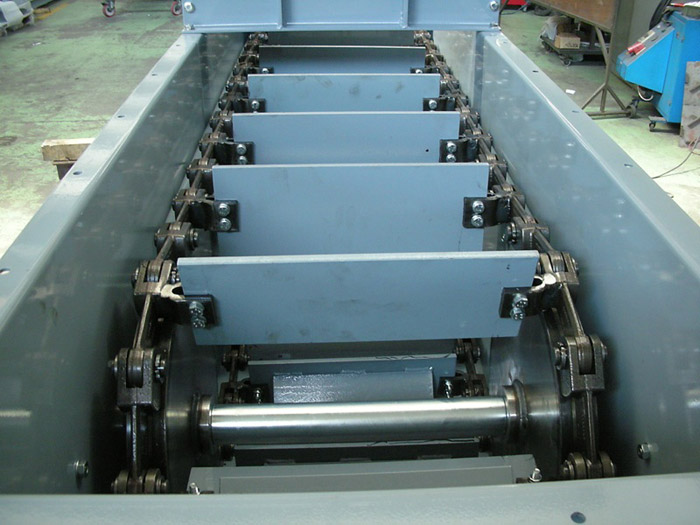
A drag chain conveyor (also called a Redler conveyor or en-masse conveyor) uses a continuous chain with attached flight bars moving through a fully enclosed rectangular trough — dragging bulk material along the trough floor while also carrying it as an en-masse column between flights. The result: very high capacity in a compact, fully dust-sealed cross-section.
The en-masse principle — why capacity is exceptional
In a standard drag conveyor, only material directly pushed by each flight bar moves. In an en-masse type (Redler principle), flights are spaced so that material between adjacent flights is also carried forward as a continuous column — filling the full trough cross-section between chain and trough floor simultaneously.
This en-masse carrying gives 2–3× the conveying capacity of a screw conveyor of equivalent trough cross-section, at lower power per tonne — making drag chain conveyors the preferred choice for high-capacity enclosed bulk material handling over distances that screw conveyors cannot achieve economically.
Fully enclosed — complete dust containment
The completely enclosed rectangular trough — sealed cover plate, flanged gasketed inlet and outlet connections, and no rotating shaft penetrations along its length — gives total dust containment throughout the conveying path. Unlike troughed belt conveyors open to atmosphere above the material, or screw conveyors with cover plate joint gaps, the drag chain trough is sealed from inlet to outlet.
This total enclosure is why drag chain conveyors are the standard specification at fly ash handling systems, cement raw material transfer, and biomass fuel handling wherever PCB dust emission compliance, worker health protection, or outdoor weatherproofing of material is required.
Advantages of Drag Chain Conveyors
Six engineering advantages that make the drag chain conveyor the preferred enclosed bulk material handling system for long-distance, high-capacity, and dusty applications.
Dust-Free Material Handling
Complete rectangular trough enclosure with sealed inlet and outlet connections — zero dust emission at any point along the conveying path. Meets PCB ambient dust standards for fly ash and cement dust without additional extraction. Weatherproof for outdoor installation.
High Capacity Conveying
En-masse effect carries material across the full trough cross-section — up to 200 TPH in standard trough sizes. Significantly higher capacity per unit of trough cross-section compared to a screw conveyor of the same physical size, at lower power per tonne.
Minimal Material Spillage
Fully enclosed trough and sealed connections eliminate material spillage. No belt edge to spill over, no cover plate gaps for material to escape — critical for expensive materials (biomass fuel, grain) and for maintaining a clean, compliant plant environment.
Low Maintenance
No hanger bearings inside the trough — unlike screw conveyors, there are no intermediate bearings in the material zone to pack and seize. Only head and tail sprocket bearings plus chain tension require periodic attention. Trough liner replacement is done in-place by unbolting cover plate sections.
Long Service Life
Forged drop chain and hardened flight bars resist the abrasive wear that rapidly destroys screw conveyor flights handling clinker, coal, and mineral powders. Properly specified chain and AR400 liner achieves 3–5+ years between major maintenance in most bulk material applications.
Long Distance Conveying
Single sections up to 60 m — far exceeding the practical length of screw conveyors (typically under 15 m). For conveying distances of 20–60 m, drag chain conveyors are the most economical enclosed conveying solution, with lower power consumption per tonne per metre than screw conveyors at these distances.
Types of Drag Chain Conveyors
Five configurations for every material, capacity, and installation requirement — from standard horizontal en-masse to heavy-duty forged chain for abrasive hot materials.
Standard horizontal en-masse drag chain — most common configuration for cement plants, power plants, and grain handling. Multiple intermediate inlets and outlets for multi-point feed/discharge. Up to 60 m single section. Up to 200 TPH.
Best for: fly ash, cement, grain, fertilizerSame enclosed trough design configured for inclinations from 0° to 45° — elevating bulk material between floor levels without a separate vertical elevator. Short-pitch chain and closer flight spacing maintain material column on the incline. Capacity calculated for your inclination angle.
Best for: multi-floor plants, space-saving elevationFully sealed variant with pressure-rated inspection doors, flanged gasketed inlet/outlet spouts, shaft seal arrangements, and optional negative-pressure port for dust extraction. For strict PCB dust emission requirements at fly ash and cement plant locations.
Best for: PCB compliance, outdoor, weatherproofForged drop chain, AR400 trough liner, heavy-duty MS frame, and high-torque drive — for highly abrasive materials (coal, clinker, minerals) and elevated temperatures. Chain selected for specific abrasiveness index of your material — no standard roller chain.
Best for: clinker, coal, hot ash, abrasive mineralsThe original Redler-principle en-masse conveyor — U-shaped or T-shaped flights on a single central chain that maximise en-masse carrying efficiency. Most compact cross-section for a given capacity. Standard for grain, seeds, and fine free-flowing materials.
Best for: grain, seeds, fine free-flowing materialsMaterials Handled
Drag chain conveyors handle the widest material range of any enclosed conveyor type — from fine fly ash to coarse coal, from light biomass chips to dense mineral powders and grain.
Fly Ash
Coal
Cement Clinker
Biomass Fuel
Wood Chips
Bagasse
Rice Husk
Grain
Fertilizer
Mineral Powders
Industries Using Drag Chain Conveyors
Drag chain conveyors are deployed wherever enclosed, high-capacity, long-distance bulk material handling is required across cement, power, biomass, grain, sugar, chemical, and mining sectors in India.
Cement Plants
Raw meal transfer from raw mill to blending silos, clinker from cooler to silo, and cement powder inter-unit transfer. Heavy-duty enclosed drag chain — 24×7 kiln operation at 50–200 TPH with PCB dust compliance as standard.
Power Plants
Fly ash from ESP hoppers and bottom ash from hoppers to silos at thermal power plants. Coal handling between crusher, bunkers, and stockpile. Forged chain for abrasive coal and ash at elevated temperatures.
Biomass Plants
Biomass chips, rice husk, and wood pellet transfer from outdoor storage to boiler feed. Enclosed trough prevents fire risk from biomass dust and protects material from moisture during outdoor storage to boiler transit.
Rice Mills
Rice husk conveying from husking to furnace/boiler. Paddy and milled rice between process stages — Redler type for gentle grain handling. Enclosed for pest control and FSSAI hygiene compliance.
Sugar Industry
Bagasse transfer from mill to boiler. Heavy wet fibrous bagasse — large trough, wide chain pitch. Enclosed for fire safety. Also for sugar transfer between process units at refined sugar plants.
Chemical Industry
Chemical powder, mineral filler, and industrial material transfer where complete dust enclosure is required for worker safety, environmental compliance, and prevention of cross-contamination between production areas.
Mining Industry
Mineral concentrate, ore fines, and processing waste transfer between crushing, screening, and processing stages. Forged chain and AR400 liner for highly abrasive mining materials. Enclosed for silica dust OEL compliance.
Fertilizer Plants
Urea, DAP, potash, and granular fertilizer between blending, conditioning, and storage. Sealed trough for hygroscopic material moisture protection. SS304 construction for coastal and high-humidity environments.
Grain Silos
Wheat, maize, soybean, and grain between intake, cleaning, drying, and storage silos — Redler en-masse for efficient grain handling. Fully enclosed pest control, moisture protection, and fire safety.
Technical Specifications
All drag chain conveyors are made-to-order. Trough cross-section, chain type, flight spacing, and motor power are calculated from your material's bulk density, required TPH, conveyor length, and inclination.
| Parameter | Specification |
|---|---|
| Conveyor type | En-masse drag chain — fully enclosed rectangular trough |
| Trough width | 200 mm to 800 mm (per required capacity and material) |
| Trough height | 100 mm to 500 mm (per material and chain size) |
| Conveyor length | Up to 60 m per section; multi-section for longer runs |
| Inclination | 0° (horizontal) to 45° inclined |
| Capacity | Up to 200 TPH (calculated per material and trough size) |
| Chain speed | 0.1 m/s to 1.0 m/s (VFD adjustable) |
| Trough material | MS (3–10 mm) / SS304 / SS316 |
| Trough liner | UHMWPE / AR400 steel / ceramic — replaceable in sections |
| Cover plate | Bolted flat plate — sealed, removable for inspection |
| Inlet / outlet | Flanged and gasketed — dust-tight connection to equipment |
| Power supply | 415 V, 3 Phase, 50 Hz |
Chain Type
Construction Material
Drive System
Download Drag Chain Conveyor Catalogue
Chain types, trough sizes, capacity tables — PDF, free.
Download PDFHow to Select the Right Drag Chain Conveyor
Eight parameters our engineers use to specify trough size, chain type, liner, and drive. Share these for a free selection and GA drawing within 24–48 hours.
Capacity recalculated for your material bulk density. Free calculation with quotation.
Drag Chain Conveyors — Live at Customer Plants
Real Neo Conveyors drag chain conveyor systems in operation — biomass, fly ash, cement, and grain handling installations across India.
More installation videos: youtube.com/@neoconveyors
Drag Chain Conveyor vs Screw Conveyor
Both conveyors move bulk material in an enclosed trough — the chain-and-flight mechanism vs the rotating helical screw. Understanding the differences prevents costly specification errors.
| Feature | ✅ Drag Chain Conveyor (This page) | Screw Conveyor |
|---|---|---|
| Long distance conveying | Excellent — up to 60 m per section | Moderate — typically under 15 m |
| Dust control | Excellent — fully sealed rectangular trough | Good — cover plate with possible gap leakage |
| Capacity per trough cross-section | Excellent — en-masse effect 2–3× screw | Good — limited by filling degree |
| Abrasive material | Excellent — chain above material, AR liner | Moderate — flight wear against trough |
| Hot material (over 120°C) | Excellent — forged chain up to 300°C | Limited — screw flight integrity affected |
| Sticky / fibrous material | Good — chain less susceptible than shaft | Moderate — material wraps on shaft |
| Power consumption (high capacity) | Lower — en-masse effect more efficient | Higher per TPH at high capacity |
| Maintenance (hanger bearings) | None — no bearings in material zone | Required every 2–3 m — potential failure |
| Capital cost (short run, low TPH) | Slightly higher | Lower — simpler construction |
| Multi-point discharge flexibility | Good — bottom-opening gates | Excellent — multiple outlet openings easily fitted |
Need a screw conveyor for short-run, lower-capacity applications? U-Trough Screw Conveyor → | Tubular Screw Conveyor →
Recent Drag Chain Conveyor Installations
Four recent projects — biomass, fly ash, cement, and rice husk — with full engineering parameters and results achieved at customer plants.
Biomass power plant needed mixed wood chips and rice husk (bulk density 0.25 t/m³) conveyed 45 m horizontally from outdoor covered storage to boiler feed hopper. Material varied in particle size and moisture — rice husk fibrous, wood chips irregular lump. Enclosed MS drag chain with large-pitch HD chain, UHMWPE liner, and sealed cover plate to protect outdoor-stored biomass from rain ingress. VFD for variable boiler feed rate matching.
Thermal power plant needed fly ash transferred 30 m horizontally from ESP collection screws to storage silo infeed at 25 TPH — PCB ambient dust monitoring onsite. Previous open-top belt conveyor had failed PCB inspection twice. Enclosed MS drag chain with sealed inlet and outlet flanges, pressure-tight bolted cover plate with gasketed inspection doors, and air-purge shaft seals. PLC integration with ESP hopper level sensors.
Cement plant needed cold clinker (bulk density 1.4 t/m³, highly abrasive, temperature 80–110°C at conveyor inlet) transferred 35 m horizontally from cooler discharge to clinker silo at 80 TPH continuous 3-shift operation. Heavy-duty forged drop chain, AR400 steel trough liner, thicker MS frame, and high-torque drive. PLC integration with kiln DCS for throughput matching to clinker production rate.
Rice mill and cogeneration plant needed rice husk (bulk density 0.12 t/m³, very low density, fibrous) conveyed 28 m horizontally from indoor storage pile to boiler feed point at 8 TPH. Rice husk's very low density and fibrous character required a large-trough drag chain rather than the screw conveyor originally specified — which had blocked twice during commissioning. MS drag chain with HD roller chain, large-pitch wide flights, and UHMWPE liner.
Why Choose Neo Conveyors?
Every drag chain conveyor is engineered from your material data — chain type, trough cross-section, liner, and drive specified for your material's abrasiveness, bulk density, temperature, and required TPH. In-house design and fabrication at Ghaziabad.
Trough cross-section, chain type, flight spacing, AR liner thickness, and motor torque calculated from your material data. Not adapted from a standard product — engineered for your abrasiveness, bulk density, and throughput requirement.
18+ years of drag chain conveyor projects across cement, power, biomass, rice milling, sugar, chemical, and mining industries. References from clients in your sector available on request.
Horizontal, inclined, enclosed, heavy-duty, and Redler types all fabricated in-house — the correct type for your material specified at no charge. No third-party subcontracting of chain conveyor fabrication.
Installation, chain fitting, alignment, tension adjustment, liner fitting, drive commissioning, and PLC setup by Neo Conveyors' own engineers. No third-party erection contractors for any drag chain conveyor project.
GA drawing showing trough cross-section, chain type, inlet/outlet positions, drive arrangement, and support structure included with every quotation at no extra charge.
Replacement chain links, flight bars, sprockets, and liner sections stocked for all standard trough sizes. Annual Maintenance Contracts and rapid-response service visits available PAN India.
Related Conveyor Solutions
Drag chain conveyors are typically part of a larger bulk material handling system. Explore the belt, screw, and bucket elevators that connect to or complement your drag chain conveyor.
Frequently Asked Questions
Drag Chain Conveyor — Service Locations Across India
Manufactured at our Ghaziabad facility — installed and commissioned by our own engineers at cement plants, power plants, biomass facilities, rice mills, sugar plants, and mineral processing units across all Indian states.
Request a Free Quote — GA Drawing Included
Share your material name, bulk density, particle size, required TPH, conveyor length, and inclination. Our engineers calculate trough size, chain type, liner, and motor — GA drawing included within 24–48 hours, no charge.