Free roller conveyor Manufacturer in India
Neo Conveyors manufacturer of free roller conveyors (gravity roller conveyors) for warehouses, logistics centres, packaging lines, manufacturing plants, assembly stations, and distribution centres. Straight, curved, heavy-duty, and expandable types. MS, galvanised, and SS frames. Custom lengths. PAN India installation.
What is a Free Roller Conveyor?
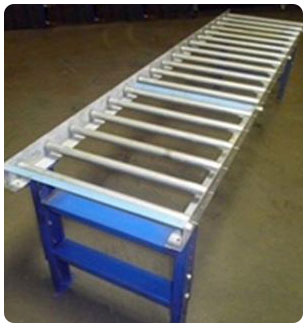
A free roller conveyor uses a series of free-spinning cylindrical rollers mounted in a frame — products are manually pushed or moved by gravity. No motor. No power. No belt. The simplest and most economical conveyor system for manual product handling operations.
Free-spinning rollers — how it works
Each roller is mounted on a fixed shaft in the frame side rails and spins freely on sealed bearings. When a product is placed on the rollers and pushed manually, or placed on a slight incline, the rollers rotate freely beneath it — reducing the friction force an operator must apply to near-zero for most carton and box weights.
The rollers provide a low-friction, high-support surface for any product with a flat, rigid base. Unlike belt conveyors, there is no continuous moving surface — only the rollers in contact with the product base rotate, and only while the product is moving.
When a free roller conveyor is the right choice
Free roller conveyors are the correct choice for any application where products are manually handled, where the layout has a slight incline allowing gravity movement, or where a simple low-cost conveyor surface is needed at a workstation, assembly bench, loading dock, or inspection table.
They are not the right choice for automated production lines where controlled, consistent belt speed is required — for those applications, a powered roller conveyor or belt conveyor is the correct specification. Our engineers will advise the correct type for your application at no charge.
How Free Roller Conveyors Work
No motor, no drive, no belt — just free-spinning rollers that reduce friction. Understanding how products move on free rollers helps specify the correct roller pitch, diameter, and frame for your application.
Product is placed on the roller surface — it must have a flat, rigid base and span at least two rollers simultaneously. The product's weight distributes across the rollers in contact with its base, and the rollers spin freely under it.
On flat conveyors, an operator manually pushes the product along the rollers — requiring only enough force to overcome roller bearing friction (very low). On inclined conveyors (2–5° slope), gravity pulls the product forward — no pushing required.
Products travel along the roller line to the next workstation, packing area, or accumulation zone. Pop-up stops or end stops can be fitted to control product flow — preventing products from rolling past a work point.
Free roller conveyors naturally accumulate products without back-pressure build-up — each product stops when it reaches the one in front without the motor-driven pile-up that belt conveyors can cause. Ideal for dispatch bays and packing stations.
Engineering note: Minimum product base = 3× roller pitch (at least 3 rollers under any product at all times). Roller diameter selected by product weight per roller = total product weight ÷ number of rollers in contact. Send your product data for a free selection.
Advantages of Free Roller Conveyors
Five advantages that make free roller conveyors the most cost-effective and practical conveyor solution for manual handling applications across India.
No Power Consumption
Zero electricity cost. No motor to purchase, wire, maintain, or replace. Free roller conveyors are entirely passive — the only energy input is the operator's manual push or the slope of the installation. Running cost is zero.
Low Maintenance
The only maintenance item is roller bearings — sealed for life on standard rollers. No belt to track, no motor to service, no chain to lubricate. Under normal conditions, free roller conveyors operate for years without any maintenance intervention.
Cost Effective Material Handling
Lowest capital cost of any powered or unpowered conveyor type. No electrical installation cost. No ongoing energy cost. For warehouses, dispatch bays, and packing lines handling moderate volumes, free roller conveyors deliver the best cost-per-metre of any conveyor solution.
Easy Installation
No electrical wiring, no motor mounting, no belt tensioning. Free roller conveyors are bolted together from sections and placed in position — most installations are complete and operational within half a day without specialist contractors.
Flexible Layout Design
Straight sections, curved sections, and merges combine freely to match your floor plan. Expandable (accordion) sections extend and retract for loading dock applications. Height-adjustable legs match working height to operators or downstream equipment.
Natural Accumulation
Products naturally accumulate on free roller conveyors without back-pressure — each carton stops when it reaches the one in front without the belt continuing to push. This makes free roller conveyors ideal for dispatch bays and packing stations where products arrive faster than they are picked.
Types of Free Roller Conveyors
Five configurations to match every layout, load, and space requirement — all manufactured in-house at our Ghaziabad plant.
Standard straight-line free roller conveyor — the most widely used type. Fixed roller pitch, fixed frame width, adjustable leg height. Available in any length. Used for dispatch lines, packing lines, inspection tables, and warehouse transfer between storage and loading docks.
Best for: dispatch, packing, inspectionTapered rollers arranged in a curved section — allows product flow to change direction 30°, 45°, 60°, or 90° without stopping or turning the product manually. Tapered roller design maintains product orientation through the curve. Used at corners and junctions in multi-directional warehouse lines.
Best for: corners, L-shapes, U-shapesSkate wheels (small disc-shaped wheels) mounted on axles replace the full-length cylindrical rollers — providing a lighter, lower-cost surface for lightweight products (under 15 kg). Widely used in courier sorting centres, e-commerce fulfilment, and light carton dispatch. Lower cost than roller type for the same length.
Best for: light parcels, courier, e-commerceAccordion-style extendable and retractable free roller conveyor — extends from compact stored position to full operational length. Ideal for extending into truck containers or vans at loading docks, temporary conveyor runs, and situations where a fixed-length conveyor is impractical. No tools required to extend or retract.
Best for: truck loading, temporary runsLarger-diameter rollers (76–89 mm), heavier-gauge frame, and closer-spaced rollers — for drums, barrels, engine parts, castings, and other industrial heavy loads. MS or galvanised frame with sealed heavy-duty bearings. Load capacity from 200 kg/m to 500 kg/m depending on roller diameter and pitch.
Best for: drums, barrels, castings, heavy partsApplications of Free Roller Conveyors
Free roller conveyors are installed wherever products need to move horizontally with minimal operator effort — across warehouses, logistics centres, packaging lines, manufacturing, assembly, and distribution.
Warehouses
Carton and case movement between receiving, storage, picking, and dispatch areas. Gravity roller lines at loading docks for carton offloading from trucks. Accumulation lines at dispatch holding areas.
Logistics Centers
Parcel and packet sorting at courier and logistics hubs — skate wheel conveyors for lightweight packets, roller conveyors for heavier cartons. Gravity inclined lines from scan stations to sorter infeeds.
Packaging Industries
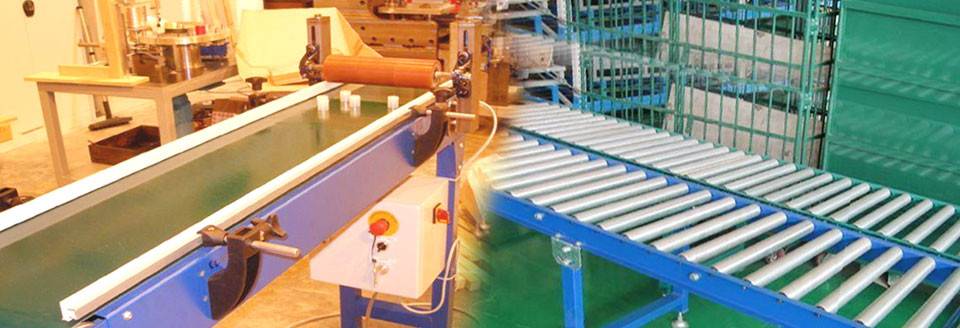
Product cartons moving from filling and sealing machines to labelling, inspection, and case packing — free roller conveyors between powered belt sections as accumulation buffers at each stage.
Manufacturing Plants
Component movement between machining, assembly, and inspection workstations. Free roller benches at each workstation — operators push components forward as each operation is completed.
Assembly Lines
Free roller conveyor benches at assembly stations — components in trays or on flat bases move along the bench between operators. No power required; operators control the pace naturally.
Distribution Centers
FMCG, retail, and e-commerce distribution — free roller lines in pick zones, packing stations, and truck loading areas. Often combined with powered roller and belt conveyors in the main sortation system.
Technical Specifications
All free roller conveyors are made-to-order. Roller diameter, pitch, and frame width are specified based on your product dimensions, weight, and required conveyor length.
| Parameter | Specification |
|---|---|
| Conveyor type | Free roller (gravity / manually pushed) |
| Frame width | 200 mm to 1200 mm (custom) |
| Conveyor length | Any length — custom or standard 1.5 m / 2 m / 3 m sections |
| Roller pitch | 75 mm to 300 mm (selected per product base size) |
| Load capacity | 25 kg/m to 500 kg/m (per roller diameter and pitch) |
| Roller face length | Frame width + 20 mm bearing overhang each side |
| Roller shaft | Spring-loaded snap-in (light/medium) or fixed bolt-in (heavy) |
| Bearing type | Deep groove ball bearing — sealed for life (standard) |
| Working height | 700 mm to 1000 mm — adjustable legs as standard |
| Inclination (gravity) | 2° to 5° — for gravity-fed sections without manual push |
| Accessories | End stops, pop-up stops, side guides, junction plates |
| Surface treatment | MS: powder-coated; GI: hot-dip galvanised; SS: 2B finish |
Roller Diameter Options
* Load per roller; total conveyor capacity = load per roller × number of rollers under product.
Frame Construction
Download Roller Conveyor Catalogue
Specifications, roller grades, case studies — PDF, free.
Download PDFHow to Select the Right Free Roller Conveyor
Five parameters determine the correct roller diameter, pitch, and frame specification. Share these with our engineers for a free selection.
Select based on heaviest product that will travel the conveyor — not average weight.
Rule: minimum 3 rollers under any product at all times. Closer pitch = smoother movement.
Share your floor plan and we recommend the number and type of sections.
Gravity flow eliminates manual effort entirely — check if your layout permits a 2–5° slope.
Free Roller Conveyors — Live at Customer Sites
Real Neo Conveyors roller conveyor systems in operation — warehouse, logistics, and manufacturing installations across India.
More installation videos: youtube.com/@neoconveyors
Free Roller Conveyor vs Powered Roller Conveyor
Both conveyors use the same roller surface — the only difference is whether the rollers are driven by a motor or spin freely. Choosing the right type depends on your application.
| Feature | ✅ Free Roller (This page) | Powered Roller Conveyor |
|---|---|---|
| Power required | No — zero electricity cost | Yes — motor + controls |
| Product movement | Manual push or gravity incline | Automatic — motor drives rollers |
| Speed control | None — manual or gravity dependent | VFD speed control — adjustable |
| Maintenance | Very low — bearings only | Drive belt/chain servicing |
| Capital cost | Lower — no motor or controls | Higher — motor + VFD + drive |
| Accumulation | Natural — no back-pressure | Requires zero-pressure zones |
| Automation potential | Limited — manual operation | High — integrates with PLC, sensors |
| Best for | Dispatch bays, packing stations, docks, assembly benches | Production lines, automation, FMCG |
Need automatic motor-driven movement? Powered Roller Conveyor →
Recent Free Roller Conveyor Installations
Four recent projects — warehouse, packaging, distribution, and assembly — demonstrating real-world specifications and results.
FMCG warehouse needed 45 m of free roller conveyor at loading docks — cartons (8–18 kg) moving from packing area to truck loading points. Gravity-fed at 3° incline — no manual push required. MS powder-coated frame with 50 mm rollers at 100 mm pitch.
FMCG packaging plant needed 20 m free roller accumulation lines connecting automated carton erector to packing stations — providing buffer so the machine can run continuously even when packing operators are slower at peak. End stops and pop-up stops at each packing station. MS frame, 50 mm rollers, 75 mm pitch.
Retail distribution centre needed 80 m of free roller conveyor for order picking — straight sections along storage aisles with 90° curve sections at aisle ends linking to central dispatch lane. Humid environment (cold storage adjacent) specified galvanised frame with galvanised rollers for corrosion resistance.
Industrial equipment manufacturer needed 12 heavy-duty free roller assembly benches (2 m each) for sub-assembly operations — components in trays up to 45 kg per tray. 60 mm rollers at 100 mm pitch with adjustable legs set at 900 mm working height. MS powder-coated frame with rubber-covered rollers to prevent tray scratch.
Why Choose Neo Conveyors?
Every free roller conveyor is designed for your product dimensions and weight — then fabricated in-house at Ghaziabad and delivered with fast lead times across India.
Every conveyor fabricated to your exact product, roller pitch, and frame width — not cut from a standard 2 m section. Product-first specification at no charge.
18+ years of roller conveyor projects across warehousing, logistics, FMCG, manufacturing, and distribution. References from clients in your sector available.
Standard free roller conveyor sections: 1–2 weeks from order confirmation. Straight MS roller conveyors are among the fastest-delivery products in the Neo Conveyors range.
Installation, leg adjustment, and commissioning by Neo Conveyors' own team across all Indian states. Most free roller conveyor installations are completed within 1 day.
All frame and roller materials in-house — MS powder-coated for standard indoor use, galvanised for humid environments, SS304 for food and pharma. No special ordering delays.
Replacement rollers stocked for all diameters (38, 50, 60, 89 mm) and all materials. Individual roller replacement — no need to replace the whole conveyor section when a bearing fails.
Related Conveyor Solutions
Free roller conveyors are often part of a larger material handling system. Explore powered roller, belt, and telescopic conveyors that connect to or replace free roller sections.
Frequently Asked Questions
Free Roller Conveyor — Service Locations Across India
Manufactured at our Ghaziabad facility — installed and commissioned across all major warehouse, logistics, manufacturing, and distribution locations in India.
Request a Free Quote — Respond Within 24 Hours
Share your product weight, base dimensions, conveyor length, and frame material preference. Our engineers specify roller diameter, pitch, and frame — and send a quotation within 24 hours at no charge.