Powered Roller Conveyor Manufacturer in India
Motorized belt-driven, chain-driven, and MDR roller conveyors for warehouse automation, FMCG packaging, logistics, and e-commerce. Built for accumulation, sortation, and zone control, with PLC and VFD integration where the line needs it.
- Belt / chain / MDR drive
- Accumulation & sortation
- PLC / VFD ready
What Is a Powered Roller Conveyor?
A powered roller conveyor drives its rollers actively, using a motor connected by chain or belt, or motors built directly into individual rollers, rather than relying on gravity and a slope to move product. That's what lets it run flat, go uphill, hold speed steady, and stop or accumulate product on command, none of which a gravity roller line can do.
If you're weighing this against a plain gravity roller conveyor, we've laid out that comparison in full on our main Roller Conveyor page, rather than repeating it here. This page is about what changes once you power the rollers: which drive technology to use, how accumulation and zoning work, and what automation options actually add value.
Belt-Driven, Chain-Driven, or MDR
This is the first real decision, and it shapes cost, noise, and how granular your zone control can be.
Belt-Driven Rollers
A drive belt under the rollers turns them via friction. Quiet running, straightforward maintenance, a sensible default for general product transport.
Chain-Driven Rollers
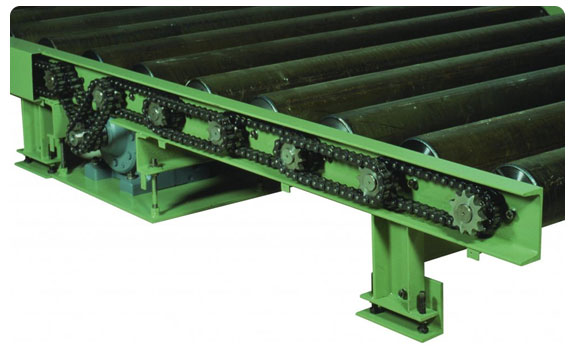
Rollers are linked by chain and sprocket for a positive drive that holds up under heavier, more demanding loads than a belt typically handles.
Motorized Drive Roller (MDR)
The motor sits inside the roller itself. Each roller or short zone can be switched independently, which makes fine-grained accumulation and zoning simpler, at a higher cost per zone than belt or chain.
How the Line Actually Runs
Drive technology is one axis; how the conveyor behaves once it's running is a separate decision.
Technical Specifications
Roller diameter is a starting point for sizing, not the whole answer. Final diameter, shaft, and pitch come from your product's weight, footprint, and how it sits on the rollers, plus conveyor width, not diameter in isolation.
| Roller diameter | Typical starting point for |
|---|---|
| 50 mm | Light cartons and small packages |
| 60 mm | General FMCG and packaged goods |
| 89 mm | Heavier cartons and palletised sub-units |
| 114 mm | Heavy or industrial loads |
These are starting points for a conversation, not capacity ratings you can read off directly. Shaft diameter, bearing arrangement, roller wall thickness, pitch, and how the load actually distributes across the rollers all factor into the real number for your product.
Where It's Used
Warehouse Automation
Accumulation and sortation lines feeding pick, pack, and dispatch zones.
FMCG Packaging
Carton and case transport between packaging machines and palletising.
Logistics & Distribution
Sortation conveyors routing parcels to the correct dispatch lane.
E-Commerce Fulfilment
High-throughput parcel handling with zone-controlled accumulation.
Manufacturing
Inter-process transport where flat or uphill runs rule out gravity rollers.
Airport & Baggage Handling
Zone-controlled accumulation for continuous, controlled product flow.
Why Choose Neo Conveyors
Drive Technology Matched to the Job
Belt, chain, or MDR recommended from your actual load and zoning needs, not sold as a default.
Automation Built In, Not Bolted On
PLC, VFD, and sensor integration designed into the conveyor from the start.
In-House Fabrication
Frame, drive, and zone assembly all built at our Ghaziabad facility.
PAN India Installation
Our own engineers handle site survey, install, and commissioning.
What an Installation Looks Like
Representative scenarios based on typical project parameters, illustrative rather than specific named customers or measured results.
Parcel Sortation Line
An e-commerce fulfilment line using MDR zones with sensors to divert parcels to the correct dispatch lane, sized around peak-hour throughput rather than daily average.
Carton Accumulation Buffer
A packaging line using zero-pressure accumulation to buffer cartons ahead of a palletiser, avoiding pressure damage during short stoppages downstream.
Want a verified reference from your sector? Get in touch and we'll share what we can.
FAQs
What is a powered roller conveyor?
A powered roller conveyor uses a motor, chain, belt, or built-in motorized rollers to actively drive the rollers, moving product without relying on gravity. It's the choice when a line needs a flat run, uphill conveying, controlled speed, or the ability to stop and hold product in place.
What is the difference between a powered and a gravity roller conveyor?
A gravity roller conveyor relies on the product's own weight and a downward slope to move; nothing drives the rollers. A powered roller conveyor drives the rollers actively, so it works on level ground, can convey uphill, and can start, stop, or hold product under control. See our main Roller Conveyor page for the full comparison.
What is MDR and how is it different from chain or belt drive?
MDR, motorized drive roller, has the motor built into the roller itself rather than driving the rollers through an external chain or belt. That makes zoning and accumulation control simpler since each roller or short zone can be switched independently, at somewhat higher cost per zone than a chain or belt-driven line.
What is zero-pressure accumulation?
It's a control scheme where product queues on the conveyor without pushing against the product ahead of it, using sensors and zone control to stop each section as it fills. It matters most for fragile or unstable loads where nose-to-tail pressure would cause damage or toppling.
What roller diameter do I need?
Diameter is a starting point, not the final answer. Final roller diameter, shaft size, and pitch depend on product weight, footprint, how the load sits on the rollers, and conveyor width, not diameter alone.
Can it be integrated with PLC and warehouse systems?
Yes, sensors, PLC zone control, VFD speed control, and communication with a WMS or SCADA system can all be added depending on how much automation the line needs.
What is the ROI on a powered roller conveyor?
It depends on your throughput, current labour cost, operating hours, and how much automation you add. We can work through the numbers for your specific case rather than quoting a generic payback period.
Get a Powered Roller Conveyor Recommendation
Share your product weight and footprint, required throughput, and whether you need accumulation, sortation, or just straight transport. We'll recommend the drive type and automation level that actually fits.