Ribbon Blender Manufacturer in India
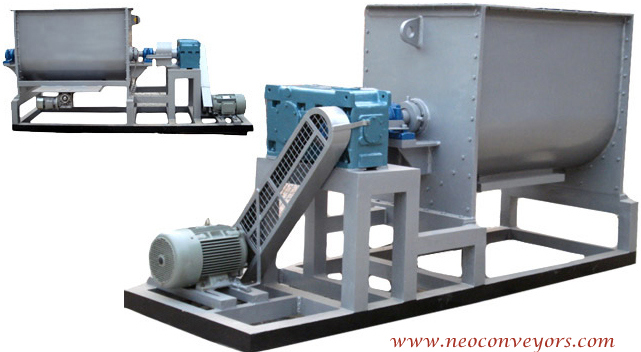
Neo Conveyors manufacturer of Custom mixer and blender,ribbon blenders, paddle mixers, screw mixers, and in-line conveyor blenders for continuous and batch blending of cement, fertilizer, food ingredients, chemical powders, animal feed, and pharma excipients. Eliminate a separate mixing step. MS, SS304, SS316. PAN India installation.
What is a Mixer and Blender Conveyor?
A mixer and blender conveyor performs two process functions simultaneously — conveying bulk material from point A to point B while blending, homogenising, or conditioning it during transit. This eliminates the need for a separate stand-alone batch mixer between conveying steps, reducing plant footprint, cycle time, and capital cost.
Conveying and blending in one unit — why it matters
In a conventional plant layout, material is conveyed to a batch mixer, loaded, mixed for a set cycle time, discharged, and then conveyed on. Each step adds time, floor space, and equipment cost. A mixer conveyor integrates the blending action directly into the conveying step — material is blended continuously as it moves, with no separate load-mix-discharge cycle and no additional floor area.
For applications where blend uniformity is required over long production runs (fertilizer NPK blending, cement additive blending, animal feed premix) and where batch mixing creates throughput bottlenecks, the mixer conveyor delivers better economics and higher continuous throughput than equivalent batch mixing systems.
Mixing action — ribbons, paddles, and screws
Three mixing mechanisms are used depending on material characteristics and required blend uniformity. Ribbon blenders use two counter-helical ribbons rotating in opposite directions — the outer ribbon moves material in one direction, the inner ribbon moves it back, creating a cross-flowing blend in the trough centre. Paddle mixers use paddles that tumble and fold material without the directional flow of ribbons. Screw mixers use a helical screw that simultaneously conveys and tumbles material through the trough length.
The correct mechanism for your material and uniformity requirement is specified by our engineers at no charge based on your material bulk density, particle size, blend ratio, and required coefficient of variation (CV) in the final blend.
Advantages of Mixer and Blender Conveyors
Six engineering and economic advantages that make mixer conveyors the preferred blending solution for continuous production processes across fertilizer, food, chemical, and cement industries.
Conveying + Blending in One Unit
Eliminates a separate stand-alone batch mixer, its loading conveyor, discharge conveyor, and the floor space and residence time associated with batch mixing. One mixer conveyor replaces three equipment items — significantly reducing plant footprint and capital cost for continuous blending applications.
Continuous High-Throughput Blending
No batch cycle time — material enters and exits continuously at rated throughput without load-mix-discharge interruption. For production rates above 5 TPH, continuous mixer conveyors match throughput to upstream and downstream process equipment without creating batch-size bottlenecks.
Consistent Blend Uniformity
Counter-flow ribbon action (inner and outer ribbon in opposite directions) creates a uniform blend across the full trough cross-section — not just surface mixing. Coefficient of variation (CV) below 5% achievable for most compatible powder blends. Uniformity validated by sampling at commissioning.
Easy Cleaning Access
Full-length hinged or bolted cleanout doors on the trough side give complete access to ribbon, shaft, and trough interior for cleaning between product changeovers. SS304/SS316 polished bore and hygienic weld finishing minimize cleaning time for food and pharma applications.
Variable Speed for Blend Control
VFD on the drive motor allows shaft speed adjustment — higher speed for more intensive mixing, lower speed for gentle blending of fragile granules that would break at high RPM. Speed also controls residence time in continuous mode, enabling blend uniformity adjustment without stopping the process.
Food & Pharma Grade Options
SS304 and SS316 construction with electro-polished bore, crevice-free TIG welds, food-grade shaft seals, CIP connection points, and GMP documentation. FSSAI-compliant food-grade ribbon blender designs available — polished to Ra 0.8 µm with validatable cleaning procedures.
Types of Mixer and Blender Conveyors
Four mixer conveyor configurations — each suited to a specific material type, blend ratio, and process requirement. Our engineers specify the correct type for your blend at no charge.
Two counter-helical ribbons (inner and outer) on the same shaft rotate in opposite directions — the outer ribbon moves material forward, the inner ribbon moves it backward, creating a vigorous counter-flow blend in the trough centre. Low shear, gentle on granules while achieving excellent blend uniformity. Available in MS, SS304, SS316. Batch and continuous modes.
Best for: fertilizer, food premix, chemical blends, cement additivesPaddles (rectangular or angled plates) mounted on a shaft tumble and fold material rather than creating a flowing ribbon action — better for moist, sticky, or cohesive materials where ribbon would agglomerate. Paddles also more effective for materials with large density differences between components (heavy and light ingredients in the same blend).
Best for: animal feed, moist materials, high-density-ratio blendsA modified screw flight design (cut flights, variable pitch, or twin-shaft counter-rotating screws) simultaneously conveys and tumbles material. The simplest and most compact mixer conveyor configuration — lower blend uniformity than ribbon type, but adequate for blends requiring only gross homogenisation (cement conditioning, fly ash + gypsum blend).
Best for: cement conditioning, simple two-component blendsA static or slowly rotating mixing element mounted in a conveyor pipe or trough — material flows through and around the mixing element as it is conveyed, achieving gentle homogenisation without a dedicated mixing shaft. Best for high-throughput applications where only light blending (10–20% CV reduction) is required during conveying.
Best for: high-throughput inline homogenisation, light blendingTwo counter-rotating paddle shafts in a W-shaped double trough — highest blending intensity of any conveyor-type mixer. Used for intensive blending of multi-component fertilizer blends, animal feed with liquids, and conditioned cement where homogeneity requirement is very high. Batch or continuous. MS and SS options.
Best for: NPK blends, conditioned feeds, high-uniformity batchesMaterials Handled
Mixer conveyors handle any dry to semi-dry powder, granule, or bulk solid requiring blending, homogenisation, or conditioning during conveying.
Cement & Additives
Fertilizer (NPK)
Food Ingredients
Pharma Excipients
Chemical Powders
Animal Feed
Grain & Meal
Mineral Powders
Industries Using Mixer and Blender Conveyors
Mixer conveyors are deployed wherever continuous in-line blending eliminates a batch mixing bottleneck — across fertilizer, cement, food, feed, pharma, and chemical industries in India.
Fertilizer Industry
NPK blending of urea, DAP, MOP, and micronutrients at fertilizer complexes. Ribbon blender for grade-to-grade uniformity. Continuous high-throughput blending to match bagging line speed. MS or SS depending on coastal / humidity environment.
Cement Industry
PPC and blended cement production — fly ash, gypsum, and OPC blending before or after mill. Cement conditioning with moisture addition using paddle mixer. Continuous mode matched to mill throughput.
Food Processing
Dry ingredient blending — spice premix, flour blends, bakery premix, seasoning, instant food mix. SS304 ribbon blender with CIP ports and quick-release cleanout doors for FSSAI compliance and frequent product changeover.
Animal Feed & Aquafeed
Compound feed, poultry premix, fish feed — paddle mixer for moist and high-density-ratio ingredients. SS304 or MS depending on moisture level. Liquid addition port for oil or molasses addition during blending.
Pharmaceutical Industry
API and excipient powder blending — SS316L electro-polished ribbon blender with hygienic seals, GMP documentation, and DQ/IQ/OQ validation support. Enclosed design for contained material handling.
Chemical Industry
Pigment blending, filler compound mixing, specialty chemical powder blending. Chemical-resistant liner options. SS316 for corrosive components. Explosion-proof motor for hazardous area installation.
Technical Specifications
All mixer and blender conveyors are made-to-order. Trough dimensions, ribbon/paddle geometry, shaft speed, and motor power are calculated from your material, blend ratio, required throughput, and blend uniformity target.
| Parameter | Specification |
|---|---|
| Mixer types | Ribbon blender, paddle mixer, screw mixer, in-line, twin-shaft |
| Operating mode | Batch / continuous / semi-continuous |
| Trough width | 300 mm to 1,200 mm (per required capacity) |
| Trough length | 1 m to 8 m per section (ribbon blender standard) |
| Shaft speed | 20–120 RPM (VFD adjustable) |
| Ribbon/paddle clearance | 3–8 mm from trough bore |
| Blend uniformity (CV%) | Typically <5% CV for ribbon blender (validated at commissioning) |
| Trough material | MS / SS304 / SS316 / SS316L |
| Bore finish | Standard / 2B / electro-polished Ra 0.8 µm |
| Shaft seals | Stuffing box / mechanical seal / double-lip seal / PTFE |
| Discharge | Flush-bottom butterfly valve (batch) / weir (continuous) |
| Power supply | 415 V, 3 Phase, 50 Hz |
Construction Materials
Drive System
Download Mixer Conveyor Catalogue
Ribbon blender, paddle mixer specs & case studies — PDF, free.
Download PDFHow to Select the Right Mixer Conveyor
Five parameters our engineers use to specify the correct mixer type, trough dimensions, shaft speed, and construction material for your blending application.
Mixer and Blender Conveyors — Live at Customer Plants
Real Neo Conveyors ribbon blender and paddle mixer installations in operation at fertilizer, food, and chemical plants across India.
More installation videos: youtube.com/@neoconveyors
Ribbon Blender vs Paddle Mixer — Which is Right for Your Material?
The two most common mixer conveyor mechanisms — selecting the correct type prevents poor blend uniformity, agglomeration, and maintenance problems.
| Feature | ✅ Ribbon Blender | Paddle Mixer |
|---|---|---|
| Blend mechanism | Counter-flow ribbons — excellent cross-trough mixing | Paddle tumbling — good tumbling blend |
| Free-flowing dry powder | Excellent — ideal application | Good — also suitable |
| Cohesive or moist material | Moderate — ribbon may agglomerate | Excellent — paddles break agglomerates |
| Large density difference between components | Moderate — lighter component may float | Better — paddles force material together |
| Blend uniformity (CV%) | Excellent — typically <5% CV | Good — typically 5–10% CV |
| Fragile granules / breakage risk | Lower — gentle ribbon contact at low speed | Higher — paddle impact more aggressive |
| Cleaning ease | Good — ribbon clears trough well | Good — paddles leave less residue than ribbon |
| Liquid addition | Good — spray nozzle in cover plate | Better — paddle ensures liquid distribution |
| Best applications | NPK fertilizer, food premix, pharma, chemical | Animal feed, moist materials, high-density blends |
Unsure which type suits your material? Share your material details for a free recommendation →
Recent Mixer and Blender Conveyor Installations
Four recent projects — NPK fertilizer blending, food premix, cement conditioning, and animal feed — with full parameters and results achieved at customer plants.
Fertilizer blending unit needed continuous NPK blending of urea, DAP, MOP, and micronutrient powder at 8 TPH — three-component blend with addition ratios varying by grade (10-26-26, 14-14-14, 20-20-0). Continuous MS ribbon blender with PLC recipe management for automated dosing ratio switching between grades. Stainless steel contact parts for fertilizer corrosion resistance.
Spice processing company needed batch blending of 8-component masala premix (ground spices + salt + starch + colour) in 200 kg batches — exact recipe accuracy required for consistent flavour profile. SS304 ribbon blender with electro-polished bore (Ra 1.6 µm), flush-bottom butterfly valve for complete batch discharge, quick-release cleanout doors, CIP spray ball, and PLC batch timer. FSSAI documentation provided.
Cement plant needed OPC cement conditioned with controlled moisture addition (0.5% water by weight) before bagging — to prevent bag-to-bag weight variation from static and flow issues. MS paddle mixer with water spray nozzle and flow meter control integrated to PLC, providing precise water/cement ratio. Paddle mixer specified over ribbon due to better liquid distribution into dry cement.
Compound feed mill needed batch blending of ground grain base (soybean meal, maize) with mineral premix, vitamin supplement, and trace elements — 5-component blend with vitamin additions at 0.1–0.5% inclusion rate. Paddle mixer specified for uniform distribution of micro-inclusions in dense grain base. SS304 with food-grade seals. 500 kg batch, 8 minutes mix time per batch.
Why Choose Neo Conveyors?
Every mixer conveyor is engineered from your material data and blending requirement — mixer type, trough geometry, shaft speed, and construction material specified for your material, blend ratio, and hygiene standard.
Mixer type, trough dimensions, ribbon geometry, shaft speed, and blend uniformity validated at commissioning — not a standard product adapted for your material, but designed from your blend ratio and CV% target.
18+ years of mixer conveyor projects across fertilizer, food, cement, feed, pharma, and chemical industries. References from clients in your sector available on request.
Ribbon blender, paddle mixer, screw mixer, in-line blender, and twin-shaft paddle — all fabricated in-house without third-party subcontracting. The correct type for your material specified at no charge.
SS304 FSSAI-compliant and SS316L GMP pharma designs with polished bore, hygienic seals, CIP ports, and DQ/IQ/OQ documentation available. No outsourcing of food-grade or pharma-grade fabrication.
Installation, ribbon/paddle fitting, seal adjustment, VFD setup, PLC recipe programming, and blend uniformity validation by Neo Conveyors' own engineers PAN India.
GA drawing and process design note (mixer type, trough dimensions, shaft speed, expected CV%) included with every quotation at no extra charge. No charge, no obligation.
Related Conveyor Solutions
Mixer conveyors are typically fed by screw or belt conveyors and discharge to further conveyors or bagging. Explore the full Neo Conveyors product range.
Frequently Asked Questions
Mixer and Blender Conveyor — Service Locations Across India
Manufactured at our Ghaziabad facility — installed and commissioned by our own engineers at fertilizer plants, food processing companies, cement plants, animal feed mills, and pharma manufacturers across all Indian states.
Request a Free Quote — Process Design Included
Share your materials, blend ratio, required throughput, batch or continuous mode, CV% target, and hygiene requirement. Our engineers specify mixer type, trough size, shaft geometry, and motor — GA drawing and process design note at no charge.