Conveyor Pulley Selection Guide: Types, Lagging, Wrap Angle
Most pulley problems get blamed on the belt. The belt drifts, so the belt must be wrong. The belt slips on the drive, so the belt must be worn. Often it is the pulley that was chosen badly: crowned when it should have been flat, bare when it should have been lagged, or sitting at a wrap angle that cannot carry the load.
This guide covers the three decisions that matter most. Flat face or crowned. Bare or lagged. And how much of the pulley the belt has to wrap. It is written for plant engineers and buyers specifying a belt conveyor, and it follows the guidance belt makers publish. Where your belt maker’s data says something different, follow theirs.
What Each Pulley on a Belt Conveyor Does
A belt conveyor can have several pulleys, and each has a different job. Knowing which one you are choosing for settles half the decision.
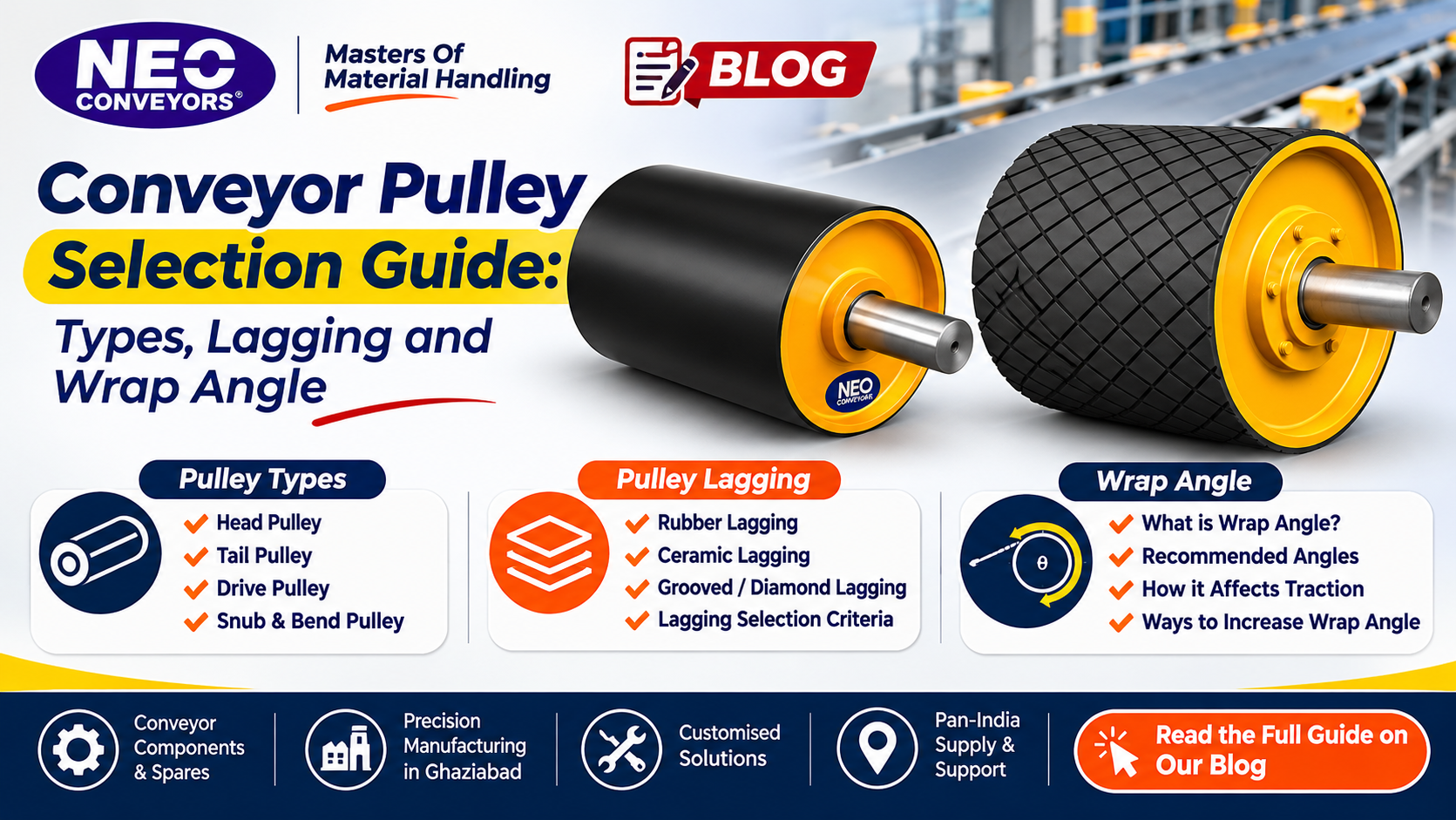
Drive pulley
The drive pulley, called the head pulley when it sits at the discharge end, passes the motor’s pull into the belt by friction. It is the pulley that slips when something is wrong, so it is the one that most often needs lagging and the right wrap angle.
Tail pulley
The tail pulley sits at the loading end and turns the belt back on itself. On many conveyors it also carries the take-up, so belt tension is set here. A wing-type tail pulley lets spilled material fall out between its bars instead of being trapped between pulley and belt.
Bend, snub and take-up pulleys
A bend pulley changes the direction of the belt. A snub pulley sits close to the drive pulley on the return side and adds wrap, which adds grip. A take-up pulley keeps the belt tight as it stretches and wears.
Flat Face or Crowned Pulley: Which to Use
A crowned pulley is slightly larger in the middle than at the ends. A belt tends to climb toward the highest point of a pulley, so a crown nudges it toward the centre. A flat face pulley, also called a straight face pulley, has the same diameter across its width.
What a crown actually does
Industry guidance, including CEMA’s, puts the effect of a crown on belt tracking at minor. A crown also makes the belt stretch differently across its width, which adds fatigue to the belt and its splices. It is no substitute for a square frame and square, level idlers. If a belt keeps running off, find the cause. Our guide to keeping a conveyor running covers the usual ones.
When to use a flat face pulley
Steel-cord and other low-stretch belts
Belt makers strongly recommend flat face pulleys for steel-cord, high-modulus and low-stretch belts. A crown must never be used with these belts. They cannot take the difference in stretch between the centre and the edges.
Pulleys with a belt cleaner on the face
A crowned face leaves uneven contact with a cleaner blade, so the cleaner works poorly. Use a flat face where a cleaner is mounted on the pulley.
Belts that track on V-guides
A belt with a V-guide on its underside runs on a flat pulley with a groove at the centre. The guide does the tracking, so a crown is not needed.
The common thread: use a flat face wherever tracking is handled by something other than the pulley, such as guides, training idlers or a properly squared frame.
When a crown can help
Light flat belts, such as PVC and PU, on short conveyors are flexible enough to take a crown, and a crowned head and tail pulley can give a little extra help with tracking. Light-belt makers also commonly suggest crowning both head and tail pulleys on reversing conveyors and on long, narrow ones. Keep to the belt maker’s limit on crown height, because too much crown damages the belt edges.
Bare or Lagged: Choosing Pulley Lagging
Why lag a pulley
Lagging is a covering bonded or bolted to the pulley shell. It does three things. It raises the friction between belt and pulley, so the drive grips. It protects the steel shell from wear. And in sticky applications it can reduce material build-up on the face. Bare steel has the lowest friction of the usual surfaces, rubber lagging is higher, and ceramic is highest.
Types of lagging
Plain rubber
A smooth rubber covering and a step up in grip from bare steel. Smooth rubber is also the usual covering on a snub pulley, which runs on the dirty side of the belt.
Grooved rubber
Diamond or herringbone grooves give water and fine material somewhere to go, which helps in wet or dusty duty.
Ceramic
Ceramic tiles set in rubber give the highest friction of the common options. They are the usual answer for heavy-duty drives, wet conditions, or slip that other lagging has not cured.
Lagging wears
Lagging wears first where the belt runs most, and that flattens any crown the pulley had. Once the pattern is worn off, it grips less. Check lagging at every shutdown.
Wrap Angle: Why a Drive Pulley Grips or Slips
What wrap angle is
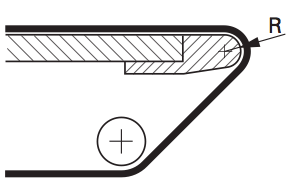
Wrap angle is the arc of the pulley that the belt touches, measured in degrees. On a simple conveyor with an end drive, the belt wraps about half the head pulley, which is 180°.
How wrap, friction and tension work together
How much pull a drive pulley can put into the belt follows the capstan relation, also called the Euler–Eytelwein equation:
T1 / T2 = eμθ
T1 is the tight-side tension, T2 the slack-side tension, μ the friction between belt and pulley, and θ the wrap angle in radians.
Three things decide grip: the wrap angle, the friction, and the slack-side tension. Pulley diameter is not one of them. A bigger pulley does not grip better, however often that is assumed.
The table shows the tension ratio for different wrap angles, using μ = 0.3 as an illustration. It is not a design value. Use your belt maker’s friction figure for real work.
| Wrap angle | Tension ratio T1 / T2 |
|---|---|
| 120° | 1.87 |
| 150° | 2.19 |
| 180° | 2.57 |
| 210° | 3.00 |
| 240° | 3.51 |
At 120° the pulley can pull about 0.87 times the slack-side tension. At 180° it can pull about 1.57 times. For the same slack-side tension, the same pulley can transmit roughly 1.8 times as much at 180° as at 120°.
Is 120° the minimum wrap angle?
People ask for a number, so here is the honest answer. There is no single minimum that applies to every belt conveyor. A standard end-drive conveyor wraps about 180°. The figure of 120° is often quoted as a floor for light belt drives, because below it the belt is likely to slip when the load spikes. Treat it as a rule of thumb, not a standard.
Wrap changes from 180° when the belt leaves the pulley at an angle, for example with a tilted return run or pulleys of different sizes. If your layout gives less than 180°, work out the grip properly with the belt maker’s friction values instead of relying on a rule of thumb.
If the drive pulley slips
- Clean and dry the belt and the pulley face. Wet or dusty conditions cut friction a lot.
- Check the slack-side tension at the take-up. Too little tension lets the belt slip however good the lagging.
- Add lagging, or move from plain rubber to grooved or ceramic.
- Add a snub pulley to increase the wrap. A single snubbed drive is generally taken up to about 210°, and about 240° is the usual limit. Beyond that a dual drive is needed.
A snub pulley runs on the dirty side of the belt, so fit a belt cleaner with it.
Pulley Diameter, Face Width, Shaft and Bearings
Diameter
Diameter is set by the belt, not by traction. Every belt has a minimum pulley diameter that depends on its thickness and construction. Go below it and the belt flexes too sharply, which shortens the life of the belt and its splices. Ask for the belt maker’s minimum and choose the next size up if the layout allows.
Face width
The face should be wider than the belt, so the edges stay fully supported when the belt moves a little. The belt maker’s data or the relevant standard gives the allowance.
Shaft, bearings and fixing
Size the shaft and bearings for the belt tension plus the pulley’s own weight. Look at how the pulley is fixed to the shaft too. Choose something your maintenance team can remove without cutting.
How to Select a Conveyor Pulley, Step by Step
- Start with the belt: its type, width and thickness. This gives the minimum diameter and tells you whether a crown is allowed.
- Decide the pulley’s job: drive, tail, bend, snub or take-up.
- For the drive pulley, check the grip. Compare the pull needed with what the wrap angle, friction and slack-side tension can give.
- Look at the environment: wet, dusty, sticky, hot, washed down or corrosive. This decides the lagging and the shell material.
- Decide on a flat face or a crown, using the guidance above and your belt maker’s advice.
- Size the shaft and bearings, and choose the fixing.
Starting points by situation
| Situation | Usual choice |
|---|---|
| Steel-cord or high-modulus belt | Flat face pulleys only |
| Belt cleaner mounted on the pulley | Flat face |
| Belt with V-guide | Flat pulley with a centred V-groove |
| Light PVC or PU belt, short conveyor | Crown is common and can help, or flat face on a square frame |
| Reversing light belt | Crown on head and tail pulleys is the usual advice. Follow the belt maker. |
| Drive pulley slipping, dry and clean | Rubber lagging |
| Drive pulley slipping, wet or dusty | Grooved or ceramic lagging, and a snub pulley if the layout allows |
| Food, pharma or corrosive area | Stainless steel shell |
| More than 180° of wrap needed | Snub pulley. Dual drive beyond about 240°. |
Pulley Care and Warning Signs
- Lagging worn smooth, cracked or coming away from the shell.
- The belt slipping at start-up or when the load rises.
- Material built up on the pulley face, or the belt running off after lagging wears unevenly.
- Bearing noise or heat at the pulley ends.
- Wear grooves in the steel shell.
Look at every pulley at each shutdown. For a wider routine, see how to keep your conveyor running. If you are still deciding on the conveyor itself, our notes on how to select conveyor equipment for a new plant and how to choose the right conveyor come first.
Tell Us About Your Conveyor
We make belt conveyors, inclined belt conveyors and roller conveyors in Ghaziabad. If a pulley problem has you stuck, or you are specifying a new belt conveyor, send us:
- The belt type, width and thickness.
- The conveyor length and any incline.
- The drive power and where the drive sits.
- The material and the environment.
- What is going wrong, if anything. A short video of the belt running helps.
We will tell you what the pulley needs.
- Phone: +91-9654112235
- WhatsApp: +91-9654112235
- Email: sales@neoconveyors.com
- Address: G-414, UPSIDC Phase-II, Ghaziabad
Related reading
- Questions to ask when choosing a conveyor belt
- What to look for in a conveyor supplier
- Conveyor manufacturers in India: a buyer’s guide
Related conveyors
Recent Posts